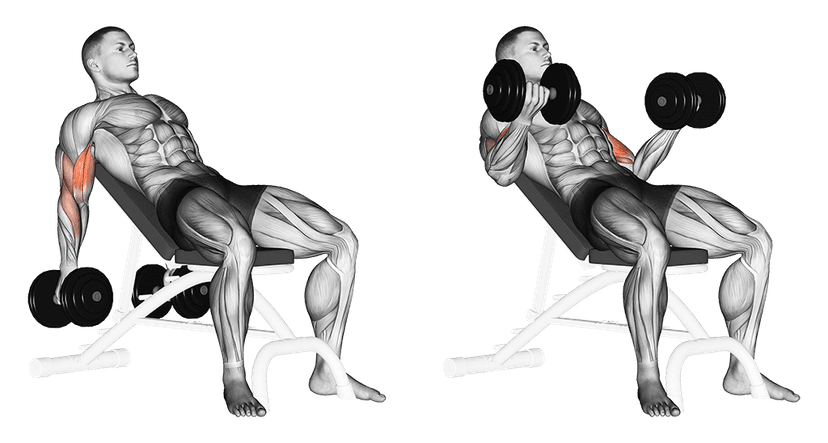
Incline Dumbbell Curl: Complete Guide
The incline dumbbell curl is one of the best exercises for targeting the long head of the biceps, the outer portion that gives the arm a full, rounded look from the side. By setting the bench at 45 degrees, you place the biceps in a maximum stretch position at the start of the movement. This tension in the lengthened position creates a unique stimulus you will not find in any other curl. If you want complete biceps with volume across their entire length, the incline curl is essential.
Targeted Muscles
- Biceps brachii, long head (outer portion): primary target thanks to the stretch in the bottom position. The arm sits behind the body plane, placing the long head under maximum tension
- Biceps brachii, short head (inner portion): participates in flexion but in a secondary role
- Brachialis: works in synergy beneath the biceps
- Brachioradialis: assists flexion at the start of the movement
- Anterior deltoid: slight shoulder stabilization
The incline curl is the exercise that stretches the biceps the most in the bottom position. This loaded stretch (stretch under load) is a powerful hypertrophy stimulus according to recent muscle physiology research.
Correct Execution
Starting Position
Set the bench backrest between 30 and 45 degrees (45 degrees is standard). Sit down with your back and head pressed against the pad. One dumbbell in each hand, arms hanging naturally at your sides, slightly behind the body. Palms facing forward (supinated). Shoulders low, shoulder blades pressed against the pad.
Concentric Phase (Lifting)
- Without moving the elbows or shoulders, contract the biceps to curl the dumbbell up.
- The elbows stay pointed toward the floor throughout the entire movement. They must not drift forward.
- Curl up until the forearms are roughly vertical (maximum contraction without the elbows moving).
- Hold for one second at the top.
Eccentric Phase (Lowering)
- Lower slowly over 3-4 seconds. This is the key phase of this exercise.
- Let the arm return fully to the stretched position. Do not cut the range of motion at the bottom.
- Feel the stretch in the biceps at the bottom before curling back up.
Breathing and Tempo
- Exhale on the way up, inhale on the way down.
- Ideal tempo: 2 seconds up, 1 second pause, 3-4 seconds down. The slow lowering is essential to benefit from the loaded stretch.
Common Mistakes
1. Elbows drifting forward during the lift The mistake that kills this exercise. If the elbows migrate forward, the biceps loses its stretched position and the movement becomes a regular curl. Keep the elbows pointed at the floor, fixed like pivots.
2. Backrest too upright At 70-80 degrees, you lose the point of the exercise: the biceps is no longer sufficiently stretched. Stay between 30 and 45 degrees. The lower the angle, the more intense the stretch (but also harder and more demanding on the shoulder).
3. Shortened range of motion at the bottom Not lowering fully deprives the biceps of the stretch phase that gives this exercise all its value. Lower to near-full extension, arms alongside the body.
4. Load too heavy The incline curl puts the biceps in a mechanically disadvantageous position. You will be 20-30% weaker than during a classic seated curl. Adjust your weights accordingly, do not copy your standing curl numbers.
5. Head and shoulders lifting off the pad A sign of compensation. If you need to lift your head or shoulders to finish a rep, it is too heavy. Stay pinned against the pad from start to finish.
Variations
Alternating Incline Curl (Beginner to Intermediate) One arm at a time, the other stays at the bottom. Allows better focus on each arm and fatigue management. The most recommended variation for getting started.
Incline Hammer Curl (Intermediate) Palms facing each other (neutral grip) throughout the movement. Targets the brachialis and brachioradialis more, building arm thickness. Excellent as a complement to the classic incline curl.
30-Degree Incline Curl (Intermediate to Advanced) The lower the backrest, the more intense the stretch. At 30 degrees, the long head stimulus is maximal, but the shoulder is more involved. Reserved for those with good shoulder mobility and solid technique.
Unilateral Cable Incline Curl (Advanced) An incline bench placed in front of a low pulley. The cable maintains constant tension, even at the bottom where a dumbbell is usually light. A superior version for hypertrophy, but requires precise setup.
Program Integration
Placement in Your Session: The incline curl works best as the first or second biceps exercise. The bottom stretch is more effective when the muscle is fresh. Place it before contraction exercises (concentration curl, preacher curl).
Volume and Intensity by Goal:
- Hypertrophy (stretch priority): 3-4 x 8-12 reps, slow tempo (3-4 sec lowering), 90 sec rest
- Volume: 3 x 12-15 reps, moderate load, 60 sec rest
- Strength: not recommended as a pure strength exercise, the leverage is too unfavorable
Frequency: 1 to 2 times per week. Ideally combine with an exercise targeting the short head (preacher curl, concentration curl) for complete biceps development.
Recommended Starting Weight: 6 to 10 kg per dumbbell for a beginner male, 3 to 6 kg for a beginner female. Expect to use 20-30% less than your classic seated dumbbell curl.
Key Takeaways
- Bench angle: 30 to 45 degrees, no more upright
- Fixed elbows: pointed at the floor, they do not move a single centimeter
- Slow lowering: 3-4 seconds, this is where the magic happens (loaded stretch)
- Full range of motion: lower to near-full extension, do not cheat at the bottom
- Modest load: 20-30% less than your regular curl, the position does the work
