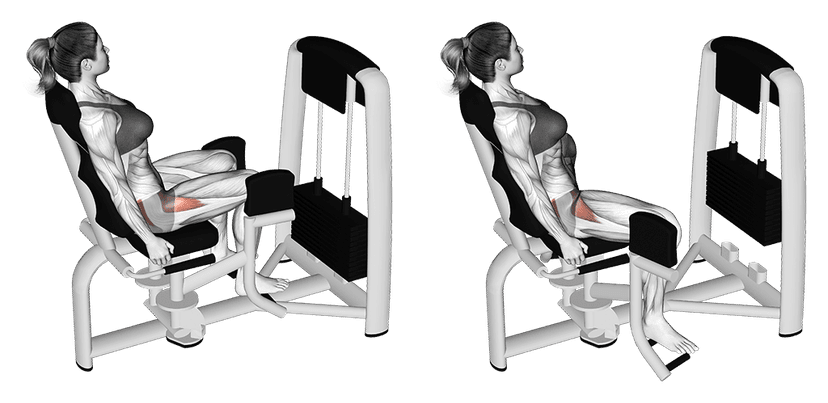
Seated Hip Abduction Machine: Complete Guide
The hip abduction machine is one of the most used pieces of equipment in the gym, and for good reason. It isolates the gluteus medius and gluteus minimus without requiring coordination or balance. It looks simple, but when executed properly, it is remarkably effective for sculpting the lateral glutes and stabilizing the hips.
Many lifters neglect abduction work in favor of squats and lunges. That is a mistake. The gluteus medius is essential for pelvic stability with every step, every squat, and every run. Strengthening it in isolation reduces the risk of knee injury and improves performance on all lower body movements.
Muscles targeted
- Gluteus medius: primary mover, responsible for hip abduction
- Gluteus minimus: works in synergy with the gluteus medius for abduction
- Tensor fasciae latae (TFL): assists abduction, especially at the start of the movement
- Gluteus maximus (upper fibers): contributes to abduction when the hip is in a neutral position
- Piriformis: deep external rotator, recruited secondarily
The gluteus medius does most of the work. If you mainly feel the TFL (the muscle on the side of the hip, toward the front), adjust your position by leaning slightly forward to better recruit the gluteus medius.
Proper execution
Machine setup
Sit all the way back in the seat, back against the pad. Adjust the lateral pads against the outside of your knees or thighs (depending on the machine). Choose a weight that allows 12-15 clean reps with a clear contraction at end range.
Concentric phase (opening)
- Push your thighs outward by contracting the lateral glutes.
- Open to your maximum range without forcing beyond your natural mobility.
- Hold the contraction for 1-2 seconds in the open position.
- The movement comes from the hips, not the knees or lower back.
Eccentric phase (closing)
- Bring your thighs back slowly toward the center over 2-3 seconds.
- Resist the load. Do not let the weight stack slam.
- Stop just before your thighs touch to maintain tension.
Breathing: exhale while opening (contraction), inhale while closing.
Common mistakes
1. Too much weight
Loading too heavy forces you to use momentum and your lower back to open the legs. The gluteus medius is a small muscle. A moderate load with total control is far more effective than a heavy weight with sloppy form.
2. Moving too fast
Opening and closing the legs rapidly without control turns the exercise into a useless swinging motion. Slow down each phase: 2 seconds to open, pause in the open position, 2-3 seconds to close.
3. Back lifting off the pad
Leaning forward excessively or lifting your back off the seat changes the working angle and can overload the lower back. Keep your back against the pad. A slight forward lean (10-15 degrees) is acceptable to better target the gluteus medius.
4. Incomplete range of motion
Some lifters only open halfway out of fear of straining. If your mobility allows it, open fully to recruit the maximum number of fibers. But never force beyond your natural range.
Variations
Forward-leaning abduction (intermediate)
Lean your torso 30-45 degrees forward while keeping your back straight. This angle targets the gluteus medius more effectively and reduces TFL contribution. An excellent variation if you feel too much at the front of the hip.
Isometric hold abduction (intermediate)
Hold each rep in the open position for 3-5 seconds. The isometric pause increases time under tension and improves the mind-muscle connection. Reduce the weight by 20% compared to your usual load.
Slow tempo abduction (beginner to intermediate)
Perform the movement at a 4-2-4 tempo: 4 seconds to open, 2-second pause, 4 seconds to close. Slow tempo is remarkably effective with light weights and reduces the risk of compensation.
Standing cable hip abduction (intermediate)
Attach an ankle strap and pull your leg outward against cable resistance. This variation works the gluteus medius while standing, which more closely mimics its function during walking and running.
Programming
Placement in your session: As a warm-up or activation drill before squats and lunges (light weight, 15-20 reps). Or as an isolation exercise at the end of a session to fatigue the abductors (moderate weight, 12-15 reps).
Volume and intensity:
- Beginner: 3 x 15-20 reps, light weight, focus on contraction
- Intermediate: 3-4 x 12-15 reps, moderate weight with a pause at end range
- Advanced: 4 x 10-12 reps, heavier load plus drop sets or isometric holds
Frequency: 2-3 times per week. The gluteus medius recovers quickly and benefits from high frequency, especially as a pre-session activation drill.
Recommended combination: Pair abduction with lunges or squats to pre-fatigue the lateral glutes. Or use them in a superset with adduction to work both opposing muscle groups.
Key takeaways
- Moderate load: total control rather than maximum weight
- Squeeze in the open position: 1-2 seconds of contraction every rep
- Back on the pad: slight forward lean is acceptable
- Controlled eccentric: 2-3 seconds closing, no weight slamming
- High frequency: ideal for daily activation or pre-session work
