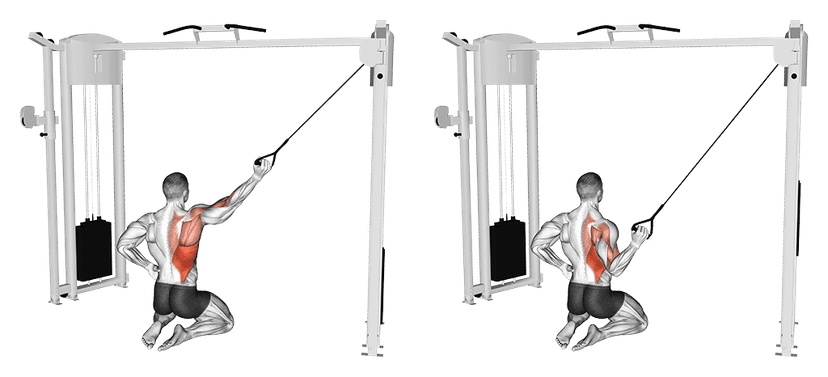
Single-Arm Lat Pulldown: Complete Guide
The single-arm lat pulldown is a powerful finishing exercise for the back. Working one arm at a time allows you to correct strength imbalances, increase range of motion, and fully focus on the lat contraction. If you have one side weaker than the other or want to refine your back recruitment, this exercise deserves a spot in your routine.
Muscles targeted
- Latissimus dorsi: primary mover, maximum stretch and contraction thanks to unilateral work
- Teres major: assists the lats in arm adduction and internal rotation
- Lower trapezius: scapular depression during the pull
- Rhomboids: scapular retraction in the bottom position (when the elbow descends)
- Biceps and brachialis: elbow flexion
- Obliques and quadratus lumborum (opposite side): anti-rotation trunk stabilization
The main advantage of unilateral work is the increased range of motion. By pulling with one arm, you can bring the elbow lower and further back than during a bilateral pulldown, which stretches and contracts the lat more.
Proper execution
Starting position
Sit at a high pulley machine. Attach a single handle (D-handle) to the pulley. Grip the handle with one hand, neutral grip (palm facing inward). Your other hand rests on your thigh or grabs the pad for stability. Make sure the thigh pad locks your legs down to prevent your body from rising when you pull. Sit tall, chest out, leaning slightly back (5-10 degrees).
Concentric phase (pull)
- Pull the handle down by initiating with scapular depression (pull the shoulder blade down).
- Continue by driving the elbow toward the hip on the same side.
- Pull until your hand reaches shoulder level or the upper chest.
- Squeeze the lat hard at the bottom. You should feel a pinch next to the shoulder blade.
- Exhale as you pull.
Eccentric phase (return)
- Let the handle rise under control, 2-3 seconds.
- Allow the shoulder blade to elevate naturally as the weight returns. This stretch benefits the lat.
- Arm fully extended at the top, shoulder slightly elevated to maximize the stretch.
- Inhale during the return.
Breathing: exhale as you pull, inhale on the way up.
Common mistakes
1. Trunk rotation to cheat Twisting the torso to help pull is the most common cheat. Your trunk must stay facing the machine. If you have to rotate to move the weight, it is too heavy. Reduce the load.
2. Pulling with the biceps If you feel the work mostly in your arm, you are not recruiting the back enough. The fix: think about pulling with your elbow, not your hand. Imagine your hand is a hook and it is the elbow that drives down.
3. Shortened range at the top Not letting your arm fully extend at the top deprives the lat of its maximum stretch. Let the shoulder blade rise and the arm extend. That is where you set up the contraction for the next rep.
4. Excessive backward lean Leaning too far back turns the vertical pull into a horizontal row. Keep a lean of 5-10 degrees maximum. If you need to lean at 30 degrees to move the weight, it is too heavy.
5. Excessive speed Pulling fast and letting the cable fly back up wastes half the movement. The ideal tempo is 1-2 seconds on the pull, 2-3 seconds on the return. Constant tension is the key.
Variations
Single-arm supinated pulldown (intermediate) Palm facing you. Recruits the biceps more and slightly changes the pulling angle on the lat. A good complement to the neutral grip.
Standing single-arm pulldown (intermediate) Stand facing the high pulley, one knee on the ground or both feet anchored. Allows a greater stretch at the top and increased stabilization work.
Single-arm pulldown with rotation (advanced) At the bottom position, slightly rotate your torso to bring the elbow even further back. An advanced movement that increases range of motion; use moderate loads.
Incline bench single-arm pulldown (intermediate) Lie face down on an incline bench facing the pulley. The bench stabilizes the trunk and completely isolates the lat. Excellent for those who struggle to avoid cheating.
Programming
Placement in your session: In the middle or at the end of your back session, after heavy compound lifts (pull-ups, barbell rows). This is an isolation and finishing exercise.
Volume and intensity:
- Intermediate: 3 x 10-12 reps per arm, 60-90 seconds rest between arms
- Advanced: 4 x 10-15 reps per arm, 60 seconds rest
- Load: moderate to light. The goal is not to pull heavy but to feel the lat working on every rep
Frequency: 1-2 times per week. If you have a left-right imbalance, always start with the weaker side and match the same rep count on both sides.
Correcting imbalances: Perform 2-3 extra reps on the weaker side for 4-6 weeks. When both sides are equal in strength and feel, return to identical volume.
Key takeaways
- One arm at a time: corrects imbalances and improves the mind-muscle connection
- Pull with the elbow: think elbow to hip, not hand down
- Full range of motion: stretch at the top, maximum contraction at the bottom
- Stable trunk: no rotation or excessive leaning
- Moderate load: contraction quality matters more than weight
