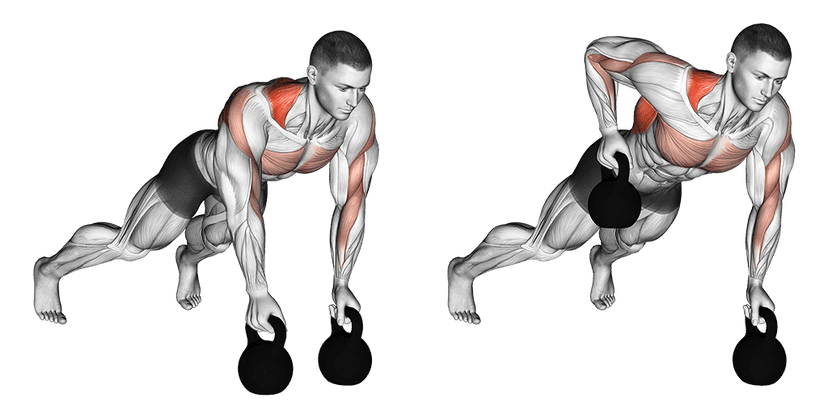
Renegade Row: Complete Guide
The renegade row is a hybrid exercise that combines the plank hold with a unilateral dumbbell row. It is one of the most complete movements you can add to your routine: it works the back, arms, shoulders, abs, and stabilizers in a single exercise. If you want a movement that builds functional strength while burning maximum calories, the renegade row is your best ally.
The concept is simple but the execution is demanding. You get into a high plank position with your hands on two dumbbells and perform a row, alternating arms. While one arm pulls, the rest of your body must remain perfectly stable. This anti-rotation aspect is what makes the exercise so effective for the abs and trunk stabilizers.
Muscles targeted
- Latissimus dorsi: primary mover of the row, responsible for shoulder adduction
- Mid trapezius and rhomboids: scapular retraction during the pull
- Posterior deltoid: assists the row
- Biceps and brachioradialis: elbow flexion during the row
- Abdominals (rectus abdominis, transverse): isometric bracing to maintain the plank
- Obliques: resist rotation when one arm lifts
- Anterior deltoid and triceps: stabilize the support arm
- Glutes and quadriceps: stabilize the lower body
It is one of the rare exercises that challenges both the pulling muscles and the anti-rotation core simultaneously. The effort-to-muscle-recruitment ratio is exceptional.
Proper execution
Starting position
Place two dumbbells flat on the floor, parallel, shoulder-width apart. Grab the handles and set up in a high plank position: arms extended, body aligned from heels to head. Spread your feet wider than shoulder width to increase your base of support and improve balance. Wrists are neutral (in line with the forearms), abs braced, glutes squeezed.
Rowing phase
- Shift your weight onto the left arm. The left arm stays locked, shoulder stacked above the wrist.
- Row the right dumbbell toward your hip, pulling the shoulder blade toward the spine.
- The elbow travels along the body, not outward. Aim for a 45-degree angle.
- Lift the dumbbell until the elbow slightly passes the back line.
- Exhale during the row.
Return phase
- Lower the dumbbell back to the floor under control. No dropping.
- Re-stabilize the plank position.
- Repeat on the other side.
- Inhale during the lowering.
Breathing: exhale as you row, inhale as you set the dumbbell down.
Common mistakes
1. Excessive hip rotation This is the number one mistake. The hips rotate as you pull the dumbbell, turning the movement into a twist and reducing the anti-rotation work. Brace your abs and glutes hard. Your hips must stay parallel to the floor. Tip: imagine a glass of water balanced on your back.
2. Feet too narrow With feet together or shoulder-width, you lack the base to resist rotation. Spread your feet to at least 1.5 times shoulder width. The wider the feet, the more stable the exercise (but less challenging for the obliques).
3. Hips sagging When the abs fatigue, the pelvis drops toward the floor and the back arches. End the set before your plank degrades. Six reps with a perfect plank beat twelve with an arched back.
4. Rowing with momentum Ripping the dumbbell off the floor with a hip jerk defeats the purpose. The row must be slow and controlled. If you have to cheat, the dumbbells are too heavy.
5. Round dumbbells that roll Use hex dumbbells. Round dumbbells roll under your hands, which is dangerous for the wrists and makes balance impossible.
Variations
Renegade row without the row (beginner) Stay in plank on the dumbbells and simply lift one hand off the floor alternately, without rowing. This builds anti-rotation stability before adding the pull.
Renegade row with push-up (advanced) Add a push-up between each row or each pair of rows. The sequence becomes: push-up, right row, left row, push-up, etc. Cardio and muscular intensity skyrockets.
Kneeling renegade row (beginner) Perform the movement from your knees instead of a full plank. The lever is shorter, which reduces the core demand. A good starting point for beginners.
Renegade row with kettlebells (intermediate) Kettlebells offer a more stable base than dumbbells thanks to their flat shape. They also provide a naturally neutral grip. A solid option if you do not have hex dumbbells.
Programming
Placement in your session: Early or mid-session in a full body workout, or as a finisher in a back or Push/Pull session. The renegade row demands significant energy and focus.
Volume and intensity:
- Beginner: 3 x 6-8 reps per side, light dumbbells (5-8 kg), focus on stability
- Intermediate: 3-4 x 8-10 reps per side, moderate dumbbells (10-15 kg)
- Advanced: 4 x 10-12 reps per side with a push-up between each pair, or in a circuit
Frequency: 1-2 times per week. The exercise is taxing on the trunk and shoulders. Allow 48 hours of recovery.
Progression: Start light and master stability first. Increase the load in 2 kg jumps once you can maintain a flawless plank across all reps.
Key takeaways
- Anti-rotation: hips stay parallel to the floor, that is the primary goal
- Wide base: spread your feet for stability
- Hex dumbbells: required for safety and balance
- Quality over quantity: stop the set when the plank breaks down
- Versatility: combines rowing, bracing, and stabilization in one exercise
