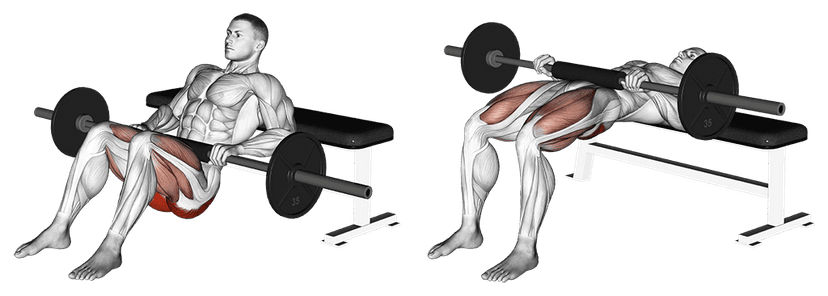
Hip Thrust: Complete Guide
The hip thrust is the number one exercise for building glutes. Popularized by Bret Contreras, it places the gluteus maximus under peak contraction with load. No other exercise targets the glutes as directly and intensely. Whether your goal is aesthetics or performance, the hip thrust deserves a spot in your program.
Targeted Muscles
- Gluteus maximus: primary mover, the most powerful muscle in the human body. The hip thrust recruits it to a greater degree than squats and deadlifts.
- Hamstrings: secondary role assisting hip extension
- Quadriceps: minor contribution for knee stabilization
- Adductors: stabilizers working in synergy with the glutes
- Erector spinae: isometric trunk bracing
The hip thrust is unique because peak resistance occurs at the top of the movement (full hip extension), exactly where the gluteus maximus is strongest.
Proper Execution
Setup
- Place a sturdy bench against a wall or rack. Ideal height: when you sit on the floor, the edge of the bench reaches the bottom of your shoulder blades.
- Roll the barbell onto your hips. Use a hip thrust pad or thick towel. The bar sits in the hip crease, not on the pelvic bones.
- Feet flat on the floor, shoulder-width apart. Shins should be vertical when you are in the top position.
Concentric Phase (Pushing Up)
- Drive through your heels to push your hips toward the ceiling.
- Rise until your torso is parallel to the floor (full hip extension).
- Squeeze your glutes hard at the top. Imagine pinching a coin between them.
- Chin tucked toward your chest (eyes looking at your knees, not the ceiling).
- Exhale during the push.
Eccentric Phase (Lowering)
- Lower your hips slowly (2 to 3 seconds).
- Do not touch the floor between reps if you want to maintain tension. Stop just above.
- Inhale on the way down.
Critical Point: Chin Position Keep your chin tucked and look toward your knees throughout the movement. Tilting your head back causes excessive lumbar extension and steals work from the glutes.
Common Mistakes
1. Lumbar Hyperextension at the Top Danger: disc compression, lower back pain. Fix: brace your abs and glutes simultaneously. Your body should form a straight line from shoulders to knees, not an arch.
2. Feet Too Close or Too Far from the Bench Too close: quads take over. Too far: hamstrings dominate and you feel cramping. Fix: at the top position, your shins should be nearly vertical (90 degrees at the knee).
3. Pushing Through the Toes Danger: calves and quads compensate, glutes only work halfway. Fix: drive through your heels. You should be able to lift your toes off the floor during the movement.
4. Bar Rolling onto the Pelvic Bones Danger: pain, bruising, premature exercise abandonment. Fix: use a thick pad. The bar should sit in the hip crease, not on the iliac crests.
5. Looking at the Ceiling Danger: cervical extension that leads to compensatory lumbar extension. Fix: chin tucked, eyes on your knees.
Variations
Bodyweight Hip Thrust (Beginner) No barbell, hands on the floor. Perfect for learning the movement and activating the glutes. Do sets of 15 to 20 reps with a 2-second hold at the top.
Banded Hip Thrust (Beginner to Intermediate) A band around the knees adds an abduction component that recruits the gluteus medius. Excellent for warm-up or light supplementary work.
Single-Leg Hip Thrust (Intermediate to Advanced) One foot on the floor, the other in the air. Corrects imbalances and intensifies the work. Start with bodyweight before adding load.
Feet-Elevated Hip Thrust (Advanced) Feet on a step or low box (10 to 15 cm). Increases range of motion and difficulty. Reserved for those who have mastered the standard version.
Programming
Placement: as the first or second exercise in your glute/leg session. This is a heavy compound movement that deserves priority when you are fresh.
- Strength (5 to 8 reps): 4 sets, 5 to 8 reps, 2 to 3 minutes rest
- Hypertrophy (8 to 12 reps): 3 to 4 sets, 8 to 12 reps, 90 seconds rest
- Endurance / activation (15 to 20 reps): 2 to 3 sets, 15 to 20 reps, 60 seconds rest
Recommended frequency: 2 times per week for optimal glute development. Glutes tolerate high volume well and recover relatively fast.
Progression: add 2.5 to 5 kg per week when you complete all sets with perfect technique.
Key Takeaways
- Chin tucked, eyes on your knees, never the ceiling
- Full hip extension at the top: maximum glute squeeze for 1 second
- Drive through heels, not toes
- Vertical shins at the top (90 degrees at the knee)
- Hip thrust pad is mandatory for comfort and consistency
