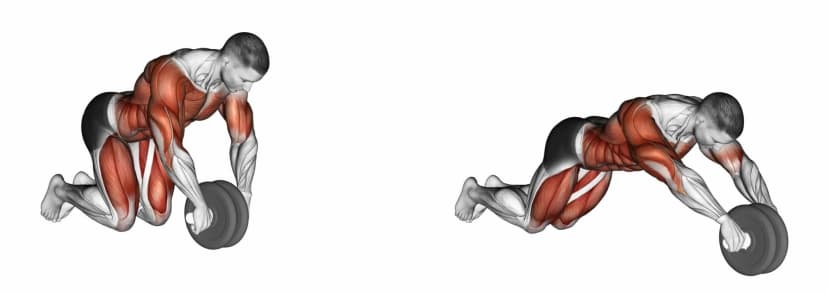
Ab Roller: Complete Guide
The ab roller (ab wheel) is one of the most challenging abdominal exercises out there. Behind its simple design, a small wheel with two handles, lies a movement that tests your entire core. If you are looking for a dynamic core exercise that outperforms the basic crunch in muscle activation, you are in the right place.
Targeted Muscles
- Rectus abdominis: primary mover, controls trunk extension and flexion throughout the movement
- External and internal obliques: lateral stabilization, prevent the pelvis from drifting side to side
- Transverse abdominis: deep core bracing, maintains intra-abdominal pressure
- Latissimus dorsi: pulls the arms back toward the body during the return phase
- Anterior deltoids: shoulder stabilization in the stretched position
- Erector spinae: anti-extension control to protect the lower back
- Serratus anterior: scapular stabilization against the rib cage
The ab roller stands out from other abdominal exercises through its anti-extension work: your abs resist gravity pulling you flat to the floor. This is what makes it so intense and effective.
Proper Execution
Starting Position
Kneel on a mat (protect your kneecaps). Grip the wheel with both hands, arms straight directly under your shoulders. Neutral spine, eyes on the floor. Brace your abs and glutes before starting. Feet can be raised or flat, both work.
Eccentric Phase (rolling out)
- Roll the wheel forward while keeping your arms straight.
- Let your body extend gradually while maintaining maximum core bracing.
- Go as far as you can control without your hips sagging. For most people, that is 70-80% of full extension.
- Keep your back neutral throughout: no lumbar arch, no rounding.
Concentric Phase (return)
- Contract your abdominals by slightly tucking your pelvis (posterior tilt).
- Pull the wheel back toward your knees using your abs, not your arms.
- Return to the starting position, arms under shoulders.
Breathing
Inhale during the rollout (eccentric). Exhale forcefully during the return (concentric). Never hold your breath.
Recommended Tempo
3 seconds rolling out, 1 second pause at the bottom, 2 seconds returning.
Common Mistakes
1. Lumbar arch (hips sagging) This is the most dangerous mistake. It happens when you exceed your controllable range. Gravity pulls your pelvis down and your lower back absorbs all the load. Solution: reduce the range. A perfect half-rollout beats a full rollout with a broken back.
2. Pulling back with the arms If your shoulders burn more than your abs, you are using your arms to return. Think about "curling your pelvis toward your ribs" rather than pulling the wheel. Arms stay straight and act as levers, not motors.
3. Going too fast Momentum destroys the purpose of this exercise. If you bounce the wheel at the bottom, you are cheating. Every inch must be controlled, especially the extension phase where your abs work eccentrically.
4. Knees too close to the wheel at the start If your hands are directly above your knees, the range of motion is tiny. Move your knees back to lengthen the lever arm and increase difficulty.
5. Head in extension (looking forward) Lifting your head pulls the cervical spine into hyperextension and encourages lumbar arching. Keep your eyes on the floor, chin slightly tucked.
Variations
Wall rollout (beginner) Perform the exercise facing a wall, about 1 meter away. The wall stops the wheel and limits range. Gradually move further back as you get stronger. Perfect for building a base without risk.
Kneeling rollout, partial range (beginner to intermediate) The standard version described above. Master the rollout at 70% extension before seeking full range. Once you can do 3 x 10 reps at full range with controlled tempo, you are ready to progress.
Standing rollout, straight legs (advanced) Start standing, feet on the floor, bend forward and roll the wheel out. The range and lever arm increase dramatically. This is a long-term goal: most people will not achieve it before 6 to 12 months of consistent training.
Single-arm rollout (expert) Same movement, but with one hand on the wheel. The anti-rotation demand skyrockets. Reserved for advanced athletes with several years of solid core training.
Programming
Placement in the session: At the end, after your main lifts. The ab roller heavily fatigues the core and can compromise stability on squats or deadlifts if done beforehand.
Volume and intensity:
- Beginner: 3 x 5-8 reps (wall rollout or partial range)
- Intermediate: 3 x 8-12 reps (full range kneeling)
- Advanced: 4 x 8-12 reps or transition to standing rollout 3 x 5-8
Frequency: 2 to 3 times per week. Abs recover relatively fast, but ab roller soreness can be severe the first few weeks. Start with twice per week and adjust.
Recommended combination: Ab roller + side plank + dead bug. These three exercises cover anti-extension, anti-lateral flexion, and anti-rotation.
Key Takeaways
- Master partial range before chasing full extension
- Your hips must never sag: if your back arches, you have gone too far
- Pull with your abs (posterior pelvic tilt), not your arms
- Slow controlled tempo: 3 seconds out, 2 seconds back
- Progress from wall rollout to standing rollout over several months
