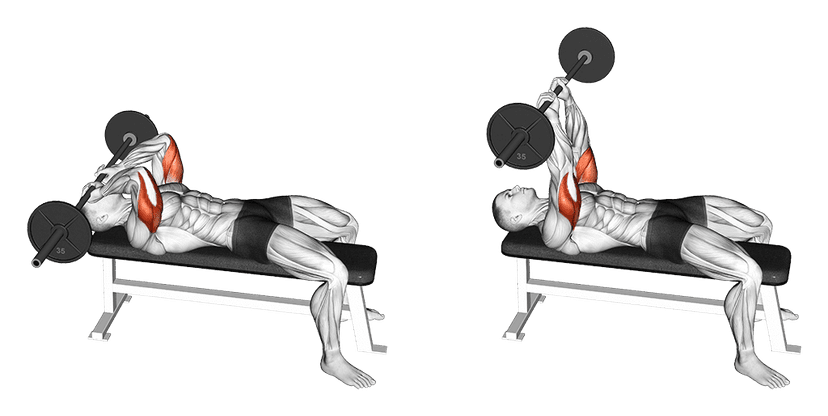
Lying Triceps Extension: Complete Guide
The lying triceps extension (skull crusher or barre au front) is the most effective isolation exercise for the triceps. Lying on a bench, you lower a bar toward your forehead then push it back up by extending your arms. This movement particularly targets the long head of the triceps, the most voluminous portion that gives the back of the arm its massive appearance. The triceps make up two-thirds of arm volume: if you want impressive arms, the lying triceps extension is your priority exercise.
Targeted Muscles
- Triceps brachii, long head: primary target. The long head is the only triceps head that crosses the shoulder joint, and the arms-overhead position places it under optimal stretch
- Triceps brachii, lateral head: the head visible from the outside, contributes to elbow extension
- Triceps brachii, medial head: the deep head, active throughout the full range of motion
- Anconeus: small muscle at the elbow, assists extension
All three triceps heads work together, but the arms-overhead position stretches the long head, increasing its contribution. This is why the lying triceps extension is superior to cable pushdowns (high pulley) for long head development.
Correct Execution
Starting Position
Lie on a flat bench, feet on the floor. Grab an EZ bar (recommended) or straight bar with a close grip, hands spaced 20-25 cm apart. Extend your arms vertically above your chest, elbows facing the ceiling.
Eccentric Phase (Lowering)
- Keeping the upper arms (humerus) fixed and vertical, flex the elbows to lower the bar.
- Lower the bar toward the forehead (hence the French name "barre au front"), just above the forehead or slightly behind (toward the crown of the head). Lowering slightly behind increases the long head stretch.
- The elbows stay pointed at the ceiling, they do not flare out to the sides.
- Lower until the forearms are roughly parallel to the floor (or slightly below).
Concentric Phase (Lifting)
- Contract the triceps to push the bar back up by extending the elbows.
- Lock out briefly at the top without snapping the elbows.
- The upper arms have not moved: only the forearms pivoted around the elbows.
Breathing and Tempo
- Inhale during the lowering, exhale during the lift.
- Recommended tempo: 3 seconds down, 1 second pause at the bottom, 2 seconds up.
Common Mistakes
1. Elbows flaring out The most common mistake. When the elbows drift outward, the movement becomes a disguised close-grip bench press. The chest and shoulders take over. Keep the elbows tight, pointed at the ceiling, shoulder-width apart.
2. Upper arms moving (humerus not fixed) If the upper arms tilt back toward the head during the lowering, you turn the exercise into a partial pullover. The movement should pivot only around the elbow joint. The humerus stays vertical.
3. Lowering toward the nose or chin The bar should descend toward the forehead or slightly behind, toward the crown of the head. If it goes toward your face, the leverage is poor and the risk of accident increases. Hence the nickname "skull crusher": be careful with the trajectory.
4. Bouncing at the bottom Using tendon elasticity to bounce at the bottom is dangerous for the elbows. Hold a micro-pause at the bottom before pushing back up.
5. Excessive load The lying triceps extension puts significant stress on the elbows. Starting too heavy is the best way to get injured. Favor volume (3-4 x 10-12) with moderate weight rather than 4 x 4 in brute strength.
Variations
EZ Bar Skull Crusher (Beginner to Intermediate) The EZ bar is the most recommended variation. The angled grip reduces wrist and elbow stress compared to a straight bar. Ideal starting point for everyone.
Dumbbell Skull Crusher (Intermediate) Replace the bar with two dumbbells, palms facing each other (neutral grip). The wrists sit in an even more natural position and each arm works independently. Useful for correcting an imbalance.
Lying Cable Triceps Extension (Intermediate) Lying on a bench, head facing a low pulley. The cable maintains constant tension, including at the top of the movement where an EZ bar is nearly neutral. Excellent variation for time under tension.
Decline Skull Crusher (Advanced) On a decline bench (15-20 degrees), the range of motion increases and the long head stretch is more pronounced. Harder and more stressful on the elbows. Reserved for experienced lifters with healthy elbows.
Program Integration
Placement in Your Session: The lying triceps extension is ideally placed as the first triceps isolation exercise, after compound movements (bench press, dips). The long head needs to be fresh to produce optimal work in the stretched position.
Volume and Intensity by Goal:
- Hypertrophy: 3-4 x 10-12 reps, controlled tempo, 90 sec rest
- Total volume: 3 x 12-15 reps, moderate load, 60 sec rest
- Strength: 4 x 6-8 reps (with caution, elbows are vulnerable under heavy load)
Frequency: 1 to 2 times per week. Triceps recover fairly quickly but are also used in all pressing movements (bench press, overhead press, dips). Keep total weekly volume at 10 to 16 sets for triceps.
Recommended Starting Weight: 15-25 kg (EZ bar included) for a beginner male, 8-15 kg for a beginner female. A standard EZ bar weighs approximately 10 kg.
Key Takeaways
- Elbows tight: pointed at the ceiling, shoulder-width apart, they do not flare
- Fixed humerus: only the forearms pivot around the elbows, upper arms do not move
- EZ bar recommended: less joint stress than a straight bar
- Lower toward the forehead or behind: never toward the nose or chin
- Long head exercise: complementary to cable pushdowns which target the lateral head more
