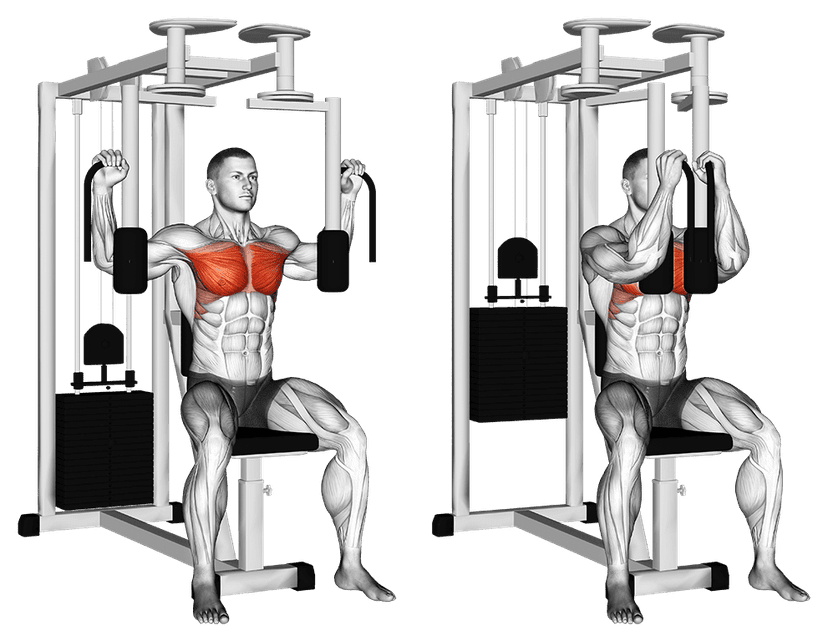
Butterfly (Pec Deck): Complete Guide
The butterfly, also known as the pec deck, is the number one isolation exercise for the chest. Performed on a dedicated machine, it targets the pectoralis major without excessively recruiting the triceps or shoulders. It is accessible from your very first session and remarkably effective for building chest volume.
Muscles targeted
- Pectoralis major (sternal head): primary mover, responsible for horizontal adduction of the arm
- Pectoralis major (clavicular head): secondary contribution, especially if elbows are slightly elevated
- Anterior deltoid: shoulder stabilization during the movement
- Biceps (short head): slight activation during the closing phase
- Serratus anterior: scapular protraction at the end of the movement
The butterfly isolates the chest much better than pressing movements because the triceps barely contribute. That is what makes it an excellent finishing exercise.
Proper execution
Starting position
Sit on the machine with your back firmly pressed against the pad. Adjust the seat height so your elbows are level with your shoulders. Grip the handles or place your forearms against the pads (depending on the model). Feet flat on the floor, chest up, shoulder blades slightly retracted.
Concentric phase (closing)
- Contract your pecs to bring your arms together in an arc in front of you.
- Keep a slight bend in your elbows throughout the movement. Never lock your arms straight.
- Bring the handles or pads together until they almost touch in front of your chest.
- Hold the contraction for 1-2 seconds in the closed position, squeezing your pecs deliberately.
Eccentric phase (opening)
Let your arms return slowly to the open position over 2-3 seconds. Do not let the weight stack slam back. Stop the opening when you feel a comfortable stretch in your chest, without forcing beyond your natural range of motion.
Breathing
Exhale while closing (effort phase), inhale while opening (return phase).
Common mistakes
1. Excessive range of motion on the opening Opening your arms as far back as possible places extreme stress on the shoulder capsule. If you feel pain in the open position, you are going too far. Limit the opening to a comfortable stretch.
2. Rounding the shoulders forward At the end of the movement, some people roll their shoulders forward to "go further." This shifts the work to the anterior deltoid and serratus anterior instead of the pecs. Keep your shoulder blades pinned to the back pad.
3. Using momentum Swinging the torso or using body momentum reduces tension on the pecs. The goal is a controlled, slow, and fluid movement.
4. Incorrect seat height If the seat is too low, your elbows end up above your shoulders and stress shifts to the rotator cuff. If the seat is too high, the work shifts to the lower chest and arms. Elbows at shoulder height is the rule.
Variations
Pad-style pec deck (beginner) Instead of gripping handles, you place your forearms against pads. This model is more stable, reduces wrist strain, and makes it easier to feel the pec contraction. Ideal for learning the movement.
Unilateral butterfly (intermediate) Work one arm at a time to correct imbalances between the left and right pec. Also allows you to focus 100% on the contraction of one side. Use your free hand to touch the working pec and verify activation.
Standing cable fly (intermediate to advanced) Cable version of the butterfly. The pulley provides constant tension throughout the range of motion and allows you to vary the angle (high, mid, low). More stabilizer recruitment since you are standing.
Dumbbell fly (advanced) Free weight version of the butterfly. Dumbbells demand complete control of the trajectory. The range of motion is greater and stabilizer recruitment is much higher. Excellent for building complete pecs.
Programming
Placement in your session: At the end of a chest workout, after compound movements (bench press, incline press). The butterfly serves as a finisher to fill the muscle with extra volume.
Volume and intensity:
- Beginner: 3 x 12-15 reps, moderate weight, focus on contraction
- Intermediate: 3-4 x 10-12 reps, last reps should be challenging
- Advanced: 4 x 10-12 reps + drop sets or slow tempo (4-second eccentric)
Frequency: 1-2 times per week depending on your split. The butterfly fits naturally in a Push session, a dedicated chest day, or a full body routine.
Ideal combination: Chain bench press, incline dumbbell press, then butterfly as a finisher. Your pecs will already be pre-fatigued from the compound lifts, and the butterfly will complete the isolation work.
Key takeaways
- Seat properly adjusted: elbows at shoulder height to target the pecs without stressing the rotator cuff
- Controlled range of motion: do not force the opening beyond a comfortable stretch
- Deliberate contraction: squeeze the pecs for 1-2 seconds in the closed position
- Slow movement: 2-3 seconds on the eccentric, no momentum
- Finishing exercise: place it after presses, not as your first exercise
