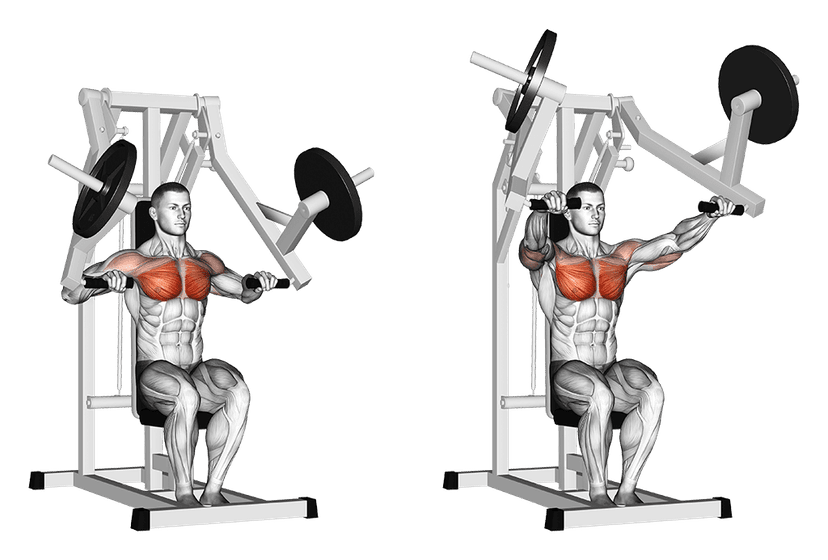
Chest Press (Machine): Complete Guide
The chest press machine is a foundational exercise for developing the pecs. It replicates the bench press movement while eliminating the need to stabilize a barbell, allowing you to focus exclusively on pushing. Perfect for beginners learning the movement pattern, and equally useful for advanced lifters at the end of a session when fatigue makes free weights risky.
Muscles targeted
- Pectoralis major (sternal and clavicular heads): primary mover, responsible for horizontal pushing
- Anterior deltoid: assists the push, especially at the start of the movement
- Triceps: elbow extension, lockout at the end of the push
- Serratus anterior: scapular protraction at end range
- Coracobrachialis: secondary assistance in arm adduction
The pec-to-triceps work ratio is better on the chest press than on a standard bench press because the machine removes instability. You can push to muscular failure of the pecs without the triceps giving out first.
Proper execution
Machine setup
Adjust the seat height so the handles are level with the middle of your chest (nipple line). If the handles are too high, the anterior deltoid takes over. Too low, and the stress shifts to the lower pecs and triceps.
Starting position
Back pressed firmly against the pad, feet flat on the floor. Grip the handles with a neutral or pronated grip depending on the model. Shoulder blades squeezed together and pulled down, chest up. This scapular position protects your shoulders and maximizes pec recruitment.
Concentric phase (push)
- Push the handles forward by contracting your pecs. The hands follow a horizontal or slightly converging path.
- Do not fully lock out your elbows at end range. Keep 5-10 degrees of bend to maintain tension on the pecs.
- Exhale during the push.
Eccentric phase (return)
- Return slowly over 2-3 seconds, controlling the load.
- Stop the return when your elbows are slightly behind the line of your shoulders. No need to force the stretch.
- Inhale during the return.
Common mistakes
1. Lifting your back off the pad Arching off the pad to push more weight turns the exercise into a pseudo-decline press and removes the safety benefit of the machine. Keep your back glued to the pad for every rep.
2. Locking out the elbows Fully extending the arms at the end transfers the load to the joints instead of the muscles. Always maintain a slight bend.
3. Shoulders shrugging up toward the ears If your shoulders rise during the push, the upper traps compensate and the anterior deltoid takes over. Consciously pull your shoulders down before each rep.
4. Moving too fast The chest press loses its value if you bounce the weight stack without control. Recommended tempo: 2 seconds push, 3 seconds return.
5. Incorrect seat adjustment A seat that is too low places the handles at collarbone level and stresses the rotator cuff. Take 30 seconds to find the right setting before starting.
Variations
Neutral grip chest press (beginner) Palms facing each other. This grip is more natural for the shoulder joint and reduces rotator cuff stress. Recommended if you experience shoulder pain with the standard grip.
Unilateral chest press (intermediate) Push one arm at a time to correct left-right imbalances. Excellent for identifying and correcting the weaker side. Place your free hand on the working pec to verify contraction.
Incline chest press (intermediate) The machine is angled at 30-45 degrees. The work shifts toward the clavicular head (upper chest). Very useful if your upper chest is lagging.
Barbell bench press (advanced) The free weight version is more demanding in terms of stabilization and recruits more muscle fibers. Move to the barbell bench once you have mastered the movement pattern on the machine.
Programming
Placement in your session: As the first exercise for beginners. As the last exercise (after free weight movements) for intermediate and advanced lifters.
Volume and intensity:
- Beginner: 3 x 10-12 reps, weight that allows perfect form
- Intermediate: 3-4 x 8-12 reps, sets close to failure
- Advanced: 4 x 8-12 reps + intensification techniques (rest-pause, drop sets)
Frequency: 1-2 times per week in a Push or chest session.
Progression: Increase the weight by 2.5 kg when you complete all sets at the top of your rep range. The chest press allows consistent linear progression because stabilization is not a limiting factor.
Key takeaways
- Adjust the seat: handles at mid-chest level, not shoulder level
- Shoulder blades retracted: back against the pad, shoulders low and back
- Do not lock out: keep 5-10 degrees of elbow bend at the end of each push
- Controlled tempo: 2 seconds push, 3 seconds return
- Simple progression: add weight as soon as you hit the top of your rep range
