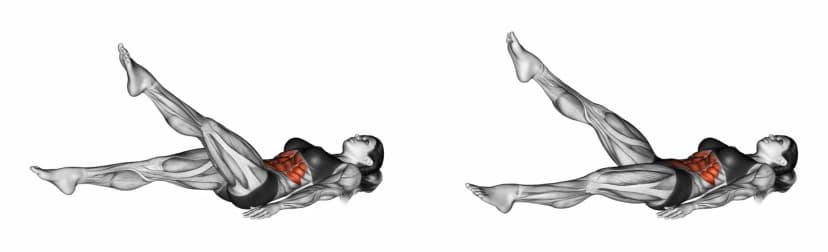
Scissor Kicks: Complete Guide
Scissor kicks are a bodyweight exercise that targets the lower abdominals with surprising intensity. Often overlooked in favor of classic crunches, they provide focused work on the lower portion of the rectus abdominis, an area many lifters struggle to develop. No equipment needed, no gym required: a simple mat is all it takes to add this movement to your routine.
The exercise involves alternating leg raises while lying on your back, keeping your lower back pressed firmly into the floor. This seemingly simple motion places serious demand on the entire abdominal wall and hip flexors. It suits beginners and advanced athletes alike, whether as a standalone ab exercise or a finisher at the end of a session.
Targeted Muscles
- Rectus abdominis (lower portion): primary mover, responsible for maintaining pelvic tilt during the movement
- Transverse abdominis: deep stabilizer, engaged throughout to brace the trunk
- Iliopsoas and rectus femoris: hip flexors that control leg movement
- Internal and external obliques: lateral stabilizers preventing pelvic shift
- Quadriceps: maintain knee extension throughout the movement
Abdominal engagement peaks when your lower back stays glued to the floor. The moment you feel an arch forming, tension shifts from the abs to the hip flexors.
Proper Execution
Starting position
Lie flat on your back, arms at your sides (palms down) or hands tucked under your glutes for extra pelvic support. Head on the floor or slightly raised with chin tucked. Contract your abs to press your lower back firmly into the floor: this is posterior pelvic tilt. Lift both legs about 15-20 cm off the ground, legs straight.
Movement phase
- Keeping legs straight, raise one leg to about 45 degrees while the other lowers toward the floor without touching it.
- Alternate in a smooth, controlled scissor-like motion.
- Each full cycle (left + right) counts as one rep.
- Maintain steady breathing: exhale on the upward beat, inhale on the downward beat.
Recommended tempo: 1 second per beat. No rushing: control quality matters more than speed.
Range of motion: the lower leg never drops below the point where you lose lumbar contact with the floor. That is your limit marker.
Common Mistakes
1. Lower back arching This is the number one error. When your lower back lifts off the floor, tension shifts from the abs to the hip flexors and lumbar vertebrae. Result: back pain and zero abdominal work. Fix: reduce range of motion (keep legs higher) or place hands under your glutes.
2. Bent knees Bending the knees shortens the lever arm and significantly reduces difficulty. Keep legs as straight as possible without fully locking the knees (slight bend is fine).
3. Moving too fast Beating your legs at full speed turns the exercise into a ballistic movement. You recruit momentum rather than muscle. Slow down, control every phase.
4. Pulling the head forward Grabbing the neck and pulling the head forward creates unnecessary cervical strain. If you raise your head, do it through abdominal contraction, not by pulling on your neck.
5. Holding your breath Breath-holding raises intra-abdominal pressure excessively. Breathe smoothly throughout every set.
Variations
Vertical scissors (beginner) Same principle but with legs higher (45 to 90 degrees). Reduces load on the abs and lower back. Perfect for learning the movement before lowering the range.
Crossover scissors (intermediate) Legs cross over each other with each beat rather than simply alternating up and down. The crossover adds adductor work and a rotational component for the obliques.
Weighted scissors (advanced) Add ankle weights (0.5 to 2 kg) to increase resistance. The extended lever arm with added weight intensifies rectus abdominis and hip flexor engagement.
Flutter kicks (tempo variation) Faster beats with smaller range of motion, often used in HIIT or military training. Same motor pattern, higher tempo.
Program Integration
Scissor kicks fit perfectly at the end of a session as part of a complete ab routine.
- Beginner: 3 sets of 10-15 beats (per leg), 45 seconds rest
- Intermediate: 4 sets of 20-30 beats, 30 seconds rest
- Advanced: 4-5 sets of 30-40 beats or 30-45 seconds continuous, 20 seconds rest
Combine them in a superset with classic crunches or planks for a full ab circuit. They also work well in an EMOM format (every minute on the minute) for metabolic conditioning.
Schedule them on days when you are not doing heavy squats or deadlifts, as the hip flexors will already be pre-fatigued.
Key Takeaways
- Lower back pressed into the floor at all times
- Straight legs, smooth and controlled movement
- Range of motion adapted to your level (higher legs = easier)
- Steady breathing, never hold your breath
- Progress through range, volume, then load (ankle weights)
