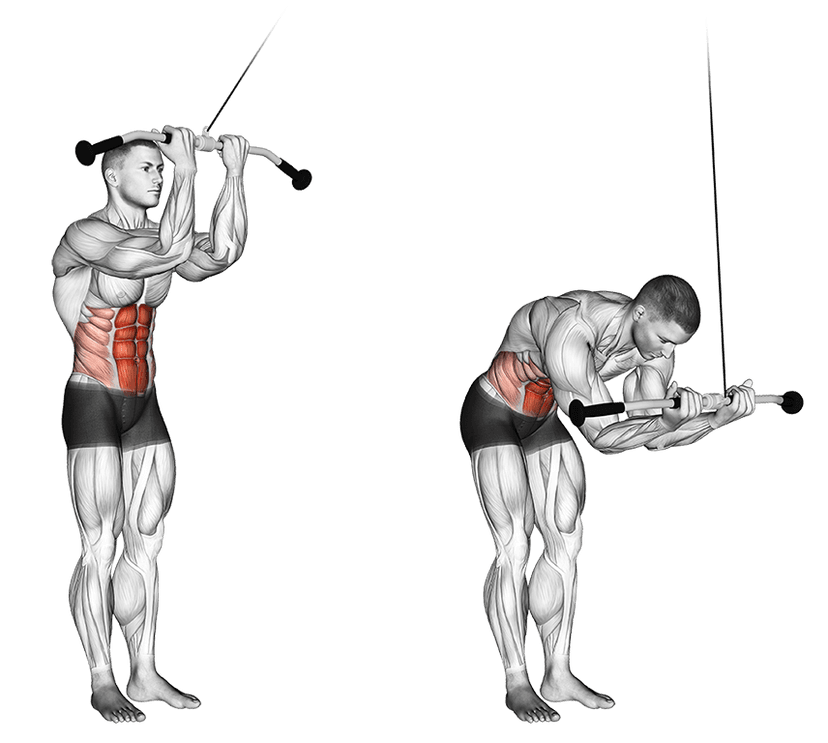
Cable Crunch: Complete Guide
The cable crunch is one of the most effective abdominal exercises you can do in the gym. Unlike floor crunches where resistance decreases at the top of the movement, the cable provides constant tension throughout the entire range of motion. This is what makes it a favorite among intermediate and advanced lifters who want to add progressive overload to their ab training.
The exercise is performed kneeling in front of a high pulley, flexing the trunk against cable resistance. It looks simple, but it demands precise technique to avoid cheating with the hip flexors. Done properly, it is a powerful tool for building thickness and definition in the rectus abdominis.
Targeted Muscles
- Rectus abdominis: primary mover, responsible for trunk flexion against resistance
- Internal and external obliques: stabilizers, contribute to lateral flexion if rotation is added
- Transverse abdominis: deep stabilizer, engaged throughout the movement
- Serratus anterior: assists upper thoracic flexion
- Hip flexors: act as stabilizers but should never become primary movers
The key is to flex the trunk (bring the ribs toward the pelvis) rather than simply bending forward at the hips. If you just hinge at the hips, the rectus abdominis does not work.
Proper Execution
Starting position
Attach a rope (or straight bar) to the high pulley. Kneel facing the machine, about 50 cm from the weight stack. Grip the rope on each side of your head, hands at temple level or behind the neck. Hips stay fixed throughout the movement. Back is straight, trunk slightly tilted forward to create pre-tension on the cable.
Concentric phase (flexion)
- Contract your abs to curl the trunk toward the floor.
- The goal is to bring the sternum closer to the pelvis, not to dive your forehead into the floor.
- Elbows travel down toward the knees or thighs.
- Exhale during flexion.
- At the bottom of the movement, hold the contraction for one second.
Eccentric phase (return)
- Slowly uncurl the trunk, vertebra by vertebra.
- Inhale on the way up.
- Do not return fully to vertical: maintain slight abdominal tension at the top.
- Recommended tempo: 2-3 seconds down (eccentric), 1-second pause, 2 seconds up.
Breathing: exhale while flexing (concentric), inhale while returning (eccentric).
Common Mistakes
1. Hip flexion instead of trunk flexion The most common error. You bend forward at the hips instead of curling the trunk. The hips must stay fixed. Only the trunk moves: think about bringing your ribs toward your pelvis.
2. Pulling with the arms If you pull the rope down with your arms, you recruit the lats and biceps instead of the abs. Your arms are hooks: they hold the rope in position, nothing more.
3. Too much weight Going too heavy forces compensation with the hip flexors and momentum. Start light (15-20 kg), master the movement, then increase gradually.
4. Short range of motion Half reps do not work the rectus abdominis through its full length. Lower until your elbows are close to your thighs, then return almost to vertical.
5. Hands positioned too low If your hands drop in front of your chest instead of staying near your head, the lever arm shortens and the exercise becomes easier (less effective). Keep your hands fixed at temple level.
Variations
Cable crunch with rotation (intermediate) As you lower, direct one elbow toward the opposite knee. Alternate left and right each rep. Adds targeted oblique work to the rectus abdominis flexion.
Standing cable crunch (intermediate) Same principle but standing, back to the pulley. Resistance works more against gravity and recruits more stabilizers. Less load possible, but excellent for proprioception.
Low cable kneeling crunch (advanced) Cable attached at the bottom, pulling upward. Reverses the force vector and creates a different resistance curve. Less common but interesting for varying stimuli.
Single-arm cable crunch (advanced) One hand holds the rope, the other is free. Work one side at a time to correct lateral imbalances. Excellent for obliques and anti-rotation stability.
Program Integration
The cable crunch fits best in the middle or at the end of an ab session, after a plank or compound movement.
- Beginner: 3 sets of 12-15 reps, light weight, 60 seconds rest
- Intermediate: 4 sets of 10-12 reps, moderate weight, 45 seconds rest
- Advanced: 4-5 sets of 8-12 reps, heavy weight, 30-45 seconds rest
The major advantage of this exercise is progressive overload: you can increase weight in 2.5 kg increments just like any other resistance exercise. That is rare for an ab movement.
Combine it with planks and a rotation exercise (Pallof press or Russian twist) for a complete abdominal routine.
Key Takeaways
- Flex the trunk, not the hips
- Hands fixed at temple level
- Hold the contraction at the bottom
- Progress through load, just like any strength exercise
- Controlled tempo, no momentum
