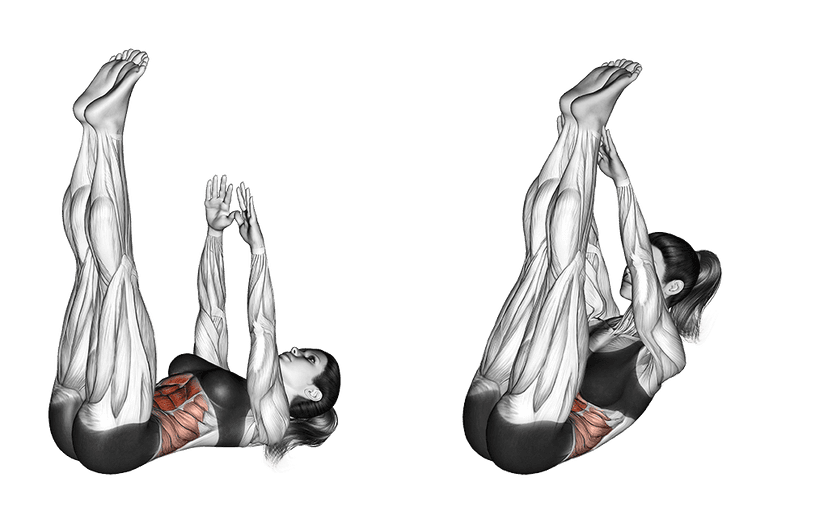
Floor Crunch: Complete Guide
The floor crunch is the most practical abdominal exercise in strength training. Lying on the floor, you raise your upper back by contracting the abs. No equipment needed, no space required: you can do it anywhere. When performed correctly, it targets the rectus abdominis with precision and zero risk to the back.
Muscles targeted
- Rectus abdominis: primary mover. This is the "six-pack" muscle. The crunch recruits it by bringing the sternum closer to the pelvis through trunk flexion.
- External obliques: provide lateral stabilization and contribute to trunk flexion.
- Internal obliques: deep stabilization, working in synergy with the external obliques.
- Transversus abdominis: deep abdominal wall muscle that contracts to maintain intra-abdominal pressure.
- Hip flexors (iliopsoas): secondary involvement. A properly executed crunch minimizes their participation.
Contrary to popular belief, crunches do not "burn belly fat." They strengthen and build the abdominal muscle. Visible ab definition depends on your body fat percentage, not on how many crunches you do.
Proper execution
Starting position
Lie on a mat on the floor. Knees bent at roughly 90 degrees, feet flat on the floor, hip-width apart. Hands behind your head (fingers interlaced without pulling on the neck) or crossed over your chest. Lower back in contact with the floor. Eyes on the ceiling.
Concentric phase (raising up)
- Contract the abs to lift your shoulder blades off the floor. The movement starts from the sternum, not the head.
- Rise about 15-20 cm. You do not need to come all the way up to your knees: the abs are fully contracted as soon as the shoulder blades leave the floor.
- At the top, imagine pulling your ribs toward your pelvis. This is trunk flexion, the real job of the rectus abdominis.
- Exhale as you rise (push all the air out to maximize the contraction).
Eccentric phase (lowering)
- Lower slowly (2 to 3 seconds), controlling the return.
- Let the shoulder blades touch the floor without completely releasing abdominal tension.
- Inhale on the way down.
Recommended tempo: 1-2 seconds up, 1 second squeeze at the top, 2-3 seconds down (1-1-3).
Common mistakes
1. Pulling on the neck The most widespread and most dangerous mistake for the cervical spine. The hands are behind the head to support it, not to pull it forward. Fix: place your fingertips on your temples, or cross your arms over your chest.
2. Rising too high Coming all the way up to a seated position is not a crunch, it is a sit-up. Beyond the shoulder blades lifting off, the hip flexors take over, not the abs. Limit the rise to 15-20 cm.
3. Lower back lifting off If your lower back leaves the floor, you are using the hip flexors. Keep the lower back pressed into the floor by pushing your navel toward your spine.
4. Excessive speed Blasting through crunches at full speed while counting reps is pointless. Quality beats quantity. One slow, controlled crunch with a solid squeeze at the top is worth ten fast ones.
5. Holding your breath Some people hold their breath throughout the set. Active exhalation on the way up is essential: it engages the transversus abdominis and increases the rectus contraction.
Variations
Feet-elevated crunch (beginner) Rest your calves on a bench or chair, thighs at 90 degrees. This position almost completely eliminates hip flexor involvement and isolates the abs better. Perfect for learning the movement.
Oblique crunch (intermediate) As you rise, rotate your torso to bring one elbow toward the opposite knee. Targets the obliques in addition to the rectus abdominis. Do not pull your head with your hand: it is the torso that rotates.
Weighted crunch (intermediate to advanced) Hold a plate or dumbbell against your chest or above your head (arms extended). Adding load increases resistance and stimulates abdominal hypertrophy. Start light (5 kg) and progress slowly.
Swiss ball crunch (advanced) Lie on a Swiss ball with your lower back on the ball. The instability forces the transversus and stabilizers to work harder. The range of motion is also slightly greater because you can extend further at the bottom.
Programming
Placement: at the end of the session, after compound exercises. The abs stabilize the trunk during squats, deadlifts, and presses. Fatiguing them early compromises your performance on those lifts.
Volume and intensity:
- Beginner: 3 x 15-20 reps, bodyweight
- Intermediate: 3-4 x 15-25 reps, or 3 x 12-15 weighted
- Advanced: 4 x 15-20 reps weighted + slow tempo (4 seconds per rep)
Frequency: 2-4 times per week. Abs recover quickly and tolerate high volume. However, if you regularly squat and deadlift heavy, twice per week is enough because those exercises already challenge the abs significantly.
Effective pairings:
- Ab circuit: floor crunch + leg raise + front plank (cycle through with no rest)
- Superset: crunch + reverse crunch (upper and lower rectus)
- Quick routine (5 min): 3 x 20 crunches with 30 seconds rest
Key takeaways
- Shoulder blades, no more: lift the shoulder blades off the floor, and that is enough. Going higher activates the hip flexors.
- Exhale on the way up: forced exhalation engages the transversus and maximizes the abdominal contraction.
- No neck pulling: fingertips on the temples or arms crossed if you tend to pull.
- Slow and controlled: one slow crunch beats ten fast ones. The quality of the contraction makes the difference.
- No spot reduction: crunches strengthen the abs, they do not melt belly fat. A caloric deficit is still required.
