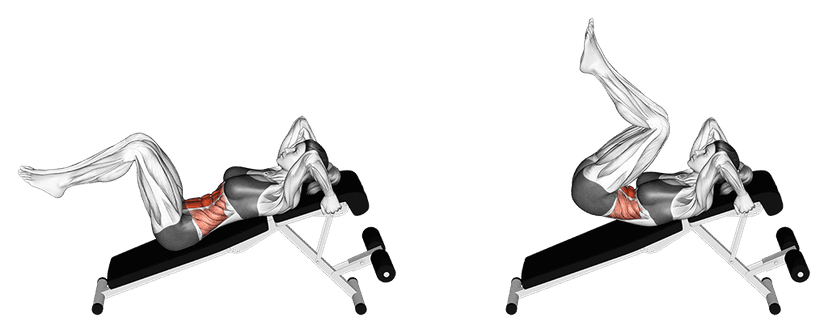
Decline Crunch: Complete Guide
The decline crunch is an advanced version of the classic crunch that uses an inclined bench to increase both range of motion and resistance. By placing your head lower than your feet, gravity works harder against you throughout the concentric phase. The result: more intense activation of the rectus abdominis compared to a flat crunch.
You will find this exercise in most gyms, performed on a dedicated decline bench or an adjustable bench with foot pads. It suits intermediate to advanced lifters who have already mastered the floor crunch and want to reach the next level.
Targeted Muscles
- Rectus abdominis: primary mover, works through a greater range of motion thanks to the incline
- Internal and external obliques: lateral stabilizers, more heavily recruited if rotation is added
- Transverse abdominis: deep bracing throughout the movement
- Hip flexors (psoas, rectus femoris): help maintain position on the bench
- Intercostals: assist upper thoracic flexion
The bench angle increases the lever arm and gravitational component. The steeper the angle, the more force the rectus abdominis must produce to curl the trunk.
Proper Execution
Starting position
Set up on the decline bench with feet secured under the pads. The bench is inclined between 20 and 45 degrees (30 degrees is a good starting point). Cross your arms over your chest or place your hands at your temples. Do not lock your hands behind your neck. Lower your trunk back under control until your back is flat (or slightly below horizontal).
Concentric phase (up)
- Contract your abs to curl the trunk toward your thighs.
- Peel your shoulder blades off the bench, then continue curling vertebra by vertebra.
- Rise until your trunk forms roughly a 90-degree angle with your thighs. No need to go higher: beyond that, the hip flexors take over.
- Exhale on the way up.
- Hold the contraction for one second at the top.
Eccentric phase (down)
- Lower slowly by uncurling the trunk.
- Inhale on the way down.
- Do not let yourself fall back. Control every centimeter.
- Lower until your shoulder blades touch the bench without fully releasing tension.
- Recommended tempo: 2 seconds up, 1-second hold, 3 seconds down.
Common Mistakes
1. Using momentum Swinging to build momentum instead of rising through abdominal contraction turns the exercise into a hip movement. Fix: slow down and eliminate all swinging.
2. Rising too high Going past 90 degrees between trunk and thighs shifts the load to the hip flexors. The rectus abdominis reaches peak contraction around 90 degrees. No need to go further.
3. Pulling on the neck Hands behind the head pulling the neck into flexion is a recipe for cervical pain. Cross your arms over your chest or keep hands at the temples without pressing.
4. Uncontrolled descent Dropping back cuts time under tension in half and raises the risk of lumbar injury. The eccentric phase is just as important as the concentric.
5. Too steep an angle too soon Starting at 45 degrees when you are new to the exercise is too ambitious. An angle of 20-30 degrees is more than enough to start. Increase the incline gradually over the weeks.
Variations
Decline crunch with rotation (intermediate) On the way up, rotate the trunk to direct one elbow toward the opposite knee. Alternate sides. Adds targeted oblique work while keeping the decline overload.
Weighted decline crunch (advanced) Hold a plate, dumbbell, or medicine ball against your chest or with arms extended overhead. Increases resistance significantly. Start with 5 kg and progress slowly.
Isometric decline crunch (intermediate) Rise to the position of maximum contraction and hold for 10-20 seconds. Excellent for building muscular endurance in the rectus abdominis and proprioceptive awareness.
Full decline sit-up (advanced) Rise until fully seated. Recruits more hip flexors and suits those who want total trunk work. Caution: more stressful on the lower back.
Program Integration
The decline crunch should be placed at the start of an ab session when you are fresh, as it demands more strength than floor exercises.
- Intermediate: 3 sets of 12-15 reps, 20-30 degree angle, 60 seconds rest
- Advanced: 4 sets of 10-15 reps, 30-45 degree angle, 45 seconds rest
- Advanced with load: 4 sets of 8-12 reps, 5-15 kg plate, 60 seconds rest
Combine it with a lower ab exercise (hanging leg raise) and a plank variation (side plank) to cover the entire core.
Recommended progression: first increase volume (reps), then the bench angle, and finally external load.
Key Takeaways
- Curl the trunk, do not perform a straight sit-up
- Slow and controlled descent (eccentric phase is crucial)
- Bench angle adapted to your level
- Hands at temples or arms crossed, never behind the neck
- Progression: volume, angle, then load
