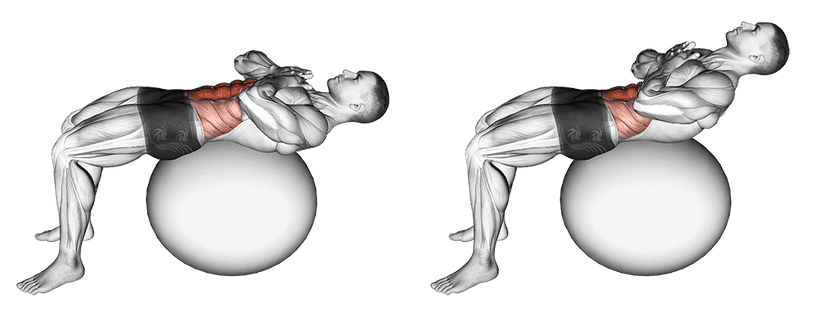
Stability Ball Crunch: Complete Guide
The stability ball crunch transforms a basic exercise into a far more complete movement. The unstable surface of the ball forces the entire abdominal wall to work constantly to maintain balance, while allowing a greater range of motion than a floor crunch. Your abs work longer and through a larger path.
What makes the swiss ball interesting is the combination of active bracing and trunk flexion. On the floor, the abs rest at the bottom position. On the ball, they stay under tension even in the extended position. This continuous tension is what makes the difference.
Targeted Muscles
- Rectus abdominis: primary mover, works through an extended range of motion thanks to the ball's curvature
- Transverse abdominis: engaged at all times to stabilize the body on the unstable surface
- Internal and external obliques: lateral stabilizers, prevent the body from rolling sideways
- Erector spinae: work eccentrically to control extension on the ball
- Hip flexors: stabilize the pelvis, moderate involvement
- Quadriceps and glutes: maintain foot position on the floor and pelvic stability
The instability of the swiss ball recruits up to 30% more core muscle fibers compared to a floor crunch, according to several electromyography studies.
Proper Execution
Starting position
Sit on the swiss ball, then walk your feet forward until your lower and mid back rest on top of the ball. Feet are flat on the floor, hip-width apart, knees bent at 90 degrees. Hips stay aligned with shoulders (do not let them drop). Hands at temples or arms crossed over the chest. The trunk is in slight extension, following the curvature of the ball.
Concentric phase (up)
- Contract your abs to curl the trunk upward.
- Peel your shoulder blades off the ball, flexing vertebra by vertebra.
- Rise until you feel maximum contraction of the rectus abdominis (roughly 30-40 degrees of flexion).
- Exhale on the way up.
- Hold the contraction for 1-2 seconds at the top.
Eccentric phase (down)
- Lower slowly, letting your back follow the curvature of the ball again.
- Inhale on the way down.
- Lower slightly below horizontal to take advantage of the extra range of motion offered by the ball. This is the main benefit of the swiss ball.
- Recommended tempo: 2 seconds up, 1-2 seconds hold, 3 seconds down.
Tip: keep your hips high and stable. If they move, you are using your hip flexors instead of your abs.
Common Mistakes
1. Ball positioned incorrectly If the ball is under your glutes rather than under your lower/mid back, the exercise becomes a sit-up on an unstable surface and loses its purpose. The ball should support the lumbar and lower thoracic curve.
2. Feet too close together Narrow feet reduce the base of support and make balance too difficult. Keep feet at least hip-width apart, or even wider when starting out.
3. Hips dropping Letting the hips sag below shoulder level reduces abdominal engagement and overloads the lower back. Contract your glutes to maintain alignment.
4. Moving too fast Speed on an unstable surface is counterproductive. You lose control, recruit momentum, and the risk of sliding off the ball increases. Slow tempo and mastery.
5. Insufficient range of motion Not taking advantage of the extension below horizontal removes the main benefit of the swiss ball. Let your back follow the ball's curvature at the bottom to stretch the abs before contracting.
Variations
Straight-arm swiss ball crunch (intermediate) Hands together, arms extended toward the ceiling. The longer lever arm increases difficulty without adding external load. Simple and effective.
Swiss ball crunch with rotation (intermediate) On the way up, rotate the trunk to direct one shoulder toward the opposite knee. Alternate sides. Combines rectus abdominis flexion with oblique rotation.
Swiss ball crunch with medicine ball (advanced) Hold a medicine ball (3-6 kg) against your chest or with arms extended overhead. The added load combined with instability creates an intense stimulus.
Swiss ball crunch with elevated feet (advanced) Place your feet on a second bench or step. The elevation reduces the base of support and increases instability. Reserved for experienced lifters.
Program Integration
The swiss ball crunch is versatile. It fits at the beginning of a session (active warm-up) as well as a finisher.
- Beginner: 3 sets of 12-15 reps, wide foot stance, 60 seconds rest
- Intermediate: 4 sets of 15-20 reps, hip-width foot stance, 45 seconds rest
- Advanced: 4 sets of 15-20 reps with medicine ball or straight arms, 30 seconds rest
It pairs well in a superset with bracing exercises (swiss ball plank) for a circuit alternating flexion and stabilization.
Ball size: 55 cm if you are under 170 cm tall, 65 cm between 170 and 185 cm, 75 cm above 185 cm. Seated on the ball, your thighs should be parallel to the floor.
Key Takeaways
- Lower back on top of the ball, not under the glutes
- Take advantage of the extended range below horizontal
- Hips stable and high throughout the movement
- Slow tempo to maximize time under tension
- Unstable surface means more core recruitment on every rep
