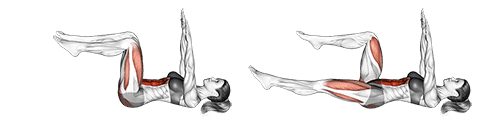
Dead Bug: Complete Guide
The dead bug is the ultimate smart core exercise. Unlike the static plank that locks you in one position, the dead bug teaches you to stabilize your trunk while your limbs move. That is exactly what your body does when you walk, run, or lift a load. If you could only choose one core exercise, the dead bug would be a serious contender.
Targeted Muscles
- Transverse abdominis: deep core muscle, keeps the lower back pressed to the floor
- Rectus abdominis: anti-extension control of the trunk
- Internal and external obliques: anti-rotation stabilization when only one arm or one leg moves
- Diaphragm: breathing-bracing coordination, essential for stability
- Iliopsoas: eccentric control of leg lowering
- Pelvic floor muscles: reflexive activation during deep bracing
The dead bug is unique because it trains limb-trunk dissociation: your core stays stable while your extremities move in alternating patterns. This is the foundation of all athletic movement.
Proper Execution
Starting Position
Lie on your back, arms extended toward the ceiling (perpendicular to the floor), hips and knees bent at 90 degrees ("tabletop" position). Your lower back is pressed flat to the floor: there should be no gap between your lumbar spine and the mat. This is the reference point for the entire exercise.
The Movement
- Brace your abdominals to lock your lower back to the floor.
- Simultaneously extend your right arm overhead and your left leg forward, lowering them toward the floor without touching it.
- Stop the descent at 5-10 cm from the floor, or before your back lifts off the mat (that is the real criterion).
- Return slowly to the starting position.
- Repeat with the left arm and right leg.
Breathing
Exhale during the descent (arm and leg moving away). Inhale during the return. The exhale forces transverse activation and keeps the back flat.
Tempo
3 seconds lowering, 1 second pause at the bottom, 2 seconds returning. No rushing.
Common Mistakes
1. Lower back lifting off the floor This is the number one mistake. If your lumbar spine arches, you have lost your brace. Two causes: too much range or abs not strong enough for the lever. Solution: reduce range (do not lower the legs as far) and focus on keeping the lower back pressed down.
2. Moving too fast The dead bug is not a cardio exercise. Each rep should be slow and deliberate. If you rush through reps, you use momentum and your abs do not work.
3. Holding your breath Many people hold their breath to "maintain" the brace. This is counterproductive: the exhale activates the transverse and reinforces stability. Exhale on every descent.
4. Moving the same-side arm and leg The dead bug is a contralateral movement (right arm + left leg). Moving the same side reduces the anti-rotation component and makes the exercise less effective.
5. Skipping the starting position check Jumping straight into the movement without verifying your back is flat is a mistake. Take 3 seconds to set up properly before each set.
Variations
Arms-only dead bug (beginner) Keep your knees at 90 degrees in a fixed position and only alternate your arms. This reduces the lever arm and lets you learn lumbar bracing without the added difficulty of the legs.
Legs-only dead bug (beginner) Keep your arms extended toward the ceiling and only lower your legs alternately. The lever is longer than the arms-only version, but you focus on a single movement pattern.
Banded dead bug (intermediate) Attach a resistance band around your hands and knees. The band tension tries to pull your extremities together, forcing your abs to work harder to maintain position. Excellent for increasing difficulty without adding weight.
Medicine ball dead bug (advanced) Hold a medicine ball between your hand and the opposite knee. When you extend the arm and leg, the medicine ball is pressed between the two sides that remain in position. This adds extra core activation.
Programming
Placement in the session: As a warm-up or at the end. The dead bug is excellent for activating the core before squats or deadlifts. At the end, it complements abdominal work.
Volume and intensity:
- Beginner: 3 x 6-8 reps per side (arms-only or legs-only)
- Intermediate: 3 x 10-12 reps per side (full version)
- Advanced: 4 x 12-15 reps per side or banded/medicine ball version
Frequency: 3 to 5 times per week. The dead bug is low-impact and can be practiced almost daily, especially as a warm-up.
Recommended combination: Dead bug (anti-extension) + bird dog (anti-extension on all fours) + side plank (anti-lateral flexion). This trio covers all three planes of trunk stability.
Key Takeaways
- Lower back stays flat on the floor at all times, that is the number one criterion
- Contralateral movement: right arm + left leg, then switch
- Exhale during the descent to activate the transverse
- Slow tempo: 3 seconds lowering minimum
- Excellent as a warm-up before heavy lifts
