Barbell Bench Press: Complete Guide
The barbell bench press is the king of chest exercises. It has been a staple in every serious training program for decades, and for good reason: no other movement allows you to load the chest as heavily while also recruiting the shoulders and triceps. Whether you are a beginner or have ten years of experience, the bench press remains a fundamental pillar.
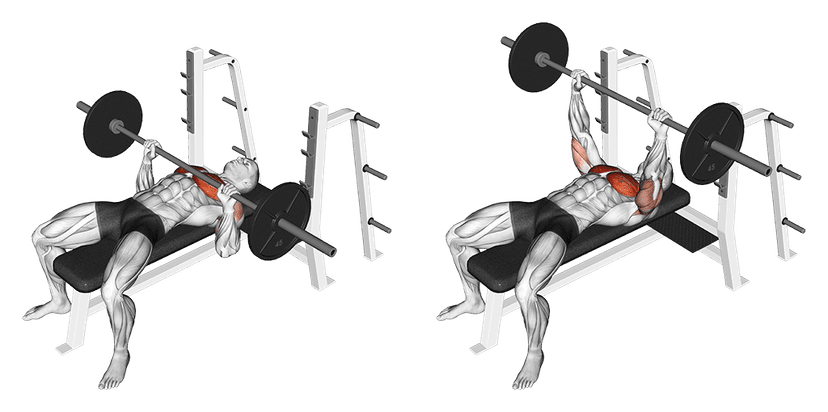
Muscles targeted
- Pectoralis major (sternal head): primary mover, responsible for horizontal pushing
- Pectoralis major (clavicular head): contributes during the first half of the movement
- Anterior deltoid: assists the push, especially in the bottom position
- Triceps: elbow extension, lockout at the top
- Serratus anterior: scapular protraction in the final phase
- Lats and biceps: stabilization during the eccentric (controlled descent)
The pectoralis major handles most of the load. If your triceps or shoulders fatigue before your chest, review your technique or grip width.
Proper execution
Starting position
Lie on the bench with your eyes under the bar. Feet flat on the floor, firmly planted. Retract your shoulder blades by pulling them back and down: imagine pinching a pencil between them. This scapular retraction is non-negotiable. It protects your shoulders and optimizes chest recruitment. Maintain a natural lower back arch (not excessive). Overhand grip, slightly wider than shoulder width.
Eccentric phase (descent)
- Unrack the bar and stabilize it with arms extended above your chest.
- Lower the bar under control toward your lower chest (nipple line).
- Your elbows should form roughly a 45 to 75 degree angle relative to your torso. Not tucked tight (too much triceps), not flared to 90 degrees (shoulder danger).
- Lower until the bar lightly touches your chest. No bouncing.
Concentric phase (push)
- Press the bar in a slight diagonal path upward and back toward the rack (reverse J curve).
- Exhale during the push.
- Lock out your elbows at the top without losing scapular retraction.
- Recommended tempo: 2-3 seconds down, 1-2 seconds up.
Breathing: inhale on the way down, exhale on the push.
Common mistakes
1. Losing scapular retraction Shoulders rolling forward during the push is the fastest way to injure the rotator cuff. Your shoulder blades must stay pinched from start to finish. Tip: drive your shoulders into the bench before you unrack.
2. Bouncing off the chest Bouncing the bar off your sternum to use the stretch reflex is dangerous (risk of sternal fracture) and reduces time under tension. Control the descent, pause for half a second at the bottom.
3. Feet lifting off the floor Flat feet anchor your body and enable leg drive (pushing your legs into the floor). Feet in the air or on the bench removes this power base and destabilizes your position.
4. Vertical bar path The bar does not travel straight up. It follows a reverse J curve: it descends toward the lower chest and rises diagonally back toward the rack. A strictly vertical path overloads the shoulders.
5. Grip too wide An excessively wide grip reduces range of motion and overloads the shoulders. The optimal grip places your forearms vertical when the bar touches your chest (roughly 1.5 times shoulder width).
Variations
Close-grip bench press (intermediate) Hands at shoulder width or slightly narrower. Shifts the work toward the triceps and clavicular head. Excellent for developing lockout strength.
Paused bench press (intermediate) Hold for 2-3 seconds with the bar on your chest before pressing. Eliminates the stretch reflex and builds explosive strength from the bottom position. Used in powerlifting.
Floor press (beginner to intermediate) Bench press performed on the floor. Range of motion is reduced because your elbows touch the ground. Ideal for working the top half of the movement and protecting sensitive shoulders.
Smith machine bench press (beginner) The guided path simplifies execution and allows you to train without a spotter. Less stabilizer recruitment, but useful for learning the movement pattern.
Programming
Placement in your session: First exercise in your chest or Push session. The bench press requires neural freshness to perform well.
Volume and intensity:
- Beginner: 3 x 8-10 reps, 60-70% of max, technique focus
- Intermediate: 4 x 6-8 reps, 75-85% of max
- Advanced: undulating periodization (strength 5x3, hypertrophy 4x8-10, endurance 3x12-15)
Frequency: 1-2 times per week. The chest recovers in 48-72 hours. A beginner can bench twice a week to accelerate technical learning.
Starting weight: Begin with an empty bar (20 kg / 45 lb). Most beginner males reach 60-70 kg (135-155 lb) within 6 months of consistent training. The classic benchmark is pressing your own bodyweight.
Key takeaways
- Scapular retraction: shoulder blades pinched from start to finish to protect the shoulders
- J-curve path: the bar descends to the lower chest and rises diagonally
- Anchored feet: leg drive for stability and power
- No bouncing: total control at the bottom of the movement
- Progression: master technique before adding weight
