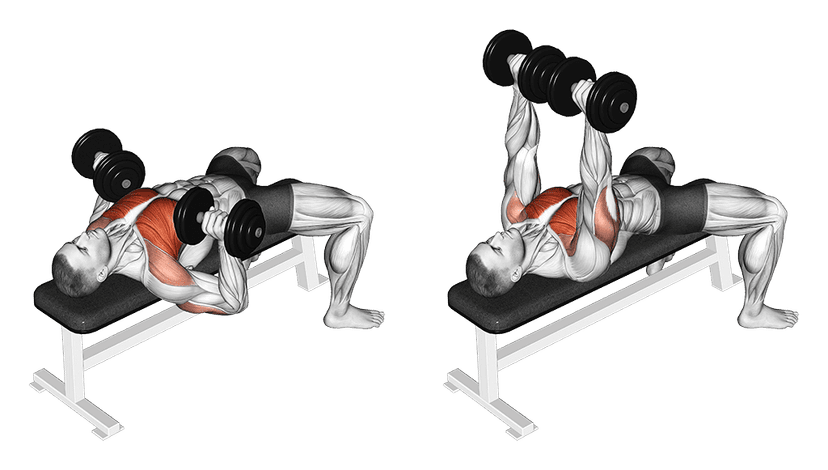
Dumbbell Bench Press: Complete Guide
The dumbbell bench press is the ideal complement to the barbell bench. It offers a greater range of motion, corrects imbalances between sides, and allows a more natural wrist position. If you could only pick one chest exercise, many coaches would recommend this one for its versatility and effectiveness.
Muscles targeted
- Pectoralis major (sternal head): primary mover, greater working range than the barbell
- Pectoralis major (clavicular head): recruited more due to the expanded range
- Anterior deltoid: assists the push in the bottom position
- Triceps: elbow extension and lockout at the top
- Shoulder stabilizers (rotator cuff): increased workload compared to barbell
- Serratus anterior: scapular protraction at the end of the movement
The major advantage of dumbbells is freedom of movement. Each arm works independently, forcing stabilizers to compensate and revealing strength imbalances.
Proper execution
Starting position
Sit on the bench with one dumbbell on each thigh. Rock back using your knees to bring the dumbbells to the top position (kick-up technique). Shoulder blades pinched into the bench, feet flat on the floor, natural back arch. Arms extended, palms facing forward, dumbbells above your chest.
Eccentric phase (descent)
- Lower the dumbbells while allowing them to drift slightly outward.
- Elbows form a 45 to 75 degree angle relative to your torso.
- Lower until the dumbbells reach chest level or slightly below. The range is greater than with a barbell since no bar blocks the path.
- You should feel a comfortable stretch in your pecs at the bottom.
Concentric phase (push)
- Press the dumbbells upward while bringing them slightly closer together (arc path).
- At the top, the dumbbells are close to each other without touching.
- Deliberately squeeze your pecs at the top of the movement.
- Exhale during the push.
Returning the dumbbells: At the end of the set, bring the dumbbells back onto your thighs by tilting them, then sit up. Never drop them to the sides: it is dangerous for the shoulders and disrespectful to the equipment.
Common mistakes
1. Dumbbells too heavy for control Unlike the barbell, dumbbells demand bilateral control. If you cannot lower them for at least 2 seconds, the weight is too heavy. Drop 15-20% compared to your barbell weight (split between both dumbbells).
2. Losing scapular retraction Same mistake as with the barbell, but more common with dumbbells because the movement is less guided. Your shoulder blades must stay pinched throughout.
3. Excessive range of motion at the bottom Lowering the dumbbells too far to "maximize the stretch" places excessive stress on the shoulder capsule. Lower to a comfortable stretch, not beyond.
4. Dumbbells rotating during the movement Wrists turning during the press indicates a lack of control or too much weight. Palms stay facing forward from start to finish (unless you are intentionally performing a rotation variation).
5. Dropping the dumbbells to the sides Throwing dumbbells to the ground at the end of a set creates a sudden abduction movement of the shoulder under load. This is a classic cause of shoulder injury. Learn the thigh return technique.
Variations
Neutral-grip dumbbell press (beginner to intermediate) Palms facing each other instead of forward. Reduces shoulder stress and activates more triceps. Ideal if you experience joint discomfort with the standard grip.
Alternating dumbbell press (intermediate) One arm presses while the other holds the top position. Doubles the core stability work and corrects imbalances. Excellent for proprioception.
Dumbbell press with rotation (intermediate to advanced) Start with palms facing each other at the bottom and progressively rotate to overhand at the top. Recruits more pec fibers across the full range of motion.
Squeeze press (intermediate to advanced) Both dumbbells stay pressed together throughout the movement. You press while maintaining medial pressure. Maximum activation of the inner chest.
Programming
Placement in your session: As your main lift if replacing the barbell, or as the second exercise after barbell bench press. Excellent as a first exercise for chest-focused sessions.
Volume and intensity:
- Beginner: 3 x 10-12 reps, moderate weight, focus on control and range
- Intermediate: 4 x 8-10 reps, progressive loading
- Advanced: 4 x 6-10 reps + intensification techniques (drop sets, slow tempo)
Frequency: 1-2 times per week. If you already barbell bench press, one dumbbell session per week is enough for complementarity.
Starting weight: Begin with 8-12 kg (18-26 lb) dumbbells to master stabilization. Most beginner males reach 20-30 kg (45-65 lb) per dumbbell within a few months.
Key takeaways
- Greater range of motion: take advantage of the extra range compared to the barbell to stretch the pecs
- Bilateral control: each arm works independently, no compensation possible
- Scapular retraction: shoulder blades pinched at all times, just like with the barbell
- Safe return: bring the dumbbells back to your thighs, never drop them
- Complementarity: combine with the barbell for complete pec development
