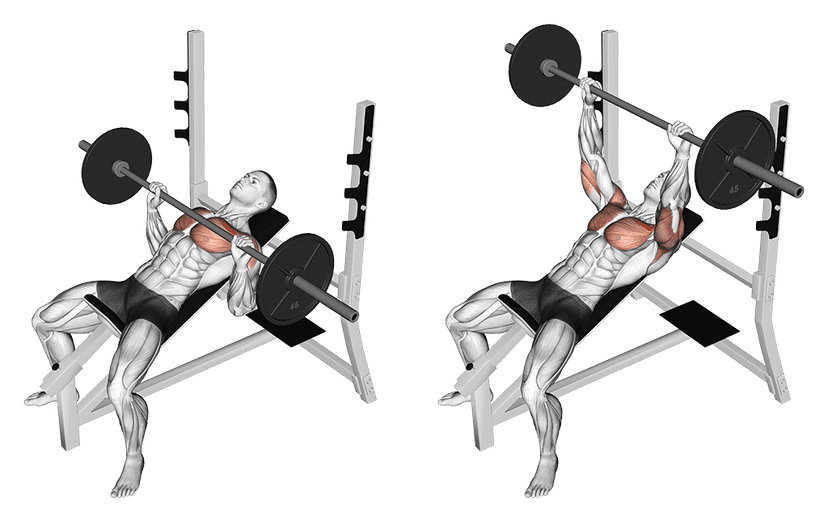
Incline Barbell Bench Press: Complete Guide
The incline barbell bench press targets the upper chest, a zone that often lags and gives the chest its full, rounded appearance. If you only flat bench, you primarily develop the sternal head. The incline completes the picture by emphasizing the clavicular head. It is a demanding compound movement that deserves a prime spot in your program.
Muscles targeted
- Pectoralis major (clavicular head): primary mover, this is the upper chest
- Pectoralis major (sternal head): secondary contribution, less recruited than on flat bench
- Anterior deltoid: heavily recruited due to the bench angle
- Triceps: elbow extension and lockout
- Serratus anterior: scapular protraction at the end of the push
- Upper trapezius: stabilization in the inclined position
The steeper the incline, the more the anterior deltoid takes over from the pecs. The optimal angle for targeting the upper chest without over-recruiting the shoulders is between 30 and 45 degrees. Beyond 45 degrees, it becomes almost a shoulder press.
Proper execution
Starting position
Set the bench to 30-45 degrees. Sit down and lean back, feet flat on the floor. Scapular retraction is identical to the flat bench: shoulder blades pinched and driven into the bench. Unrack the bar with arms extended above your upper chest. Grip slightly wider than shoulder width.
Eccentric phase (descent)
- Lower the bar under control toward your upper chest (collarbone area).
- Elbows form a 45 to 60 degree angle relative to your torso.
- The bar lightly touches your upper chest, just below the collarbones.
- Descent tempo: 2-3 seconds.
Concentric phase (push)
- Press the bar upward in a near-vertical line (the path is straighter than on flat bench).
- Exhale while pressing.
- Lock out at the top without releasing your shoulder blades.
- Focus on contracting the upper chest.
Breathing: inhale on the way down, exhale on the push.
Common mistakes
1. Angle too steep Beyond 45 degrees, the exercise becomes a disguised shoulder press. The anterior deltoid takes over and the pecs work less. 30 degrees is often the sweet spot.
2. Bar descending too low Instead of aiming for the collarbones, some people lower toward mid-chest out of flat bench habit. This reduces clavicular head recruitment and overloads the shoulders at an unfavorable angle.
3. Glutes lifting off the bench On the incline, the temptation to push with your glutes is strong. But if your glutes lift off, you reduce the effective incline and turn the exercise into a near-flat bench. Stay planted on the bench.
4. Grip too wide On the incline, a wide grip puts even more pressure on the shoulder joint than on flat bench. Keep a moderate grip with vertical forearms when the bar touches your upper chest.
5. Same weight as flat bench You will be 20-30% weaker on incline compared to flat. That is normal. Do not let ego push you to load too heavy at the expense of technique.
Variations
Smith machine incline press (beginner) The guided path lets you focus on the contraction without worrying about stabilization. A good starting point for learning the movement.
Paused incline press (intermediate) Hold for 2 seconds with the bar on your chest. Eliminates the stretch reflex and forces the clavicular head to work harder from the bottom position.
Close-grip incline press (intermediate to advanced) Hands at shoulder width. Activates more triceps and the inner portion of the upper chest. Also excellent for overhead press lockout strength.
Incline press with chains or bands (advanced) Resistance increases as you press. Forces acceleration and develops power at the end of the movement.
Programming
Placement in your session: First or second exercise. If upper chest is your weak point, place the incline first, before flat bench. Otherwise, after flat bench.
Volume and intensity:
- Beginner: 3 x 8-10 reps, moderate weight, technique focus
- Intermediate: 4 x 6-8 reps, steady progression
- Advanced: 4-5 x 5-8 reps, strength/hypertrophy periodization
Frequency: 1-2 times per week. The incline can replace flat bench every other session to vary the stimulus.
Strength benchmark: On incline, expect to lift roughly 70-80% of your flat bench max. If you bench 100 kg flat, 70-80 kg on incline is a solid reference.
Key takeaways
- 30-45 degree angle: beyond that, you work the shoulders more than the chest
- Descent toward the collarbones: not toward mid-chest
- Scapular retraction: identical to flat bench, shoulder blades pinched at all times
- Lower weight: 20-30% less than flat bench is normal
- Upper chest priority: if it is your weak point, place incline as your first exercise
