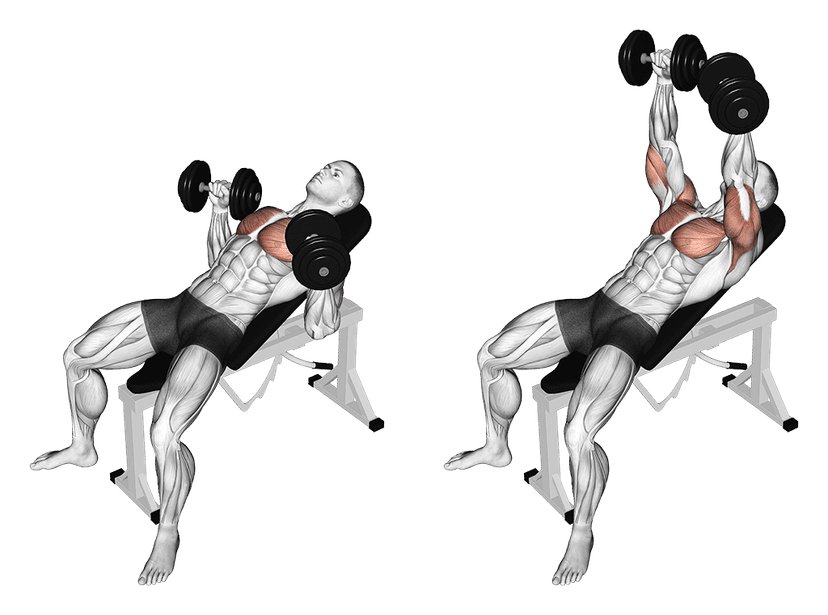
Incline Dumbbell Bench Press: Complete Guide
The incline dumbbell bench press combines the benefits of the incline angle (upper chest targeting) with the advantages of dumbbells (greater range of motion, unilateral work). It is the exercise of choice for building a thick, symmetrical upper chest. The stretch at the bottom is deeper than with a barbell, making it a powerful tool for clavicular head hypertrophy.
Muscles targeted
- Pectoralis major (clavicular head): primary target due to the incline
- Pectoralis major (sternal head): secondary contribution
- Anterior deltoid: heavily recruited by the bench angle
- Triceps: extension and lockout at the top
- Shoulder stabilizers (rotator cuff): increased workload compared to barbell
- Serratus anterior: protraction at the end of the movement
- Core (abs, obliques): trunk stabilization in the inclined position
The combination of incline plus dumbbells maximizes clavicular head recruitment while forcing intense stabilizer work. It is a demanding exercise that requires coordination.
Proper execution
Setup
Set the bench to 30-45 degrees. Sit with one dumbbell on each thigh. Rock back while helping the dumbbells up with your knees (kick-up). Retract your shoulder blades: pinch them and drive them into the bench. Feet flat on the floor.
Eccentric phase (descent)
- Lower the dumbbells to each side while controlling the path.
- Elbows at roughly 45-60 degrees from your torso, not flared to 90 degrees.
- Lower until the dumbbells reach upper chest level. Dumbbells allow you to go deeper than a barbell, so take advantage of that extra range.
- Feel the stretch in your upper chest. Stop if you feel shoulder pain.
Concentric phase (push)
- Press the dumbbells upward while bringing them slightly closer together (arc path).
- At the top, the dumbbells are close without touching.
- Deliberately squeeze the upper chest at the peak.
- Exhale during the push.
Recommended tempo: 2-3 seconds down, 1-2 seconds up. No jerky movements.
Common mistakes
1. Bench angle too steep Same trap as with the barbell. Beyond 45 degrees, the shoulders take over. Stay at 30 degrees if you truly want to target the pecs.
2. Dumbbells too heavy On the incline with dumbbells, you stack two difficulty factors: the unfavorable angle and free weight instability. Reduce by 25-30% compared to your flat dumbbell bench.
3. Divergent paths If the dumbbells travel in different directions, you lose pec tension and risk injury. Maintain a symmetrical, fluid path. If that is impossible, the weight is too heavy.
4. Descent too fast On incline, gravity naturally accelerates the descent. If you do not control the eccentric, you risk a sudden shoulder stretch at the bottom. 2-3 seconds minimum on the way down.
5. Forgetting scapular retraction On the incline, the natural tendency is to let the shoulders roll forward. Force yourself to keep your shoulder blades pinched into the bench throughout the set.
Variations
Neutral-grip incline dumbbell press (beginner) Palms facing each other throughout the movement. Reduces shoulder joint stress and makes scapular retraction easier. Perfect for beginners or if you have sensitive shoulders.
Alternating incline dumbbell press (intermediate) One arm presses while the other holds the top position. Excellent for core stability and correcting imbalances. Doubles the time under tension per set.
Incline dumbbell press with rotation (intermediate to advanced) Start palms facing each other at the bottom, rotate to overhand at the top. This rotation recruits more clavicular head fibers across the full range.
Single-arm incline dumbbell press (advanced) One dumbbell only, the other hand free or placed on the bench. Anti-rotation core demand is maximal. Reserved for experienced lifters who have mastered stabilization.
Programming
Placement in your session: After flat bench press or as the first exercise if upper chest is your priority. Fits naturally as the second or third exercise in a Push session.
Volume and intensity:
- Beginner: 3 x 10-12 reps, light to moderate weight, focus on range and control
- Intermediate: 3-4 x 8-10 reps, progressive loading
- Advanced: 4 x 8-12 reps + intensification techniques (rest-pause, drop sets)
Frequency: 1-2 times per week. If you already do incline barbell press, one incline dumbbell session is enough.
Starting weight: 6-10 kg (13-22 lb) per dumbbell for beginners. Incline plus dumbbells is the most demanding configuration for stabilization. Do not rush the progression.
Key takeaways
- 30-degree angle: the best chest-to-shoulder compromise for most body types
- Maximum range: take advantage of the absence of a barbell to stretch the upper pecs deeply
- Absolute control: 2-3 seconds minimum on the descent, no sudden movements
- Modest weight: 25-30% less than flat dumbbell bench, ego does not come before technique
- Scapular retraction: even more important on incline than on flat
