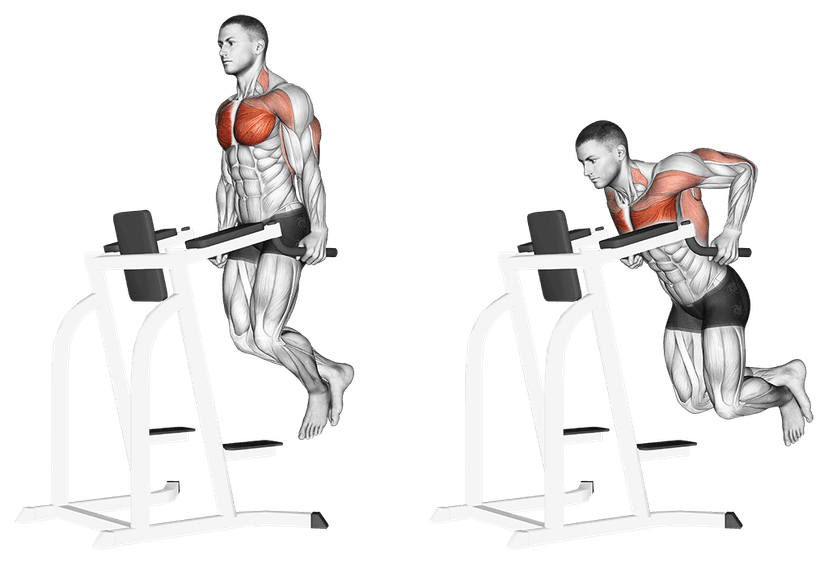
Dips (Parallel Bars): Complete Guide
Dips on parallel bars are one of the most effective bodyweight exercises for the upper body. Often called the "squat of the upper body," this compound movement massively recruits the chest, triceps, and anterior deltoids. It requires no fancy equipment and can be performed almost anywhere. The trade-off: it is a demanding movement that requires baseline strength and decent shoulder mobility.
Muscles targeted
- Pectoralis major (sternal and clavicular heads): heavily recruited when the torso leans forward
- Triceps: primary mover if the torso stays upright
- Anterior deltoid: stabilization and assistance in the bottom position
- Rhomboids and lower trapezius: scapular retraction and depression
- Serratus anterior: protraction at the end of the movement
- Latissimus dorsi: trunk stabilization
- Abdominals: static bracing to maintain position
The chest-to-triceps ratio depends on torso angle. The more you lean forward, the more the chest works. The more upright you stay, the more the triceps take over.
Proper execution
Starting position
Grip the parallel bars with arms extended, body suspended. Shoulders down (away from ears), chest out, eyes straight ahead. Cross your legs behind you or keep them slightly bent. Engage your core before descending.
Eccentric phase (descent)
- Lean your torso slightly forward (15-30 degrees) to target the chest.
- Bend your elbows, allowing them to flare slightly to the sides.
- Lower until your arms form a 90-degree angle at the elbow, or slightly below if your mobility allows.
- Keep your shoulders down and your chest open. Do not let the shoulders ride up toward your ears.
- Tempo: 2-3 seconds on the descent.
Concentric phase (ascent)
- Push through the bars by contracting your chest and triceps.
- Rise to near-full arm extension (do not slam your elbows to lockout).
- Exhale on the way up.
- Maintain the forward lean throughout.
Breathing: inhale on the way down, exhale on the way up.
Common mistakes
1. Going too deep Dropping well below 90 degrees of elbow flexion places considerable stress on the shoulder capsule. If you lack the mobility, stay at 90 degrees. Depth will come with time and stretching.
2. Shoulders riding up toward the ears This signals weakness in the scapular depressors (lower trapezius, lats). Letting the shoulders rise compresses the supraspinatus and risks subacromial impingement. Keep your shoulders down at all times.
3. Torso too upright If you stay perfectly straight, dips become a triceps exercise. That is a valid variation, but if you want to work the chest, lean forward 15-30 degrees.
4. Body swinging Swinging back and forth to gain momentum reduces muscle tension and increases shoulder injury risk. Keep your body stable. Movement should only occur at the elbows and shoulders.
5. Elbows flaring too far back Elbows drifting behind you places excessive stress on the shoulder joint. Let them flare slightly to the sides, not behind you.
Variations
Assisted dips with machine or band (beginner) The assisted dip machine or a resistance band attached to the bars offsets some of your bodyweight. This is the best way to progress toward full dips if you cannot yet perform 5 clean bodyweight reps.
Bench dips (beginner) Hands on a bench behind you, feet on the floor or on another bench. Less demanding than parallel bars, but the movement targets the triceps more than the chest and can stress the shoulder in the bottom position.
Weighted dips (intermediate to advanced) Add weight with a dip belt, a dumbbell between your legs, or a weighted vest. This is the natural progression once you master 3 sets of 12-15 bodyweight reps.
Ring dips (advanced) Rings add a major instability component. Shoulder stabilizer and core recruitment is maximal. Reserved for experienced lifters with excellent shoulder mobility.
Programming
Placement in your session: As a primary exercise for a Push or chest session if you train bodyweight. As a second or third exercise after presses if used as a complement.
Volume and intensity:
- Beginner (assisted): 3 x 6-8 reps, focus on form
- Intermediate (bodyweight): 3-4 x 8-12 reps
- Advanced (weighted): 4 x 6-10 reps with progressive loading
Frequency: 1-2 times per week. Dips stress the shoulder joint, so avoid doing them three days in a row with heavy bench pressing.
Progression: If you cannot do 5 clean dips, start with assisted dips or push-ups. When you reach 3 x 12 at bodyweight, move to weighted dips. Add 2.5-5 kg (5-10 lb) per month.
Ideal combination: Barbell bench press, then dips, then flies or pec deck as a finisher. Dips come after bench press because they benefit from the pre-fatigue of the chest and triceps.
Key takeaways
- Torso lean: lean forward for chest, stay upright for triceps
- Shoulders down: away from ears, this is safety rule number one
- Controlled range: 90 degrees at the elbow, do not go deeper without adequate mobility
- Progression: assisted, bodyweight, weighted, that is the logical order
- Versatility: dips work chest, triceps, and deltoids in a single movement
