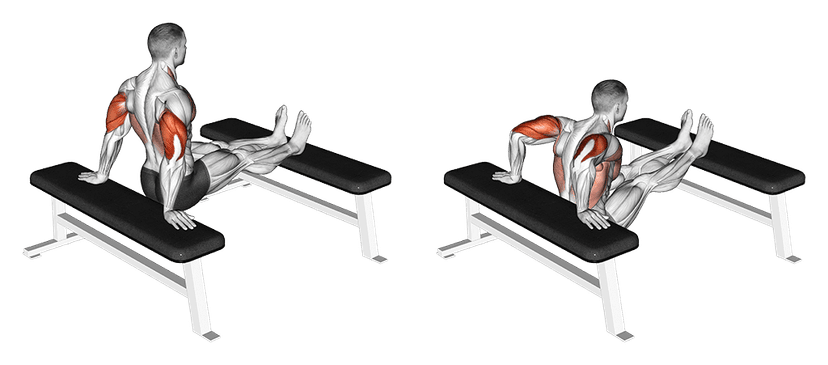
Bench Dips: Complete Guide
Bench dips are an accessible and effective triceps exercise that requires nothing more than two elevated surfaces. Unlike parallel bar dips that demand significant baseline strength, bench dips let you start immediately regardless of your level. It is a versatile exercise you can perform at home with two chairs, in a park, or at the gym.
The main advantage of bench dips is how easily you can adjust the difficulty: feet on the floor for beginners, feet elevated for intermediates, weight on the thighs for advanced lifters. This scalability makes them essential for building strong, well-defined triceps.
Muscles targeted
- Triceps (all three heads): primary mover, responsible for elbow extension
- Anterior deltoids: assist the push, heavily recruited at the bottom of the movement
- Pectoralis major (lower fibers): contributes to the ascent, especially with greater range of motion
- Trapezius and rhomboids: shoulder blade stabilization during the movement
- Rotator cuff: shoulder joint stabilization
The triceps do the vast majority of the work. If your shoulders burn before your triceps, you are likely descending too deep or your hands are too far from your body.
Proper execution
Starting position
Sit on the edge of a bench with your hands placed on each side of your hips, fingers pointing forward and gripping the edge. Slide your hips off the bench. Your legs are extended in front of you, heels resting on a second bench of equal height (or on the floor for beginners). Your arms are straight, supporting your weight. Your torso is upright, shoulders down and away from your ears.
Eccentric phase (descent)
- Bend your elbows to lower your body toward the floor.
- Your elbows travel behind you (not to the sides). They stay pointed backward.
- Lower until your arms form a 90-degree angle. Do not go deeper: this overloads the shoulders without additional triceps benefit.
- Control the descent over 2-3 seconds. No free-falling.
Concentric phase (push)
- Push firmly through your hands on the bench to drive back up.
- Exhale during the effort.
- Return to the starting position with arms straight, avoiding elbow hyperextension.
- Keep your shoulders down and torso upright throughout the ascent.
Breathing: inhale on the way down, exhale as you push.
Common mistakes
1. Descending too deep Going below 90 degrees places the shoulder in an extreme internally rotated position under load. This is the top cause of shoulder pain on this exercise. Stop the descent when your arms form a right angle.
2. Elbows flaring out Elbows drifting to the sides transfers load to the shoulders and reduces triceps work. Keep them pointed straight back throughout the movement.
3. Shoulders rising toward the ears Shrugging the shoulders compresses the rotator cuff. Keep your shoulders down by engaging the lower trapezius. Imagine pushing the bench toward the floor.
4. Back drifting away from the bench If your torso moves away from the bench during the descent, the load shifts to the shoulders. Stay close to the bench. Your hips should nearly brush the edge.
5. Bouncing at the bottom Bouncing in the bottom position reduces time under tension and increases the risk of shoulder injury. Pause briefly at the bottom before pushing back up.
Variations
Floor-feet bench dips (beginner) Instead of placing your feet on a second bench, keep them on the floor with your knees bent at 90 degrees. This significantly reduces the load and lets you focus on technique.
Weighted bench dips (intermediate to advanced) Place a weight plate, dumbbell, or loaded backpack on your thighs. Increase the weight progressively. Make sure you can first perform 15+ bodyweight reps with perfect form.
Single-leg bench dips (intermediate) Keep only one foot on the opposite bench, the other leg extended in the air. This increases the load and adds a balance challenge. Alternate legs between sets.
Parallel bar dips (advanced) The natural progression after bench dips. Your entire body is suspended, increasing the load and recruiting more chest and deltoid muscle. If you can complete 4 x 15 clean bench dips, you are ready for parallel bars.
Programming
Placement in your session: In the middle or end of a triceps or Push session. Bench dips work perfectly after heavy compound exercises (bench press, overhead press, bar dips) to finish off the triceps.
Volume and intensity:
- Beginner (feet on the floor): 3 x 10-15 reps
- Intermediate (feet elevated): 3-4 x 10-15 reps
- Advanced (weighted): 3-4 x 8-12 reps
Frequency: 2-3 times per week. Triceps recover quickly, so you can include them in multiple Push sessions without issue. Avoid doing them the day before a heavy bench press session.
Supersets: Bench dips pair very well with biceps curls. Chain dips plus curls with no rest between the two, then rest 60 seconds. Excellent for arms.
Key takeaways
- 90-degree maximum: do not descend beyond that to protect the shoulders
- Elbows backward: not to the sides, to maximize triceps work
- Shoulders down: away from the ears, lower trapezius engaged
- Close to the bench: hips brush the bench edge on every rep
- Simple progression: feet on the floor, feet elevated, weighted, parallel bars
