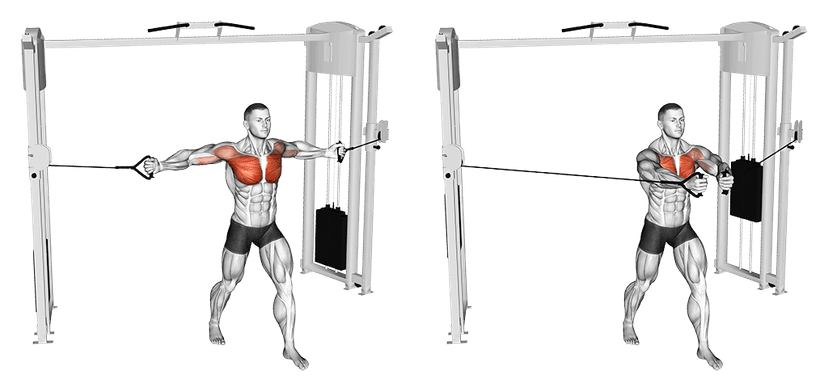
Cable Crossover (Cable Fly): Complete Guide
The cable crossover, or cable fly, is an isolation exercise for the pecs that offers a unique advantage: constant tension throughout the entire range of motion. Unlike dumbbells where resistance drops at the top, cables maintain the load from start to finish. It is one of the best exercises for achieving an intense pec contraction and a deep stretch.
Muscles targeted
- Pectoralis major (sternal head): primary mover, horizontal adduction and slight arm flexion
- Pectoralis major (clavicular head): recruited more when pulleys are set low
- Pectoralis major (abdominal head): recruited more when pulleys are set high
- Anterior deltoid: shoulder stabilization throughout the movement
- Biceps (short head): controls the slight elbow bend
- Core: trunk stabilization in the standing position
The advantage of cables is angle modulation. By changing pulley height, you can precisely target each head of the pectoralis major.
Proper execution
Setup
Set the pulleys to the high position to target the sternal head (classic version). For the upper chest, set them low. For mid-chest work, set them at shoulder height.
Starting position
Stand in the center of the cable station, one foot slightly in front of the other for stability. Grip one handle in each hand. Lean your torso slightly forward (10-15 degrees). Arms open to the sides, elbows slightly bent (15-20 degrees), shoulder blades retracted.
Concentric phase (closing)
- Contract your pecs to bring your hands together in front of you in an arc.
- Your hands meet in front of your lower chest (high pulleys) or upper chest (low pulleys).
- At the end of the movement, slightly cross your hands over each other to maximize pec contraction.
- Hold the contraction for 1-2 seconds.
Eccentric phase (opening)
Let your arms return slowly to the open position over 2-3 seconds. Control the load. Do not let the cables pull you back. Stop the opening when you feel a comfortable stretch in your pecs.
Breathing
Exhale while closing the arms (contraction). Inhale while opening (stretch).
Common mistakes
1. Too much weight, not enough control When the weight is excessive, the movement turns into a full-body pull. The arms bend excessively, the torso sways, and the pecs stop working. Reduce the weight until you can control every centimeter of the movement.
2. Arms too straight Keeping the arms completely straight places enormous stress on the biceps tendons and shoulder capsule. Always maintain a slight elbow bend (15-20 degrees).
3. Leaning too far forward A torso that is too far forward transfers the work from the pecs to the anterior deltoid and looks like a pulling movement. Keep a subtle 10-15 degree forward lean.
4. No contraction at end range Many people stop the movement as soon as their hands are in front of them. The cable fly gets its full value from the final contraction: slightly cross your hands and squeeze the pecs hard for 1-2 seconds.
5. Unstable foot position Feet together or too close together cause instability. One foot staggered in front of the other provides a stable base. Alternate the front foot between sets.
Variations
High cable fly, leaning forward (classic) Pulleys set high, torso slightly leaning forward. Targets the sternal head and lower portion of the pecs. This is the most common version in the gym.
Low cable fly (intermediate) Pulleys set low, pulling up and inward. Targets the clavicular head (upper chest). Excellent complement to the high fly for complete development.
Shoulder-height cable fly (intermediate) Pulleys at shoulder height. The movement is purely horizontal. Targets the mid-section of the pecs. Very natural range of motion that is comfortable for the shoulders.
Unilateral cable fly (advanced) One arm at a time. Allows you to correct imbalances and focus 100% on one side. The free hand rests on your hip or the machine for stability.
Programming
Placement in your session: At the end of a chest workout, after compound exercises. The cable fly is the quintessential finishing exercise.
Volume and intensity:
- Beginner: 3 x 12-15 reps, light weight, focus on contraction and technique
- Intermediate: 3-4 x 10-12 reps, maximum contraction at end range
- Advanced: 4 x 10-12 reps + supersets with bench press or push-ups
Frequency: 1-2 times per week. Fits into a Push session, a chest session, or an upper body day.
Effective combination: Alternate pulley positions between sessions. Session 1: high pulleys. Session 2: low pulleys. This ensures complete work of all pec heads over the week.
Key takeaways
- Constant tension: the main advantage of cables over dumbbells
- Cross your hands at end range to maximize pec contraction
- Elbows slightly bent: 15-20 degrees, never locked
- Vary pulley height to target different heads of the pecs
- Control the weight: if you cannot hold the contraction for 2 seconds in the closed position, it is too heavy
