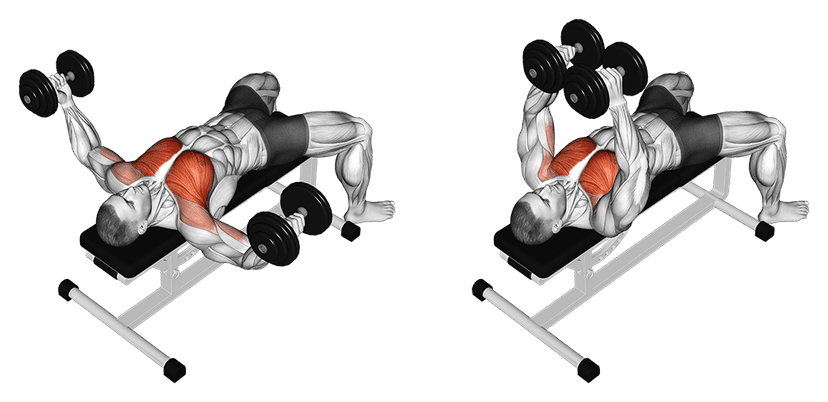
Dumbbell Chest Fly: Complete Guide
The dumbbell chest fly is the classic free weight isolation exercise for the pecs. Unlike the butterfly machine that guides the trajectory, the dumbbell fly demands total control of the movement. This instability is what makes it so effective: every stabilizing fiber in the pecs, shoulders, and core is recruited.
Muscles targeted
- Pectoralis major (sternal head): primary mover, performs horizontal adduction of the arm
- Pectoralis major (clavicular head): contributes on flat bench, more pronounced on incline
- Anterior deltoid: stabilizes the glenohumeral joint throughout the full range of motion
- Biceps (short head): controls elbow extension during the eccentric phase
- Serratus anterior and pectoralis minor: scapular stabilization
- Core (transverse abdominis, obliques): trunk stabilization on the bench
The dumbbell fly works the pecs through a greater range of motion than the bench press. That is why it generates a deep stretch and an intense muscular pump.
Proper execution
Starting position
Lie on a flat bench, feet on the floor, back in its natural arch (physiological curve, not excessive). One dumbbell in each hand, arms extended above your chest, palms facing each other. Shoulder blades squeezed together and pressed into the bench.
Eccentric phase (lowering / opening)
- Lower the dumbbells by opening your arms in an arc, elbows slightly bent (15-20 degrees).
- The elbow bend stays constant throughout the movement. Do not straighten your arms on the way down or bend them more on the way up.
- Lower until your arms are at shoulder height or slightly below. You should feel a clear stretch in the pecs.
- Control the descent for a minimum of 3 seconds.
Concentric phase (lifting / closing)
- Contract the pecs to bring the dumbbells back above your chest, as if you were hugging a tree.
- The dumbbells come close together without touching (keep 5 cm between them to maintain tension).
- Deliberately squeeze the pecs in the top position for 1 second.
Breathing
Inhale deeply while opening the arms (lowering). Exhale while closing (lifting).
Common mistakes
1. Turning the fly into a press The most common mistake. On the way down, the elbows bend more and more, and the lift back up looks like a press. Cause: weight too heavy. Fix: reduce the weight and focus on the arc trajectory. The elbows keep the same angle from start to finish.
2. Lowering too deep Dropping the dumbbells well below shoulder line places extreme stress on the shoulder capsule and ligaments. Limit the descent to shoulder height or just below.
3. Touching the dumbbells at the top When the dumbbells touch above your chest, tension on the pecs disappears completely. Keep a 5 cm gap to maintain the contraction.
4. Excessive back arch An exaggerated arch reduces range of motion and shifts some of the work to the lower pecs. Keep a natural arch with your glutes glued to the bench.
5. Jerky movement The dumbbell fly is a control exercise, not a power exercise. Any jerking or sudden acceleration increases the risk of pec tendon tear. Keep the movement fluid and controlled at all times.
Variations
Incline dumbbell fly (intermediate) Bench set to 30-45 degrees. The work shifts to the clavicular head (upper chest). Excellent if your upper chest is lagging. Note: you will use less weight than on a flat bench.
Decline dumbbell fly (intermediate) Bench set to a 15-30 degree decline. Targets the lower sternal head more. Less common but useful for complete development. The declined position makes the exercise slightly easier because the leverage is favorable.
Low cable fly on bench (intermediate to advanced) Performed on a bench placed between two low pulleys. Cable resistance maintains constant tension throughout the full range of motion, unlike dumbbells where tension drops at the top. Superior version for continuous contraction.
Resistance band fly (beginner) Bands increase resistance at the top position, where dumbbells lose effectiveness. Excellent option for beginners or as a warm-up. Very low joint stress.
Programming
Placement in your session: After compound movements (bench press, incline press). The dumbbell fly is an isolation exercise meant to finish the chest work with additional volume.
Volume and intensity:
- Beginner: 3 x 12-15 reps with light dumbbells (technique focus)
- Intermediate: 3-4 x 10-12 reps, last reps close to failure
- Advanced: 4 x 10-12 reps + slow eccentric tempo (4-5 seconds)
Frequency: 1-2 times per week. The fly fits into a Push session, a dedicated chest day, or a full body routine.
Starting weight: Begin with 6-10 kg dumbbells to master the trajectory. The fly is an exercise about feel, not performance. The weight will increase naturally once your technique is solid.
Key takeaways
- Constant elbow angle: 15-20 degrees of bend from start to finish
- Arc trajectory: think "hugging a tree," not "pushing a weight"
- Controlled range of motion: lower to shoulder height, not deeper
- Do not touch the dumbbells at the top: keep a 5 cm gap to maintain tension
- Moderate weight: if you need to bend your elbows more to lift, it is too heavy
