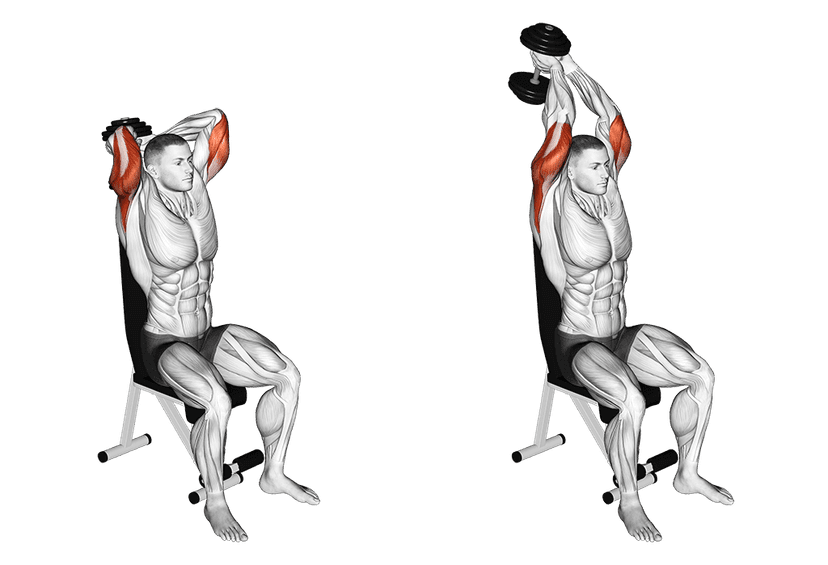
Dumbbell Triceps Extension: Complete Guide
The dumbbell triceps extension (or overhead triceps extension) is a formidable isolation exercise for the triceps. By placing the arms overhead, you stretch the long head of the triceps to its maximum, which stimulates muscle growth more than movements where the arm stays by the side. It is the go-to exercise for building thick arms when viewed from the side.
Whether you use a single dumbbell held with both hands or one dumbbell per hand, this movement targets the most visible and voluminous part of the triceps: the long head. If you could only do one isolation exercise for the triceps, this should be your pick.
Muscles targeted
- Triceps (long head): primary target, maximally stretched in the overhead position
- Triceps (lateral head): significant contribution to elbow extension
- Triceps (medial head): stabilizer and finisher at the end of the extension
- Deltoids (stabilization): keep the arms in the vertical position
- Abdominals and lower back: stabilize the trunk to prevent excessive arching
The long head is the only triceps head that attaches to the scapula (not just the humerus). By raising the arms, you fully stretch it, increasing mechanical tension and the hypertrophy stimulus.
Proper execution
Starting position (two-hand version, single dumbbell)
Sit on a bench with a backrest (or stand with feet hip-width apart). Grip a dumbbell with both hands, forming a triangle around the handle. Lift the dumbbell overhead with arms fully extended. Your elbows face forward, close to your head. Your torso is upright, abs engaged, no excessive lower back arch.
Eccentric phase (descent)
- Bend your elbows to lower the dumbbell behind your head.
- Your elbows stay fixed, pointing at the ceiling. Only the forearms move.
- Lower until your forearms are below parallel. You should feel a stretch in the long head of the triceps.
- Control the descent over 2-3 seconds. The dumbbell should not fall.
Concentric phase (extension)
- Push the dumbbell upward by contracting the triceps.
- Exhale during the extension.
- Rise to full elbow extension without hyperextending.
- Do not let your elbows drift forward during the ascent. They stay fixed.
Breathing: inhale on the way down, exhale on the way up.
Common mistakes
1. Elbows flaring out Elbows drifting outward reduces tension on the long head and overloads the shoulders. Keep them pointed at the ceiling, close to your head. If you cannot manage this, the dumbbell is too heavy.
2. Excessive lower back arching Arching the back to compensate for a heavy dumbbell compresses the spinal discs. Engage your abs and use a bench with a backrest. If the problem persists, reduce the load.
3. Upper arm movement The most common error: the entire arms move instead of just the forearms. The humerus (upper arm) must remain vertical and fixed. If your elbows travel forward and backward, you are recruiting the shoulders instead of the triceps.
4. Insufficient range of motion Lowering only a few centimeters is not enough to stretch the long head. Lower until your forearms are below parallel. This stretched zone is where the long head works the most.
5. Too much weight The overhead extension is an isolation exercise. You do not need to load it like a bench press. A moderate load with perfect technique will deliver better results than a heavy load with degraded form.
Variations
Single-arm extension (intermediate) Use one dumbbell in one hand. This corrects imbalances between arms and allows a greater range of motion. Place your free hand on the working elbow to stabilize it if needed.
Lying extension (dumbbell skull crushers) Lying on a bench with arms extended above the chest, you bend the elbows to lower the dumbbells toward the temples. The angle changes the resistance profile and targets the lateral head more. Excellent as a complement to the overhead version.
Cable overhead extension (intermediate) Same movement pattern but with a cable. The tension is constant throughout the range of motion (no dead zone at the top). Ideal for high-rep sets and finishing work.
EZ-bar overhead extension (intermediate) Same movement as the dumbbell version, but with an EZ curl bar. The angled grip is more comfortable on the wrists and allows slightly heavier loading.
Programming
Placement in your session: In the middle or end of a Push or arms session. Start with compound exercises (bench press, dips, overhead press), then finish with triceps extensions as isolation work.
Volume and intensity:
- Beginner: 3 x 10-12 reps, light load, technique focus
- Intermediate: 3-4 x 8-12 reps, moderate load
- Advanced: 4 x 8-15 reps, intensity techniques (drop sets, rest-pause)
Frequency: 1-2 times per week for isolation. Your triceps already work during compound pressing exercises. Adding 2-3 isolation sets 1-2 times per week is enough to stimulate long head growth.
Weight selection: Start with a dumbbell you can control for 12 clean reps. If you cannot lower your forearms below parallel, the dumbbell is too heavy. Technique always trumps load.
Key takeaways
- Elbows fixed toward the ceiling: only the forearms move
- Full stretch: lower the forearms below parallel
- No arching: abs engaged, use a bench with a backrest if needed
- Moderate load: this is an isolation exercise, technique comes first
- Long head targeting: the overhead position is irreplaceable for this portion of the triceps
