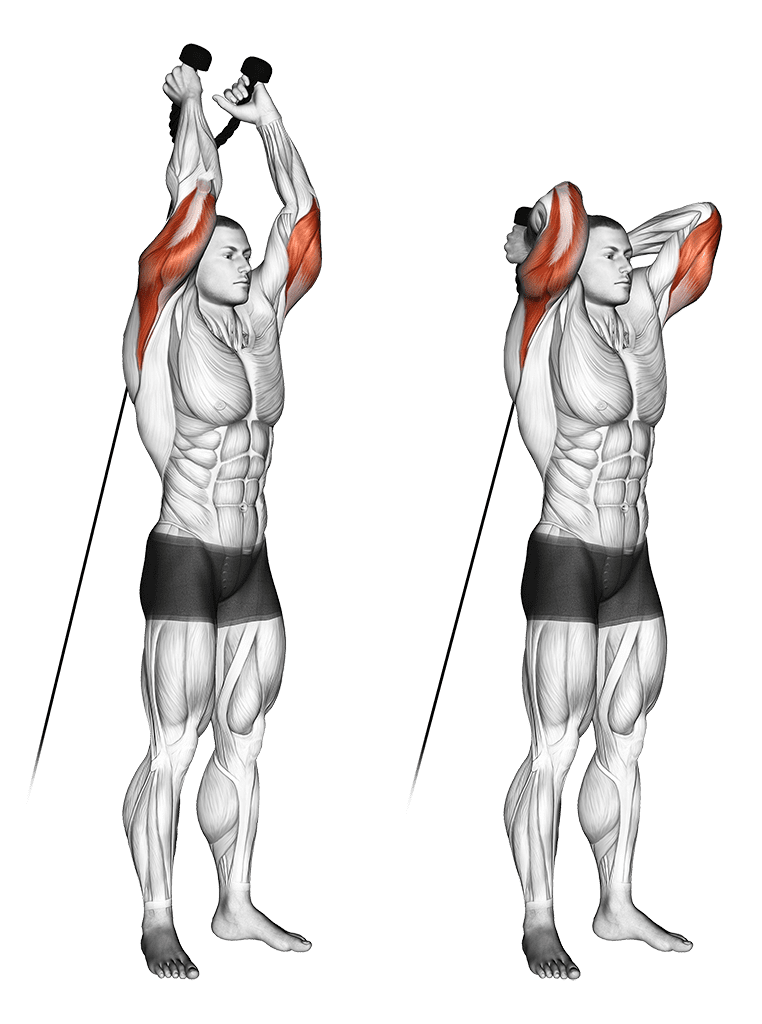
Cable Overhead Triceps Extension: Complete Guide
The cable overhead triceps extension from a low pulley is a powerful isolation exercise for the long head of the triceps. Unlike a high pulley pushdown where the triceps works in a shortened position, the low pulley places your arm overhead and fully stretches the muscle at the bottom. This loaded stretch is a potent signal for hypertrophy. If you want thicker arms when viewed from the side, this exercise deserves a permanent spot in your routine.
The concept is straightforward: stand with your back to the low pulley, grab a rope or bar attachment, arms overhead, and extend your forearms. Gravity and the cable maintain constant tension through the full range of motion, making it superior to dumbbell overhead extensions in terms of resistance curve.
Muscles targeted
- Triceps (long head): primary mover, deeply stretched at the bottom thanks to shoulder flexion
- Triceps (lateral head): contributes to elbow extension
- Triceps (medial head): deep elbow stabilizer, active throughout the range
- Anconeus: small elbow extension muscle active at lockout
- Core stabilizers: abs and lower back keep the torso steady under load
The long head is the only triceps head that crosses the shoulder joint (bi-articular). The overhead position places it at maximal stretch, recruiting more fibers than standard pushdowns.
Proper execution
Starting position
Attach a rope or EZ bar to the low pulley. Grab the attachment, turn your back to the machine, and take one or two steps forward. Adopt a split stance (one foot ahead) for stability. Lean your torso slightly forward, roughly 30 to 45 degrees. Arms are overhead, elbows pointed toward the ceiling, forearms folded behind your head.
Concentric phase (extension)
- Extend your arms by pushing your hands toward the ceiling and forward.
- Keep your elbows fixed, pointed upward. Only the forearms move.
- Squeeze the triceps hard at the top.
- Exhale during the extension.
Eccentric phase (return)
- Let your forearms fold back behind your head slowly.
- Lower until you feel a deep stretch in the triceps, without forcing the shoulder.
- Control the load over 2 to 3 seconds on the way down.
- Inhale during the descent.
Breathing: exhale as you extend, inhale as you bend.
Common mistakes
1. Elbows flaring out If your elbows drift to the sides, the load shifts to the shoulders and you lose triceps isolation. Keep your elbows tight, pointed at the ceiling. Imagine they are locked in cement.
2. Torso swinging Rocking your body to move the weight turns this into a shoulder exercise. Your torso must stay still. If you have to cheat, the weight is too heavy. Lower it and focus on the contraction.
3. Incomplete range of motion Not going low enough robs the triceps of its maximum stretch, where hypertrophy stimulus is greatest. Lower until your forearms nearly touch your biceps, as long as your shoulder allows it.
4. Too much weight This exercise is not designed for heavy loads. It is an isolation movement that relies on tension and control. Use a weight that allows 10-15 clean reps with a full stretch at the bottom.
Variations
Single-arm low pulley extension (intermediate) Working one arm at a time corrects imbalances and increases mind-muscle connection. Use a single handle and keep the elbow locked in place.
EZ bar low pulley extension (beginner) The EZ bar provides a more stable grip than the rope and reduces wrist stress. A solid option for learning the movement path.
Rope extension facing the high pulley, torso leaned (intermediate) Same movement pattern but standing face to the high pulley, leaned at 45 degrees. The angle replicates the long head stretch. A good alternative when the low pulley is taken.
Lying low pulley triceps extension (advanced) Lying on a bench placed in front of the low pulley, you replicate a skull crusher with constant tension. The stretch is maximal and the bench stability lets you focus entirely on the triceps.
Programming
Placement in your session: Last or second-to-last exercise of your arm or Push session. Low pulley extensions are an isolation finisher, not a strength exercise.
Volume and intensity:
- Beginner: 3 x 12-15 reps, light load, focus on the stretch
- Intermediate: 3-4 x 10-12 reps, tempo 2-0-1-1
- Advanced: 4 x 10-12 plus a drop set on the last set
Frequency: 1-2 times per week. Combine with a shortened-position triceps exercise (pushdown, dips) to work the full force curve.
Progression: Increase the weight by 1-2 kg when you can complete 4 x 12 with perfect form. The goal is not max load but the quality of the stretch and contraction.
Key takeaways
- Fixed elbows: only the forearms move, elbows stay pointed up
- Full stretch: go as deep as possible to exploit the long head
- Moderate load: prioritize tension and control over heavy weight
- Stable torso: no swinging, split stance for balance
- Complementarity: pair with a shortened-position exercise for complete development
