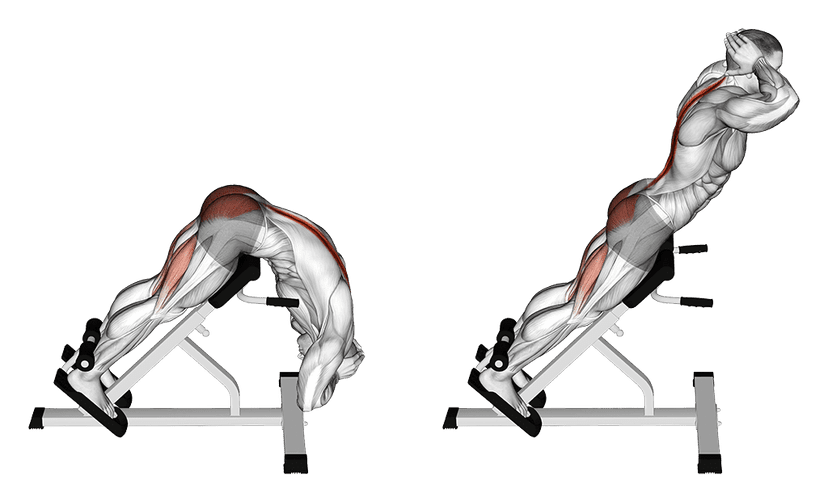
Back Extension / Hyperextension: Complete Guide
Back extensions on the hyperextension bench are a fundamental exercise for the posterior chain. Despite its name, this exercise goes far beyond the lower back: it recruits the glutes, hamstrings, and spinal erectors in a hip movement that strengthens the entire back side of your body. It is an underrated exercise that deserves more attention, especially if you spend hours sitting or want to improve your deadlift.
Many lifters neglect direct lower posterior chain work, assuming squats and deadlifts are enough. However, back extensions specifically target the spinal erectors at angles those compound lifts do not cover. They also build the ability to maintain a neutral spine under load, which reduces the risk of lower back injury.
Muscles targeted
- Spinal erectors (iliocostalis, longissimus, spinalis): primary movers, responsible for spinal extension
- Gluteus maximus: hip extension, especially active in the second half of the movement
- Hamstrings (biceps femoris, semitendinosus, semimembranosus): hip extension in synergy with the glutes
- Quadratus lumborum: lateral spinal stabilization
- Multifidus: deep spinal stabilizers, essential for back health
The workload distribution depends on technique. A hip hinge movement (neutral spine) targets the glutes and hamstrings more. A spinal flexion-extension movement targets the erectors more.
Proper execution
Starting position
Adjust the bench so the upper pad sits at hip level (iliac crests). Your hips must be free to pivot. Lock your ankles under the roller pads. Your body forms a straight line from ankles to head. Arms crossed over your chest or hands behind your ears (not behind your neck, to avoid pulling on the cervical spine).
Eccentric phase (descent)
- Lean your torso forward by hinging at the hips, not the spine.
- Keep a neutral back (not rounded, not hyperextended) throughout the descent.
- Lower to roughly 60-90 degrees of hip flexion. You should feel a stretch in your hamstrings.
- Inhale during the descent.
Concentric phase (ascent)
- Rise by contracting your glutes and spinal erectors.
- Push your hips into the pad to initiate the movement.
- Rise until your body is aligned in a straight line (not beyond, to protect the lower back).
- Squeeze the glutes hard at the top. Hold for one second.
- Exhale during the ascent.
Breathing: inhale on the way down, exhale on the way up.
Common mistakes
1. Hyperextending the back at the top Rising beyond body alignment compresses the lumbar discs. Stop the movement when your body forms a straight line. This is a hip extension, not a spinal extension.
2. Rounding the back on the way down A rounded back increases pressure on the intervertebral discs. Keep the spine neutral by bracing your abs and pulling your shoulders back. Imagine a stick running along your spine.
3. Moving too fast Free-falling down and swinging back up removes muscular tension and increases injury risk. Control each phase over 2-3 seconds.
4. Incorrect pad height If the pad is too high (stomach level), range of motion is limited and the lower back is overloaded. If it is too low (thigh level), the movement loses its effectiveness. The correct setup places the upper edge of the pad at iliac crest level.
5. Pulling on the neck Placing hands behind the neck and pulling to get back up is dangerous for the cervical vertebrae. Cross your arms over your chest or place hands behind your ears without applying pressure.
Variations
45-degree back extension (beginner) The 45-degree inclined bench reduces resistance at the bottom compared to the horizontal bench. Ideal for beginners or during rehabilitation. The technique remains the same.
Weighted back extension (intermediate to advanced) Hold a plate or dumbbell against your chest to add resistance. Start with 5 kg and progress slowly. Maintain perfect technique before adding weight.
Back extension with rotation (intermediate) At the top of the movement, rotate your torso slightly to one side then the other. This recruits the obliques and quadratus lumborum. Perform without weight at first.
Reverse hyper (advanced) Your torso is fixed on the bench and your legs rise behind you. This exercise targets the glutes and hamstrings with less lumbar compression. Requires a dedicated machine or an elevated flat bench.
Programming
Placement in your session: Mid or late in your leg, back, or full body session. Back extensions are an excellent complement after squats or deadlifts.
Volume and intensity:
- Beginner: 3 x 12-15 reps at bodyweight, focus on neutral spine
- Intermediate: 3-4 x 10-12 reps with load (5-15 kg)
- Advanced: 4 x 8-12 reps with load (15-25 kg) or slow tempo (4 seconds eccentric)
Frequency: 2-3 times per week. The spinal erectors recover quickly and benefit from frequent, moderate-volume work.
Progression: First master 3 x 15 at bodyweight with a slow tempo. Then add load progressively in 2.5-5 kg increments.
Key takeaways
- Neutral spine: no rounding or hyperextension, keep your back straight throughout
- Hip hinge: the movement comes from the hips, not the spine
- Glute squeeze: squeeze hard at the top to maximize recruitment
- Pad setup: upper edge at iliac crest level
- Progression: master bodyweight before adding load
