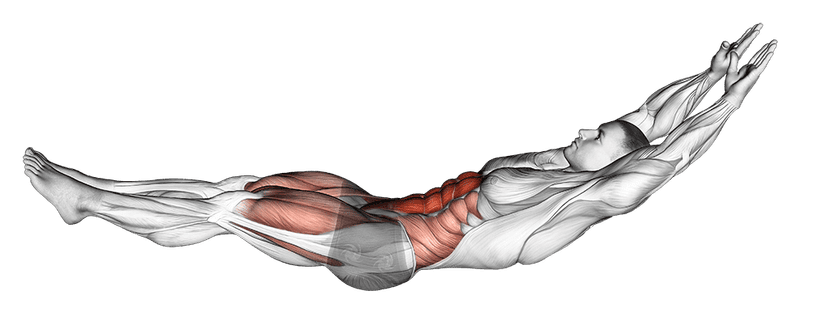
Hollow Body Crunch: Complete Guide
The hollow body crunch combines two demanding exercises into a single movement: the hollow body hold (a gymnastic bracing position) and the crunch. The result is an abdominal exercise that simultaneously works isometric stabilization and dynamic trunk flexion. Borrowed from gymnastics, it has taken over the fitness and CrossFit world for its raw effectiveness.
Unlike the classic crunch where the lower body stays still, the hollow body crunch requires you to maintain a position of total tension: legs straight and off the floor, arms overhead, lower back pressed into the ground. This dual demand is what makes the exercise so challenging and so rewarding.
Targeted Muscles
- Rectus abdominis: primary mover, engaged along its full length (flexion + stabilization)
- Transverse abdominis: deep stabilizer, 100% engaged to maintain the hollow position
- Internal and external obliques: anti-extension and anti-rotation stabilization
- Hip flexors (psoas, rectus femoris): keep the legs suspended
- Quadriceps: knee extension to keep legs straight
- Serratus anterior: stabilizes the shoulder blades when arms are overhead
The hollow body crunch is one of the rare abdominal exercises that recruits the rectus abdominis along its entire length by combining upper flexion (crunch) and lower stabilization (suspended legs).
Proper Execution
Starting position (hollow body)
Lie on your back. Contract your abs to press your lower back into the floor (posterior pelvic tilt). Raise your straight legs about 15-30 cm off the ground. Extend your arms overhead, biceps near your ears. Head is slightly raised, chin tucked. Your body should form a hollow arc: from hands to feet, everything is under tension. This is the hollow position.
Crunch phase
- From the hollow position, contract your abs to curl the upper trunk toward the legs.
- Simultaneously, bring the knees toward the chest (arms stay extended or reach to touch the shins).
- The body folds in on itself: this is the crunch position.
- Exhale during the contraction.
- Hold for one second at maximum contraction.
Return to hollow position
- Extend the legs and arms back to the hollow position.
- Inhale during the extension.
- NEVER release tension: the lower back stays pressed to the floor, limbs do not touch the ground.
- Recommended tempo: 2 seconds for the crunch, 1-second hold, 2 seconds to return to hollow.
The trap: every rep starts AND ends in hollow position. If you rest your feet or shoulders on the floor between reps, you lose the essence of the exercise.
Common Mistakes
1. Losing the hollow position between reps This is the fundamental error. If your feet or arms touch the floor between reps, you eliminate the isometric component that makes this exercise unique. Maintain tension from the first rep to the last.
2. Lower back lifting off the floor A sign that your abs are not strong enough to maintain posterior pelvic tilt with straight legs. Fix: bend the knees slightly or raise the legs higher until you have the strength to go lower.
3. Arm movement without trunk flexion Waving the arms toward the knees without curling the trunk. The arms follow the trunk movement, they do not replace it. Focus on bringing the ribs toward the pelvis.
4. Disordered breathing The hollow body crunch is demanding. Many people hold their breath. Exhale during the crunch, inhale during the return to hollow. Pace every rep with your breathing.
5. Insufficient range of motion Micro-crunches in hollow position are not worth much. Curl the trunk enough to lift the shoulder blades off the floor and bring the knees toward the chest to maximize contraction.
Variations
Hollow body hold (beginner) Simply hold the hollow position without the crunch phase. Excellent for building baseline isometric strength before adding flexion. Aim for 3 sets of 20-30 seconds.
Straight-leg hollow body crunch (advanced) Instead of bringing the knees in, keep legs straight and raise them to 90 degrees during the crunch. Arms reach to touch the toes. Maximum lever arm, maximum difficulty.
Weighted hollow body crunch (advanced) Hold a medicine ball (2-4 kg) in your hands during the movement. The extra weight increases the load on the abs in both the hollow and crunch phases.
Hollow body rock (intermediate) Hold the hollow position and rock back and forth like a cradle. The entire body stays rigid. Works core endurance and coordination. Add crunches between rocks for an advanced combo.
Program Integration
The hollow body crunch is demanding. Place it at the start of an ab session when you are fresh, or use it as the main exercise in your core circuit.
- Beginner (start with hollow hold): 3 sets of 20-30 second holds, 60 seconds rest
- Intermediate: 3-4 sets of 8-12 reps, 45-60 seconds rest
- Advanced: 4-5 sets of 12-15 reps (straight legs or weighted), 30-45 seconds rest
It works very well in a superset with a back extension exercise (superman hold) to balance trunk flexion and extension work.
Gymnasts use the hollow body as the foundation of nearly all their movements. If you integrate this exercise regularly, you will notice improved stability on squats, presses, and Olympic lifts.
Key Takeaways
- The hollow position is maintained from start to finish of every set
- Lower back pressed into the floor at all times
- Each rep combines isometric stabilization and dynamic flexion
- Progression: hollow hold, then knee crunch, then straight legs, then weighted
- Breathing synchronized with movement
