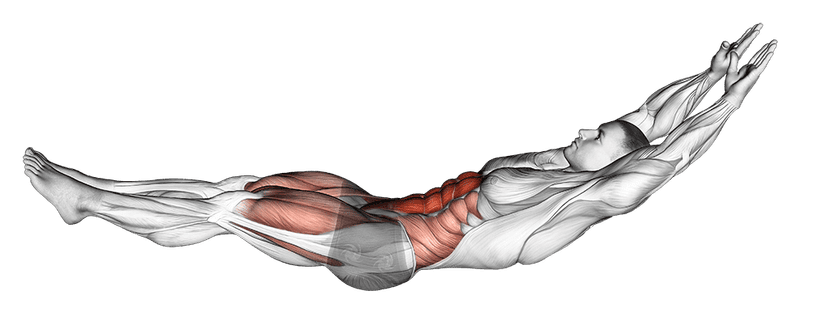
Hollow Hold: Complete Guide
The hollow hold is the foundational core position in gymnastics. Used by gymnasts for decades, this exercise creates total tension across the abdominal wall that transfers to nearly every strength movement. If crunches and sit-ups are the ab exercises of the past, the hollow hold is part of the future of core training.
Targeted Muscles
- Rectus abdominis: isometric hold in trunk flexion, working across its full length
- Transverse abdominis: deep abdominal compression, creates the characteristic "hollow" shape
- Internal and external obliques: lateral trunk stabilization
- Hip flexors (psoas, rectus femoris): holding the legs in suspension
- Quadriceps: locking the knees in extension
- Serratus anterior: scapular protraction when arms are extended
- Deep neck flexors: holding the head in neutral position off the floor
The hollow hold recruits the abdominals across their full length, from pubis to sternum. Unlike the crunch that only works the upper portion, the hollow hold demands a complete and sustained contraction.
Proper Execution
Setup
Lie on your back, arms at your sides. Press your lower back into the floor by performing a posterior pelvic tilt (pubic bone rises toward the ceiling, lumbar spine flattens into the floor). This is the key to the entire exercise.
Building the Position
- Brace your abdominals to keep the lower back glued to the floor.
- Lift your shoulders and head a few centimeters off the floor. Look toward your feet, not the ceiling.
- Lift your legs off the floor, knees straight, feet together, toes pointed (or flexed based on preference).
- Extend your arms overhead (biceps near ears) for the full version.
- Your body forms an inverted "C" curve: shoulders and legs in the air, lower back flat.
Breathing
Breathe normally but shallowly. Exhaling helps maintain transverse engagement. Do not hold your breath.
Duration
Hold the position as long as you can maintain perfect form. As soon as your lower back lifts off the floor, the set is over.
Common Mistakes
1. Lower back lifting off the floor Critical error. If your lumbar spine arches, you overload your spine and your abs stop working. Main cause: legs or arms are too low for your strength level. Solution: raise the legs higher or slightly bend the knees.
2. Holding your breath Breath-holding allows you to hold longer but does not develop true core strength. Learn to breathe in the position, even if it is difficult at first. This ability is what transfers to other exercises.
3. Head in hyperextension Letting the head fall back destroys alignment and disconnects the anterior chain. Keep the chin slightly tucked, eyes directed toward your feet.
4. Legs too low too soon The closer the legs are to the floor, the longer the lever and the harder the exercise. Many beginners try to place their legs 15 cm from the floor when they cannot even control the position at 45 degrees. Start high and lower gradually.
5. Shoulders shrugged toward the ears Shoulders should be pulled down with scapulae in slight protraction. Shrugging creates unnecessary tension in the traps.
Variations
Tuck hollow hold (beginner) Same position but knees bent toward the chest instead of straight legs. Arms can stay at your sides. This dramatically reduces the lever arm and allows you to learn the lumbar press.
Hollow hold with arms at sides (beginner to intermediate) Straight legs but arms along the thighs instead of overhead. The upper lever is reduced. Ideal intermediate step.
Full hollow hold (intermediate) The version described above, arms overhead and legs straight. The goal is to hold for 30 to 60 seconds with impeccable form.
Hollow rock (advanced) Same position as the hollow hold, but you rock back and forth like a rocking chair. The movement must be initiated by the abs and the body must remain perfectly rigid. If form breaks during the rocking, return to the static hollow hold.
Programming
Placement in the session: As a warm-up (15-20 seconds to activate the core) or at the end (longer holds). Gymnasts also use it between exercises as a postural "reset."
Volume and intensity:
- Beginner: 3 x 15-20 seconds (tuck hollow)
- Intermediate: 3 x 30-45 seconds (full version)
- Advanced: 4 x 45-60 seconds or transition to hollow rock 3 x 15-20 reps
Frequency: Daily if you want. The hollow hold is a low-impact isometric exercise that can be practiced every day without overtraining risk.
Recommended combination: Hollow hold + superman hold (posterior chain) + side plank. This trio covers bracing on all three sides of the trunk.
Key Takeaways
- Lower back stays glued to the floor: this is the absolute quality criterion
- Build the position progressively: tuck, arms at sides, then full version
- Breathe in the position instead of holding your breath
- Duration with perfect form beats total duration
- Direct transfer to pull-ups, dips, and all gymnastics movements
