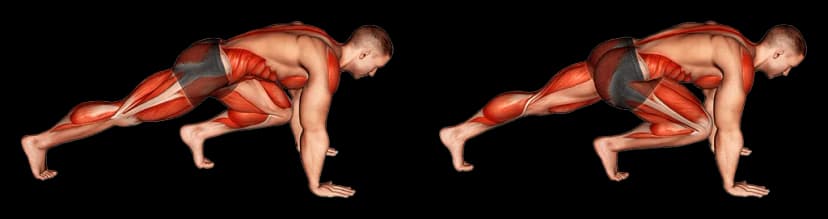
Mountain Climber: Complete Guide
The mountain climber is a bodyweight exercise that combines core bracing, cardio, and lower body work in a single movement. From a high plank position, you alternately drive your knees toward your chest, simulating running in place. Easy to understand, hard to sustain, it is a staple of circuit training and dynamic warm-ups.
What makes the mountain climber so effective is that it works the entire body simultaneously. The shoulders, arms, and core stabilize while the legs move. Heart rate climbs quickly, making it an ideal tool for burning calories while strengthening the abdominal wall.
Muscles targeted
- Rectus abdominis and transverse abdominis: trunk stabilization in anti-extension
- Obliques: anti-rotation stabilization with every leg switch
- Hip flexors (iliopsoas): drive the knee toward the chest
- Quadriceps: knee extension on the back leg, controlled flexion on the front
- Deltoids and triceps: maintain the high plank position
- Pectoralis major: shoulder stabilization in a closed chain
The core handles the bulk of the static work. The hip flexors drive the dynamic movement. The shoulders and arms support bodyweight throughout the exercise.
Proper execution
Starting position
Get into a high plank: hands under your shoulders, arms straight, body aligned from head to heels. Feet at hip width. Gaze at the floor about 30 cm ahead of your hands. Pelvis in neutral, neither too high nor too low.
The movement
- Drive one knee toward your chest, keeping the foot off the floor.
- Return that leg while driving the other knee forward.
- Alternate legs rapidly in a smooth, continuous motion.
- Hips stay at shoulder height, not bouncing up and down.
- Hands stay fixed on the floor, shoulders directly above the wrists.
Breathing: Breathe steadily and continuously. Avoid holding your breath. A natural rhythm develops: inhale on one leg, exhale on the other, or breathe freely without overthinking it.
Common mistakes
1. Hips rising too high
Glutes pushing up into a pyramid turns the exercise into a hamstring stretch. Your body should stay in a straight line from head to heels. If your hips rise, slow down the pace or take breaks.
2. Hips sagging
The opposite: pelvis dropping toward the floor signals a core that is giving out. This position overloads the lower back. Brace your abs as if someone were about to punch your stomach. If you can no longer hold it, end the set.
3. Hips bouncing
Hips rising and falling with each leg switch means you are using momentum instead of control. The hips should stay stable. Only the legs move.
4. Hands too far forward
Placing hands ahead of the shoulders overloads the wrists and shoulders. Wrists should sit directly under the shoulders. Check your position regularly during the exercise.
5. Insufficient range of motion
Driving the knees only halfway reduces effectiveness. Aim for the knee to reach chest or elbow level with each rep. If you cannot manage that at high speed, slow down the tempo.
Variations
Slow mountain climber (beginner)
Perform the movement slowly, one leg at a time, with a one-second pause between switches. This version builds core control and teaches the movement pattern without the intense cardio component. Ideal for beginners or rehabilitation.
Cross-body mountain climber (intermediate)
Instead of driving the right knee toward the chest, aim it toward the left elbow, and vice versa. This variation increases oblique work and adds a controlled rotation component. Excellent for the entire abdominal wall.
Slider mountain climber (intermediate)
Place gliding discs (or towels on a smooth floor) under your feet. The feet slide instead of lifting, which increases core work and reduces joint impact. A smoother, more continuous version of the movement.
Spider mountain climber (advanced)
Drive the knee toward the elbow on the same side, outside the arm. This variation opens the hips and targets the obliques, hip flexors, and adductors. It requires good hip mobility.
Programming
Placement in your session: As a dynamic warm-up (30-45 seconds at moderate pace). In a circuit or HIIT session. As a finisher to exhaust the core and spike heart rate.
Volume and intensity:
- Beginner: 3 x 20 seconds, 40 seconds rest, moderate pace
- Intermediate: 4 x 30 seconds, 30 seconds rest, sustained pace
- Advanced: 5 x 45 seconds, 15-20 seconds rest, maximum pace
Frequency: 2-5 times per week. The bodyweight mountain climber is low-impact and can be performed frequently. It fits easily into any session as a warm-up or finisher.
In a circuit: The mountain climber pairs well with burpees, jump squats, push-ups, and jumping jacks. Place it mid-circuit: it raises heart rate without exhausting a specific muscle group.
Key takeaways
- Solid plank: stable hips, neither too high nor too low
- Hands under shoulders: wrists aligned to avoid overload
- Knees to chest: full range of motion every rep
- Continuous breathing: never hold your breath, breathe naturally
- Appropriate speed: slow down if technique breaks down
