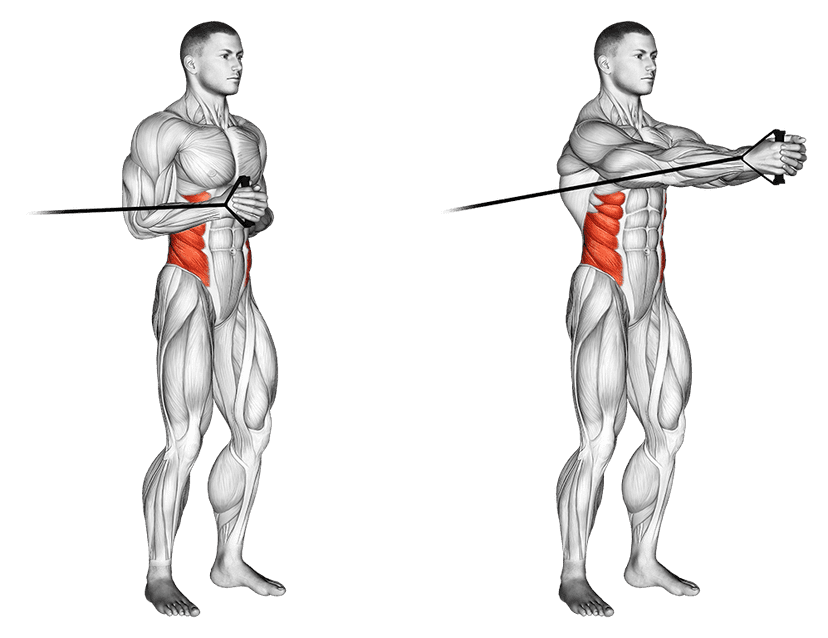
Pallof Press: Complete Guide
The Pallof press is an anti-rotation exercise that strengthens your core's ability to resist twisting forces. Named after physiotherapist John Pallof, it is performed with a cable machine or a resistance band. Unlike traditional ab exercises that produce movement (flexion, rotation), the Pallof press requires you to resist movement. This "anti" logic is what makes it so valuable for trunk stability and injury prevention.
If you play sports (any sport), the Pallof press belongs in your program. Most athletic movements involve rotational forces that your trunk must control. A core that is strong in anti-rotation is what makes you stable and powerful when transferring force between your upper and lower body.
Muscles targeted
- External and internal obliques: primary anti-rotation muscles, resist lateral pulling force
- Transversus abdominis: deep bracing to lock the trunk
- Rectus abdominis: co-contraction to maintain trunk rigidity
- Quadratus lumborum: lateral stabilizer
- Erector spinae: maintains neutral spinal posture
- Shoulder stabilizers: control arm position against the pulling force
The Pallof press is unique because it recruits the abs in their primary function: stabilization. Your abs are not primarily designed to flex the trunk (crunch). They are designed to prevent the trunk from moving when an external force tries to displace it. The Pallof press trains exactly this skill.
Proper execution
Starting position
Set the cable pulley at chest height. Grab the handle (or band) with both hands, fingers interlaced. Step 2-3 paces back to create tension. Stand with feet shoulder-width apart or slightly wider. Knees slightly bent. Hold the handle against your chest, elbows bent. The cable pulls laterally: your body wants to rotate, but you resist.
Concentric phase (arm extension)
- Push the handle straight out in front of you, fully extending your arms. Arms at chest height.
- As soon as your arms are extended, the lever arm increases and the rotational force on your trunk surges. This is where the real work begins.
- Keep your hips and shoulders perfectly square. Zero trunk rotation.
- Hold the arms-extended position for 1-3 seconds.
Eccentric phase (return)
- Bring the handle back to your chest under control.
- Tension decreases but do not release your brace.
- Exhale during the extension, inhale during the return.
Repetitions: Complete all reps on one side (cable from the left), then turn 180 degrees and work the other side.
Common mistakes
1. Trunk rotation during extension If your shoulders or hips rotate toward the pulley when you extend your arms, the weight is too heavy. Lower the load until you can maintain perfect alignment. The goal is not to lift heavy: it is to resist without moving.
2. Arms too high or too low Your arms should stay at chest height, in line with the pulley. Pushing too high loses the lateral pulling angle. Too low, and you compensate with the shoulders.
3. Stance too narrow A narrow stance reduces your base of support and makes anti-rotation much harder (not necessarily a problem if intentional, but while learning, widen your base). Shoulder width minimum.
4. Insufficient bracing If you do not actively engage your abs before extending your arms, your body will compensate through pelvic rotation or hip shift. Contract the transversus and obliques before each extension.
5. Moving too fast The Pallof press is a control exercise, not a speed exercise. Each extension should take 2 seconds, the hold 1-3 seconds, the return 2 seconds. Fast reps eliminate the anti-rotation component.
Variations
Kneeling Pallof press (intermediate) Kneeling on the floor, same movement. The narrower, lower base of support increases anti-rotation difficulty. Excellent for progressing once the standing version becomes easy.
Split-stance Pallof press (intermediate) One foot forward, one foot back (lunge position). This asymmetrical base adds an extra stability challenge. Perform both sides with each leg forward.
Pallof press with rotation (advanced) Instead of simply resisting, add a controlled trunk rotation toward the pulley, then return to neutral. Combines anti-rotation work with active rotation. Reserved for advanced trainees with excellent trunk control.
Pallof press with resistance band (beginner) Replace the cable with a band attached to a fixed point. The progressive resistance of the band (stronger when stretched) provides different feedback. Perfect for home training.
Programming
Placement in your session: At the end with the rest of your core work. Or as a warm-up with light load to activate bracing before compound movements. The Pallof press fits well before squats or deadlifts.
Volume and intensity:
- Beginner: 3 x 8-10 reps per side, light load, focus on control
- Intermediate: 3-4 x 10-12 reps per side or 3 x 20-30 second isometric holds (arms extended)
- Advanced: 4 x 12-15 reps per side in split stance or kneeling
Frequency: 2-3 times per week. The Pallof press perfectly complements front planks and back extensions (superman). Together, they cover all three planes of trunk stabilization.
Progression: Increase reps and hold time with arms extended before increasing load. Control quality always takes priority over weight.
Key takeaways
- Anti-rotation: the goal is to resist movement, not produce it
- Perfect alignment: hips and shoulders stay square throughout the extension
- Moderate load: choose a weight that allows zero compensation
- Slow tempo: 2 seconds extension, 1-3 second hold, 2 seconds return
- Bilateral: work both sides with equal volume and load
