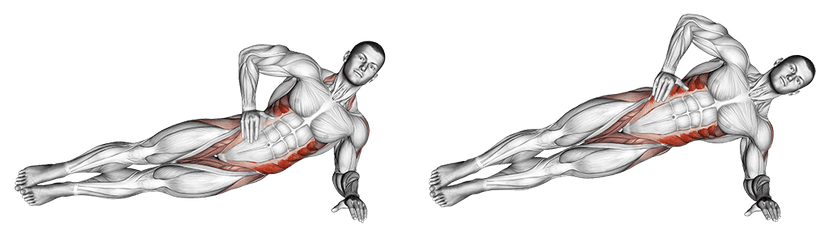
Side Plank: Complete Guide
The side plank is the reference exercise for lateral trunk bracing. While the standard plank works the anterior side, the side plank targets the obliques and quadratus lumborum, two often neglected muscles that are essential for pelvic stability and lower back injury prevention. If you squat, deadlift, or play any sport, the side plank should be part of your routine.
Targeted Muscles
- External oblique (lower side): primary mover, keeps the hips elevated
- Internal oblique (lower side): works in synergy with the external oblique for lateral bracing
- Quadratus lumborum (lower side): deep lateral stabilizer of the lumbar spine
- Gluteus medius (upper side): pelvic stabilization, prevents hip drop
- Rectus abdominis: anti-flexion stabilization, prevents the trunk from folding forward
- Transverse abdominis: deep abdominal compression
- Deltoid (lower side): supports body weight on the base arm
- Adductors: support leg stabilization
The side plank is the only core exercise that primarily targets the quadratus lumborum, a key muscle in lower back pain prevention. This is why physical therapists prescribe it so often.
Proper Execution
Starting Position
Lie on your side, forearm on the floor perpendicular to your body, elbow directly under the shoulder. Legs straight, feet stacked (or top foot in front for more stability). Body aligned from head to feet.
Getting Into Position
- Brace your abdominals and glutes.
- Lift your hips off the floor by pushing through your forearm and the side of your lower foot.
- Raise your hips until your body forms a straight line: no hips sagging down, no hips hiking up.
- The free arm can be placed on the hip, extended toward the ceiling, or along the body.
Alignment Checkpoints
- Front view: the body forms a perfect diagonal, no break at the hips
- Top view: shoulders are stacked vertically, no trunk rotation
- The elbow stays under the shoulder to avoid joint stress
Breathing
Breathe normally. The classic mistake is holding your breath. Exhale slowly through the mouth to maintain abdominal tension.
Duration
Hold the position until your form degrades (hip dropping). Duration with perfect form is the only criterion.
Common Mistakes
1. Hip sagging toward the floor The most frequent mistake. The obliques and quadratus lumborum fatigue and the hip drops. Solution: reduce duration and do more sets, or switch to the knee version. Three sets of 20 clean seconds beats one set of 60 seconds with degrading form.
2. Trunk rotating forward or backward The body must stay in a single frontal plane. If your shoulders turn forward, you compensate with the pectorals and anterior abs instead of the obliques. Think about keeping your chest open.
3. Elbow too far from the shoulder If your elbow is in front of or behind the shoulder line, the lever arm changes and you overload the shoulder joint. Elbow strictly under the shoulder, always.
4. Head dropping Letting the head hang toward the floor breaks cervical alignment and overloads the traps. Keep the head in line with the spine, eyes straight ahead.
5. Holding your breath Breath-holding increases blood pressure and limits your ability to hold the position. Force yourself to breathe regularly, even if it is uncomfortable at first.
Variations
Knee side plank (beginner) Instead of supporting on your feet, bend your knees at 90 degrees and support on the lower knee. The lever is reduced by half. Perfect for building base strength before the full version.
Side plank with hip dip (intermediate) From the side plank position, lower the hip toward the floor (without touching) then raise it back up. 10-15 reps per side. This dynamic variation increases oblique and quadratus lumborum activation compared to the static version.
Straight-arm side plank (intermediate) Instead of the forearm, support on the hand with a fully extended arm. The center of gravity is higher, increasing the balance challenge. Good intermediate step before advanced variations.
Side plank with hip abduction (advanced) In the side plank position, raise the top leg toward the ceiling (about 45 degrees). The gluteus medius and obliques work together. Excellent for runners and athletes who need lateral pelvic stability.
Programming
Placement in the session: As a warm-up to activate trunk stabilizers, or at the end in a core circuit. The side plank is also an excellent alternative to the Pallof press on days without a cable machine.
Volume and intensity:
- Beginner: 3 x 15-20 seconds per side (knee version)
- Intermediate: 3 x 30-45 seconds per side (full version)
- Advanced: 3 x 45-60 seconds per side or hip dips 3 x 12-15 per side
Frequency: 3 to 5 times per week. Like the hollow hold, the side plank is a low-impact exercise that can be practiced daily.
Recommended combination: Side plank (anti-lateral flexion) + front plank (anti-extension prone) + dead bug (anti-extension supine). This trio forms the foundation of functional bracing.
Key Takeaways
- Hips high, body in a straight line: no sagging or breaking
- Elbow directly under the shoulder, always
- Breathe normally, do not hold your breath
- Work both sides equally to avoid imbalances
- Duration with perfect form beats total duration
