Push-ups: complete guide
Push-ups are the most universally accessible strength exercise in existence. No equipment, no gym, no excuses. But "accessible" does not mean "easy to master." Most people perform push-ups with poor form and leave significant strength and muscle gains on the table. Here is how to do them correctly and how to progress them indefinitely.
Muscles targeted
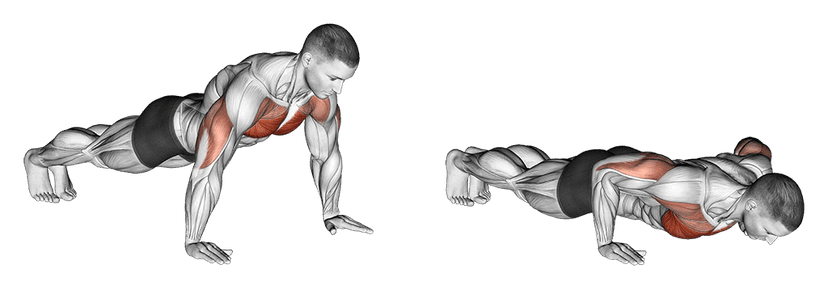
Push-ups are a horizontal pressing movement and train the same muscles as the bench press:
- Pectoralis major: The primary mover. Adducts and horizontally flexes the humerus. Both the clavicular (upper) and sternal (lower) heads are active depending on hand position and angle.
- Anterior deltoid: Assists the chest in pressing and flexing the shoulder.
- Triceps brachii: Extends the elbow to lock out each rep.
- Serratus anterior: Protracts the scapula at the top of each rep. This is the key muscle that prevents scapular winging and makes push-ups superior to bench press for shoulder health.
Your core acts as a stabilizer throughout the movement: if your hips sag or pike, you lose rigidity and the exercise becomes far less effective.
Proper execution
Starting position (plank): Place your hands slightly wider than shoulder-width, fingers pointing forward or slightly outward. Your body should form a straight line from your heels to your head: hips in line with shoulders and ankles, not sagging or piked. Squeeze your glutes and brace your core before lowering.
The descent: Lower your chest toward the floor by bending your elbows. Your elbows should track at roughly 45 degrees from your torso, not flared out to 90 degrees (this is the most common form error and the one most associated with shoulder impingement). Your chest, not your nose or forehead, should approach the floor at the bottom.
Full range of motion: Lower until your chest touches or nearly touches the floor. Partial reps (stopping halfway down) significantly reduce the training stimulus. Full range of motion builds more muscle and strength.
The push: Drive your hands into the floor and press back up. At the top, actively push your upper back toward the ceiling (scapular protraction). This final movement is unique to push-ups and bodyweight pressing: it engages the serratus anterior and contributes to shoulder health.
Breathing: Inhale on the way down, exhale on the way up. For high-rep sets, breathe naturally.
Common mistakes
Hips sagging. When your core is not braced, your lower back drops and the exercise becomes a lower-back compression exercise rather than a chest press. Squeeze your glutes and brace your abs from the first rep to the last.
Elbows flared at 90 degrees. Pressing with elbows pointing straight out to the sides reduces power, limits range of motion, and compresses the shoulder joint. Keep elbows at 45-60 degrees from your torso. Think "arrow shape," not "T shape."
Partial range of motion. Only going halfway down is not "easier push-ups," it is just less effective push-ups. If you cannot reach the floor with good form, scale the exercise (knee push-ups, elevated push-ups) until you can.
Head dropping. Letting your head hang down or looking straight at the floor encourages cervical spine rounding. Keep your gaze slightly forward, chin slightly tucked, neck in a neutral position.
Not finishing at the top. Stopping the press before your arms are fully extended and before you push your upper back up means you miss the serratus anterior activation that makes push-ups special. Lock out fully and spread the floor at the top.
Variations
Knee push-ups. The standard regression for beginners who cannot yet perform full push-ups with good form. Kneeling reduces the load by approximately 50-60%. Do not think of these as "girl push-ups": they are a progression tool, and technique matters just as much as in full push-ups.
Decline push-ups. Elevate your feet on a bench, box, or chair. This increases the angle and shifts more load to the upper chest and anterior deltoids. The higher the elevation, the more it resembles an overhead press. A natural next step after mastering flat push-ups.
Diamond push-ups (close-grip). Place your hands close together, thumbs and index fingers touching to form a diamond shape. This variation dramatically increases triceps involvement and reduces chest activation. The most effective bodyweight triceps exercise.
Archer push-up. In the bottom position, extend one arm to the side while the other remains bent and bears most of the load. Alternate sides. A progressively more difficult variation that transitions toward the one-arm push-up. Builds unilateral chest and shoulder strength.
One-arm push-up. The advanced standard of bodyweight pressing. Requires exceptional core stability, shoulder strength, and technique. Place your non-working hand behind your back, spread your feet wide for a base, and lower your chest to the floor while maintaining a rigid body. Months of progression through the above variations lead here.
Programming
For beginners: Start with knee push-ups or elevated push-ups (hands on a bench). Aim for 3 sets of 8-12 reps. When you can complete 3 x 15 with perfect form, progress to the next variation or the flat full push-up.
For intermediate lifters: Push-ups work exceptionally well in higher rep ranges (15-30 reps per set) for chest and triceps volume, or as a finisher after bench press. They also work as a superset with rows for balanced push-pull training.
For advanced athletes: Add load with a weighted vest or plates on your back, or progress to archer and one-arm variations. Deficit push-ups (hands on parallettes or plates to allow deeper range of motion) add additional stretch at the bottom.
Train push-ups 2-4 times per week. Because they use bodyweight, recovery is faster than with barbell pressing and more frequent training is tolerated well by most people.
Key takeaways
- Your body must form a rigid plank: core braced, glutes squeezed, from first rep to last
- Elbows track at 45 degrees from your torso: never flared out to 90 degrees
- Full range of motion every rep: chest to the floor, arms fully extended at the top
- Push your upper back toward the ceiling at the top for full serratus anterior activation
- Knee push-ups and elevated push-ups are legitimate progressions, not shortcuts: use them to build toward full push-ups with correct form
