One-Arm Push-Up: Complete Guide
The one-arm push-up is one of the most impressive and demanding bodyweight exercises. It requires considerable strength in the chest, triceps, and shoulders, along with exceptional core stability and perfect balance control. It is the holy grail of push-ups, a movement that proves you have reached an advanced level of functional strength.
Do not let the difficulty discourage you. With a methodical progression and patience, the one-arm push-up is achievable for anyone who trains seriously. This guide gives you everything you need to get there.
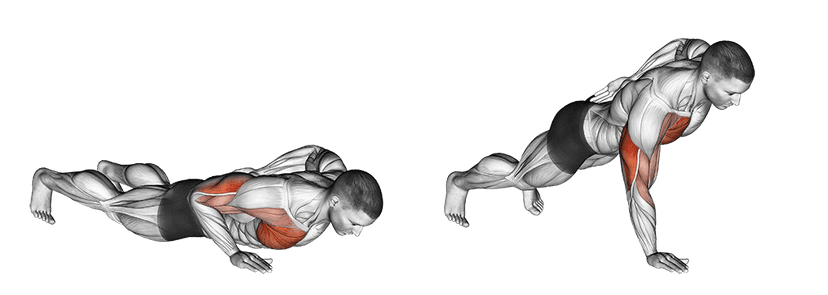
Muscles targeted
- Pectoralis major: primary mover, supports the entire load on one side
- Triceps: elbow extension, intensified by the unilateral load
- Anterior deltoids: assist the push and stabilize the shoulder
- Obliques and transverse abdominis: anti-rotation bracing, essential to prevent the torso from twisting
- Latissimus dorsi: trunk stabilization throughout the rep
- Quadratus lumborum: maintains lateral pelvic alignment
The anti-rotation component of the core work is what makes this exercise unique. You train the trunk just as much as the upper body pushing muscles.
Proper execution
Starting position
Get into a push-up position with your feet spread well beyond shoulder width (wider feet make balance easier). Your working hand is placed under the shoulder, fingers turned slightly outward. Your free hand is placed behind your back or along your thigh. Your body forms a straight line from shoulders to heels. Brace your abs hard to lock the position in place.
Eccentric phase (descent)
- Bend the elbow, keeping it close to the body (roughly 30-45 degrees relative to the torso).
- Lower slowly over 3-4 seconds while maintaining body alignment.
- Resist torso rotation: this is the hardest part. Squeeze your abs and glutes.
- Lower until your chest is a few centimeters off the floor.
Concentric phase (push)
- Push firmly through your hand to drive back up.
- Exhale during the push.
- Maintain body alignment until the elbow is fully locked out.
- Avoid rotating your hips or shoulders on the way up.
Breathing: inhale on the way down, exhale as you push.
Common mistakes
1. Torso rotation This is the most common error. The body rotates toward the free-hand side because core bracing is insufficient. Spread your feet wider and squeeze your obliques harder. If rotation persists, go back to progressions.
2. Hips sagging The lower back collapses and the hips nearly touch the floor. Squeeze your glutes and abs as if holding a plank. If you cannot maintain position, strengthen your core with side planks and Pallof presses.
3. Feet too close together Feet at shoulder width makes the exercise exponentially harder and nearly impossible for most people. Start with feet well beyond shoulder width, then gradually narrow your stance over weeks.
4. Incomplete range of motion Dropping 10 centimeters and coming back up does not count. Aim for a range where your chest comes within a few centimeters of the floor. If you cannot, use an elevated surface (countertop, bench) to reduce the load.
5. Hand too far from the body Placing your hand too wide overloads the shoulder and makes the movement unstable. Your hand should be under your shoulder or very slightly outside it.
Variations
Elevated one-arm push-up (beginner to intermediate) Place your working hand on a bench, step, or countertop. The higher the surface, the easier the exercise. Gradually lower the height over weeks. This is the best progression for building the required strength.
Assisted one-arm push-up (intermediate) Place your free hand on a basketball or medicine ball. It helps you stabilize without bearing significant load. Gradually reduce the support from that hand over time.
Eccentric one-arm push-up (intermediate) Lower slowly over 5-8 seconds with one hand, then push back up with both hands. Eccentrics build strength faster than concentrics and prepare tendons for the load.
Narrow-stance one-arm push-up (advanced) Once you master the exercise with a wide stance, gradually bring your feet closer together. The feet-together version is the ultimate form, demanding exceptional core stability.
Programming
Placement in your session: At the start of your session when you are fresh, since this is a strength and coordination movement requiring total focus. Not at the end of a session after 15 sets of chest work.
Volume and intensity:
- Progression (elevated): 4 x 5-8 reps per side
- Intermediate (floor, wide stance): 3-4 x 3-6 reps per side
- Advanced (narrow stance): 3 x 3-5 reps per side
Frequency: 2-3 times per week. Train both sides equally. If one side is weaker, add an extra set on that side.
Progression timeline: Expect several months to go from the elevated version to the floor version. Patience is key. Adding one rep per week is an excellent rate of progress.
Key takeaways
- Anti-rotation bracing: the real challenge is not rotating, not just pushing
- Wide feet: a wider stance makes balance easier, narrow it gradually
- Elevated progression: start high, lower the surface over time
- Balanced bilateral work: train both sides with equal volume
- Patience: this is an advanced movement, give yourself time to progress
