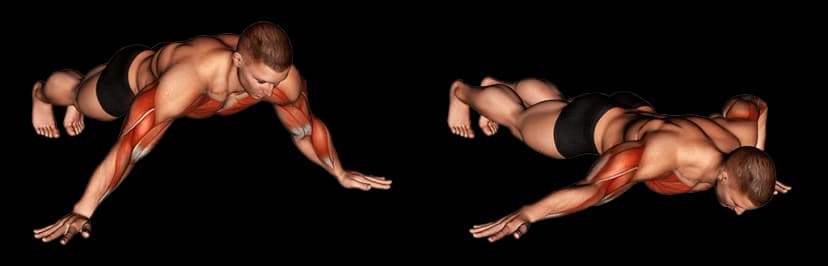
Archer Push-Up: Complete Guide
The archer push-up is an advanced push-up variation that approaches unilateral work while keeping both hands on the floor. The working arm supports most of the load while the extended arm acts as a stabilizer. It is an ideal transitional exercise between regular push-ups and one-arm push-ups.
The archer push-up lets you develop asymmetric strength, correct imbalances between sides, and increase intensity without added weight. It is essential for anyone looking to push their bodyweight limits further.
Muscles targeted
- Pectoralis major (working side): primary mover, supports the majority of the load
- Triceps (working side): elbow extension, heavily recruited due to increased load
- Anterior deltoids: stabilization and pushing assistance
- Pectoralis major (extended side): active stretch, stabilization work
- Obliques and transverse abdominis: anti-rotation bracing to prevent the torso from turning
- Serratus anterior: protraction and stabilization of the shoulder blades
The work is intentionally asymmetric. The bending arm side handles 70-80% of the work, while the extended arm does 20-30%. This creates a progressive stimulus toward one-arm push-ups.
Proper execution
Starting position
Adopt a push-up position with your hands spread about twice shoulder width. Fingers point outward at roughly 45 degrees. Feet are at shoulder width or slightly wider. Your body is braced and perfectly aligned from shoulders to heels.
Eccentric phase (descent)
- Choose your working side (for example, the right). Bend your right elbow to lower your torso toward your right hand.
- Simultaneously, your left arm slides outward and extends fully. The extended arm stays in contact with the floor, palm flat or on the heel of the hand.
- Lower slowly over 2-3 seconds.
- Lower until your chest nearly touches the floor next to the working hand.
Concentric phase (push)
- Push through the working hand (right) to drive back up.
- The extended arm (left) accompanies the movement as it returns toward center.
- Exhale during the push.
- Return to the starting position with both arms slightly bent.
Breathing: inhale on the way down, exhale as you push.
Common mistakes
1. Extended arm bending If the arm that should stay straight bends, you turn the archer push-up into a wide push-up and lose the unilateral work. Focus on keeping the elbow locked. If you cannot manage it, your strength may be insufficient: go back to regular push-ups or wide push-ups.
2. Torso rotation The torso twists toward the extended arm side because core bracing is insufficient. Squeeze your abs and glutes. Widen your feet if needed to improve stability.
3. Insufficient range of motion Only lowering halfway does not recruit enough chest muscle. Lower until your chest nearly touches the floor. If you lack strength, elevate your hands on a step.
4. Hands not wide enough If the hands are too close together, the extended arm cannot fully deploy and the distinction between sides disappears. Spread them to at least twice shoulder width.
5. Excessive speed Free-falling and bouncing at the bottom builds neither strength nor muscle. Control every centimeter of the movement, especially the eccentric phase.
Variations
Elevated archer push-up (beginner to intermediate) Place your hands on a bench or step. The reduced angle decreases the load. An excellent starting point if the floor version is too difficult.
Sliding archer push-up (intermediate) Place a small towel or slider under the extending hand. The sliding reduces friction and makes the movement smoother. Ideal for learning the movement pattern.
Typewriter push-up (advanced) Lower to one side, then shift laterally to the other hand while staying in the bottom position, and push up on the other side. One rep equals left-right. Double the work volume and considerable muscular endurance.
Fingertip archer push-up (advanced) The extended arm rests on only one or two fingers instead of the full palm. This drastically reduces assistance and brings you closer to the one-arm push-up.
Programming
Placement in your session: At the start or middle of a Push or chest session. This is a movement that requires focus and freshness. Do it before isolation exercises.
Volume and intensity:
- Beginner (elevated version): 3 x 6-8 reps per side
- Intermediate (floor): 3-4 x 6-10 reps per side
- Advanced (typewriter or fingertip): 3 x 5-8 reps per side
Frequency: 2-3 times per week. Alternate which side you start with to avoid always beginning on the strong side. Rest 60-90 seconds between sets.
Progression: When you can complete 4 x 10 floor archer push-ups with full range of motion and controlled tempo, you are ready to work on one-arm push-up progressions with elevated surfaces.
Key takeaways
- Extended arm locked: the elbow stays straight, that is rule number one
- Lateral descent: the torso goes toward the working hand, not straight down
- Solid bracing: abs and glutes contracted to prevent rotation
- Full range of motion: chest near the floor on every rep
- Transition to one-arm push-ups: the archer push-up is the step before
