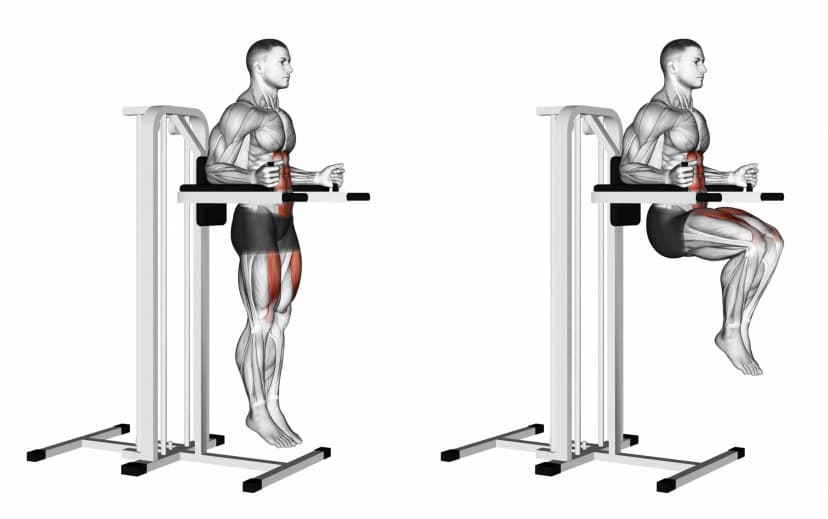
Captain's Chair Leg Raise: Complete Guide
The captain's chair is one of the best tools for training your abs in the gym. Leg raises on this apparatus target the lower portion of the rectus abdominis, an area often neglected by standard crunches. The main advantage is that your arms rest on the pads, stabilizing your upper body so you can focus entirely on the abdominal contraction. Whether you want to strengthen your core for athletic performance or sculpt visible abs, this exercise deserves a spot in your program.
The machine is found in nearly every gym. It consists of a backrest, two padded armrests, and handles. You position yourself with your back against the pad, forearms on the rests, and raise your legs. Simple in appearance, but highly effective when performed with proper form.
Muscles targeted
- Rectus abdominis (lower portion): primary mover, responsible for flexing the pelvis toward the ribcage
- Rectus abdominis (upper portion): active stabilizer throughout the movement
- Iliopsoas: hip flexor, mostly involved at the beginning of the movement
- Rectus femoris (quadriceps): helps maintain leg position whether bent or straight
- External and internal obliques: lateral stabilizers, more involved if you add rotation
- Transverse abdominis: deep core bracing to prevent swinging
The classic trap is letting the hip flexors do all the work. If you feel a burn in your hip crease rather than your abs, you need to correct your technique by emphasizing the posterior pelvic tilt.
Proper execution
Starting position
Stand with your back against the pad, forearms flat on the armrests, hands gripping the handles. Keep your shoulders down, away from your ears. Your back stays pressed against the pad. Legs hang slightly forward (not perfectly vertical). Engage your transverse abdominis by gently drawing your navel inward.
Concentric phase (raise)
- Initiate the movement by contracting your abs, not by pulling with the hip flexors.
- Raise your legs with slightly bent knees (standard version) or straight legs (advanced version).
- Lift until your thighs are at least parallel to the floor. Ideally, go slightly beyond by performing a posterior pelvic tilt (pubic bone curls up toward your navel).
- This pelvic tilt is what separates a hip flexor exercise from a true ab exercise.
Eccentric phase (descent)
- Lower your legs slowly (2-3 seconds minimum).
- Control the movement to prevent any swinging.
- Do not fully release tension at the bottom. Stop just before your legs are completely vertical.
Breathing: exhale as you raise your legs (effort), inhale as you lower them.
Common mistakes
1. Using momentum and swinging Swinging turns the exercise into a pendulum motion. You lose all abdominal tension. Lower slowly, pause briefly at the bottom, then rise without jerking. If you must swing to get your legs up, it is too difficult: bend your knees more.
2. Not tilting the pelvis Raising your legs without a posterior pelvic tilt works the hip flexors, not the abs. At the top of the movement, imagine curling your pelvis toward the ceiling. That slight rounding of the lower back is what activates the rectus abdominis.
3. Shrugging the shoulders Shoulders rising toward your ears creates unnecessary tension in the traps and neck. Keep your shoulders down by actively pushing into the armrests.
4. Insufficient range of motion Raising your legs only to 45 degrees is not enough to fully activate the rectus abdominis. You need to reach at least horizontal, and ideally go beyond with the pelvic tilt.
5. Dropping too fast Letting your legs fall cancels all the eccentric work. The controlled descent accounts for half the exercise. Count 2 to 3 seconds on the way down.
Variations
Knee raises (beginner) Bend your knees to 90 degrees and bring them toward your chest. The shorter lever arm reduces the difficulty. Ideal for learning the movement pattern and the posterior pelvic tilt.
Straight leg raises (advanced) Keep your legs perfectly straight throughout the movement. Difficulty increases significantly because the lever arm is at its maximum. Reserved for trainees who already master the bent-knee version without swinging.
Leg raises with rotation (intermediate) Bring your knees up alternating toward the right then the left. This variation recruits the obliques in addition to the rectus abdominis. Control the movement to avoid rotating your upper body.
Windshield wipers (advanced) Raise your straight legs to horizontal, then sweep from right to left like a windshield wiper. Very demanding for the obliques and transverse abdominis. Only attempt this variation if you perfectly control straight leg raises.
Programming
Placement in your session: Place this exercise at the start of your ab work if it is a priority, or at the end of a session as a finisher. Avoid doing it right before heavy squats or deadlifts, as ab fatigue can compromise your stability.
Volume and intensity:
- Beginner: 3 x 10-12 reps (bent knees), focus on pelvic tilt
- Intermediate: 3-4 x 12-15 reps (semi-straight legs), tempo 2-0-3
- Advanced: 4 x 10-12 reps (straight legs), with ankle weights or a medicine ball between the feet
Frequency: 2-3 times per week. Abs recover quickly due to their high proportion of slow-twitch fibers. Still allow 48 hours between intense sessions.
Progression: Start with bent knees, then gradually straighten your legs over the weeks. When you can perform 4 x 15 with straight legs and no swinging, add weight (1-2 kg between your feet).
Key takeaways
- Posterior pelvic tilt: the pelvic tilt is what targets the abs, not just raising the legs
- Zero swinging: slow controlled descent, no momentum on the way up
- Shoulders down: push into the armrests to depress the shoulders
- Full range of motion: thighs at least parallel to the floor
- Smart progression: bent knees before straight legs, added weight last
