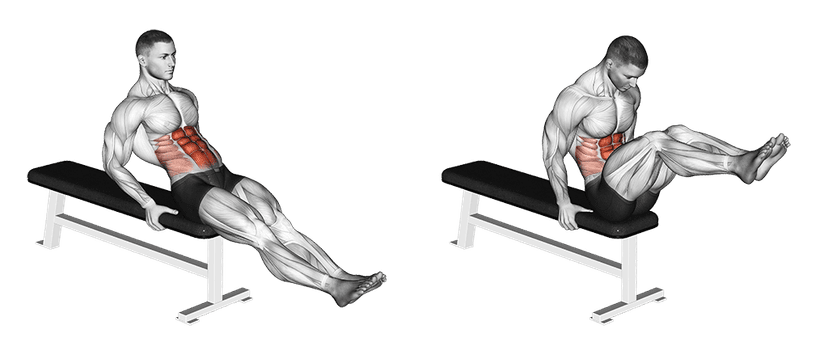
Seated Leg Raise: Complete Guide
The seated leg raise is an often underestimated ab exercise. Accessible to all levels, it requires nothing more than a flat bench and no special equipment. Its main strength is that the seated position naturally limits swinging and cheating, which forces the abs to work without the hip flexors taking over. It is an excellent exercise for beginners learning proper ab contraction, and for intermediate trainees looking for a complementary exercise at the end of a session.
The bench serves as an anchor point. You sit on the edge, hands gripping behind you for stability, and raise your legs. The movement is short but intense when done correctly, with a deliberate contraction at the top.
Muscles targeted
- Rectus abdominis (lower portion): primary mover, responsible for pelvic flexion
- Rectus abdominis (upper portion): trunk stabilizer in the seated position
- Iliopsoas: hip flexor, involved at the start of the movement
- Rectus femoris (quadriceps): maintains leg extension
- Transverse abdominis: deep core bracing to maintain the seated posture
- Obliques: lateral stabilization throughout the movement
The seated position reduces hip flexor contribution compared to hanging or lying versions. This is an advantage for those who experience hip flexor pain with other leg raise variations.
Proper execution
Starting position
Sit on the edge of the bench. Your glutes are about 10-15 cm from the edge. Place your hands behind you on the bench, fingers pointing forward or outward, arms slightly bent. Lean your torso slightly back (about 10-15 degrees). Legs extended in front of you, feet slightly above the floor. Engage your transverse abdominis by gently drawing in your stomach.
Concentric phase (raise)
- Contract your abs and raise your legs upward with slightly bent or straight knees.
- Lift until your thighs form roughly a 90-degree angle with your torso.
- At the top, perform a slight posterior pelvic tilt to maximize rectus abdominis contraction.
- Hold the top position for 1 second while voluntarily contracting your abs.
Eccentric phase (descent)
- Lower your legs slowly (2-3 seconds).
- Do not let your feet touch the floor between reps to maintain continuous tension.
- Stop the movement when your legs are nearly extended, feet a few centimeters off the floor.
Breathing: exhale as you raise your legs, inhale as you lower them.
Common mistakes
1. Leaning too far back Leaning excessively transforms the exercise into a lever movement that relies more on the hip flexors. Maintain a constant torso angle throughout the movement. Your shoulders should not move.
2. Resting feet on the floor between reps Touching the floor at each rep removes continuous tension from the abs. Keep your feet 5-10 cm off the floor at the bottom to maintain the contraction.
3. Locking the elbows Straight locked arms transfer stress to the wrists and elbows. Keep a slight bend in your arms for better stability and less joint pressure.
4. Moving too fast Swinging the legs up and down without control uses momentum rather than muscular force. Recommended tempo: 2 seconds up, 1 second hold at the top, 3 seconds down.
5. Forgetting the pelvic tilt As with all leg raise variations, the pelvic tilt at the top of the movement is what separates an effective ab exercise from a hip flexor exercise.
Variations
Seated knee raises (beginner) Bend your knees to 90 degrees and bring them toward your chest. The short lever arm makes control easier and lets you focus on the posterior pelvic tilt.
Seated leg raises with medicine ball (intermediate) Place a small medicine ball (1-3 kg) between your ankles or feet. The added weight increases intensity without changing the technique.
Seated leg raises with upright torso (advanced) Do not lean back at all. Keep your torso perfectly vertical and raise your legs. Much harder because the range of motion is reduced and the abdominal contraction must compensate.
V-sit hold (advanced) Raise your legs and torso simultaneously to form a V shape. Hold for 10-30 seconds. Excellent for dynamic core bracing and proprioception.
Programming
Placement in your session: Complementary exercise in the middle or end of an ab session. It pairs well with crunches (upper abs) and planks (static bracing) for complete core work.
Volume and intensity:
- Beginner: 3 x 12-15 reps (bent knees), focus on control
- Intermediate: 3-4 x 15-20 reps (straight legs), tempo 2-1-3
- Advanced: 4 x 12-15 reps with medicine ball or V-sit holds
Frequency: 2-3 times per week. This exercise is gentle enough to be used as a warm-up or finisher at every session without overtraining risk.
Progression: Start with bent knees, then gradually straighten your legs. Add weight when you master 4 x 20 with straight legs and a controlled tempo.
Key takeaways
- Constant torso angle: lean slightly back but do not move during the set
- Feet off the floor: never touch the ground between reps to maintain tension
- Posterior pelvic tilt: tilt the pelvis at the top to target the abs
- Slow tempo: 2 seconds up, 1 second hold, 3 seconds down
- Accessibility: a flat bench is all you need, works at home or in the gym
