Decline Bench Leg Raise: Complete Guide
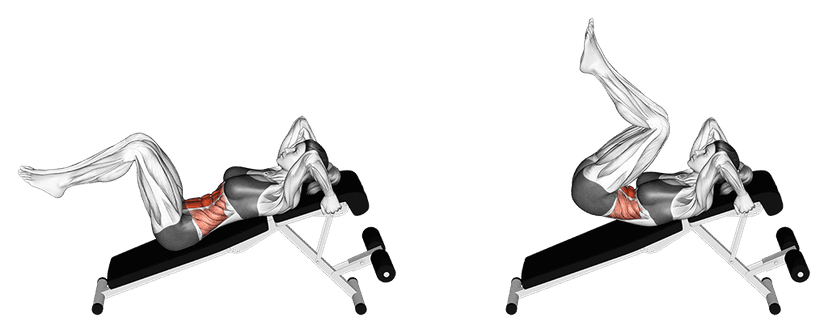
The decline bench leg raise is an intermediate variation that increases intensity compared to the floor version thanks to the angle of the bench. Gravity works against you over a greater range of motion, lengthening time under tension and recruiting more of the rectus abdominis. It is a particularly interesting exercise for trainees who find floor leg raises too easy but are not yet ready for the captain's chair or hanging bar.
The decline bench (typically used for decline press) becomes a powerful ab tool. You lie with your head up, feet pointing down, and raise your legs by contracting your abs. The incline adds constant resistance that the floor version cannot provide.
Muscles targeted
- Rectus abdominis (lower and upper portions): primary mover, recruited over a greater range of motion due to the bench angle
- Iliopsoas: hip flexor, active at the start of the movement
- Rectus femoris: maintains leg extension
- External and internal obliques: trunk stabilization on the inclined plane
- Transverse abdominis: deep core bracing to control the movement
- Neck flexors: stabilize the head if not resting on the bench
The decline angle increases the load on the abs compared to the horizontal version. The steeper the bench, the harder the exercise. An angle of 20-30 degrees is a good starting point.
Proper execution
Starting position
Lie on the decline bench with your head at the top and feet pointing down. Hook your feet or shins under the roller pads. Your hands grip the edge of the bench or the handles behind your head for stability. Back flat on the bench, shoulders down. Legs straight or slightly bent, aligned with the bench.
Concentric phase (raise)
- Contract your abs and begin raising your legs.
- Lift your legs with slightly bent knees (standard) or straight legs (advanced).
- Continue until your legs are perpendicular to the floor or beyond.
- At the top, perform a posterior pelvic tilt by slightly lifting your glutes off the bench. The pelvis curls toward the ribcage.
- Hold the contraction for 1 second at the top.
Eccentric phase (descent)
- Lower your legs slowly and under control (3 seconds minimum).
- Resist gravity pulling your legs downward.
- Stop the descent when your legs are aligned with the bench (not below, to protect the lower back).
Breathing: exhale as you raise your legs, inhale as you lower them.
Common mistakes
1. Lowering legs below bench level Letting your legs drop below the horizontal line of the bench places excessive stress on the lumbar spine. Always stop the descent at bench level, especially if you have a history of lower back pain.
2. Pulling with the arms If you grip the bench behind your head, it is tempting to pull with your arms to assist the movement. Your arms are only there to stabilize you, not to generate force. If you need to pull, the angle is too steep or your abs are not strong enough.
3. Momentum at the bottom As with all leg raises, momentum is the enemy. The inclined position makes cheating even more tempting because gravity helps launch the legs. Lower slowly, stop, then raise without jerking.
4. Forgetting the pelvic tilt Once again, raising the legs without curling the pelvis primarily recruits the hip flexors. The slight lift of the glutes at the top of the movement is essential for optimal ab work.
5. Too steep an angle too soon Starting on a steeply inclined bench (45 degrees or more) when your abs are not prepared increases the risk of lower back pain and hip flexor compensation. Start at 15-20 degrees and increase gradually.
Variations
Decline knee raises (beginner) Bend your knees to 90 degrees and bring them toward your chest. The shorter lever arm makes control easier on the inclined plane. Excellent for learning the movement safely.
Decline straight leg raises with pause (intermediate) Hold for 2-3 seconds at the top of the movement with legs perpendicular to the floor and glutes lifted. This isometric intensifies the contraction and eliminates all cheating.
Decline leg raises with rotation (intermediate to advanced) At the top of the movement, rotate your knees or feet to the right then to the left. Adds oblique work to the rectus abdominis recruitment.
Weighted decline leg raises (advanced) Place a medicine ball or dumbbell between your feet. The added weight significantly increases difficulty. Only attempt this variation if you perfectly control the unweighted version.
Programming
Placement in your session: Primary or secondary exercise in your ab session. Place it after bracing exercises (planks) and before isolation work like cable crunches.
Volume and intensity:
- Beginner: 3 x 10-12 reps (bent knees, 15-20 degree angle)
- Intermediate: 3-4 x 12-15 reps (straight legs, 25-30 degree angle), tempo 2-1-3
- Advanced: 4 x 10-12 reps (straight legs, 30-45 degree angle), with weight or pause
Frequency: 2-3 times per week. Alternate with other ab exercises to vary the stimulus.
Progression: Double progression works best. First, increase reps at a constant angle. Then increase the bench angle. Finally, add weight. Only move to the next step when the previous one is perfectly mastered.
Key takeaways
- The angle sets the difficulty: the steeper the bench, the harder the abs work
- Stop at bench level: never lower your legs below the bench line
- Posterior pelvic tilt: slightly lift the glutes at the top to target the abs
- Gradual progression: low angle before steep angle, bent knees before straight legs
- Hands stabilize only: your arms do not pull, they hold you in place
