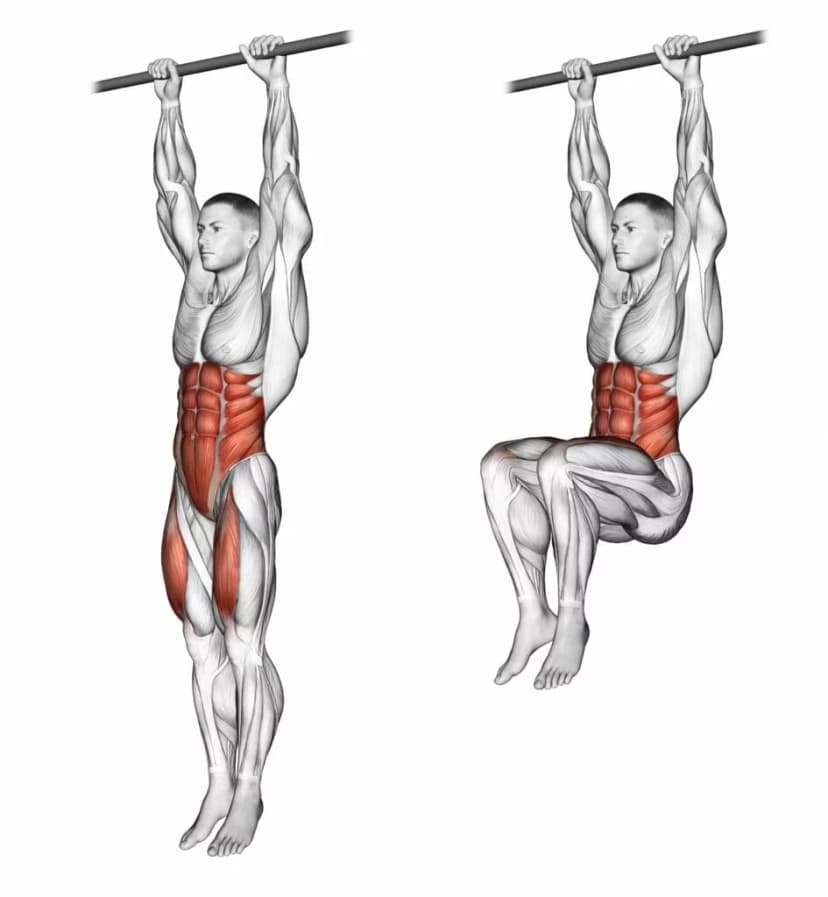
Hanging Leg Raise: Complete Guide
The hanging leg raise from a pull-up bar is considered one of the most demanding abdominal exercises. Suspended by your hands with no back support, you must lift your legs using only the strength of your core. This exercise recruits the rectus abdominis along its entire length, engages the obliques as stabilizers, and demands an iron grip. If you are looking for a single exercise to build rock-solid abs, this is probably it.
The advantage of the hanging leg raise is that it requires nothing more than a pull-up bar. No complex machine, no bench. Just you, gravity, and your ability to control your body in space. It is also an excellent indicator of overall functional strength: if you cannot perform 10 clean reps, there is work to be done.
Muscles targeted
- Rectus abdominis (lower and upper portions): primary mover, intensely recruited through maximal range of motion
- External and internal obliques: essential anti-rotation stabilizers in the hanging position
- Transverse abdominis: deep core bracing to limit swinging
- Iliopsoas: hip flexor, active during the first part of the movement
- Lats and grip muscles: maintaining the hang, intense isometric work
- Forearms (finger flexors): grip is often the limiting factor
The hanging leg raise is unique because it combines maximal ab work with isometric upper body work. Your forearms, lats, and shoulders work continuously just to keep you hanging.
Proper execution
Starting position
Grab the pull-up bar with an overhand grip (palms facing forward), hands at shoulder width or slightly wider. Hang with arms extended. Engage your shoulders by pulling them slightly down (active scapular depression). Legs straight, feet together, body aligned with no swinging. Engage your transverse abdominis before moving.
Concentric phase (raise)
- Initiate the movement by contracting your abs, not by swinging your hips.
- Raise your straight legs in front of you, feet together.
- Lift until your feet reach at least hip height (legs parallel to the floor).
- Ideally, continue beyond by curling your pelvis (posterior pelvic tilt) to bring your feet toward the bar. At this point, the lower back rounds slightly, a sign that the rectus abdominis is fully engaged.
- Do not let your shoulders rise during the lift.
Eccentric phase (descent)
- Lower your legs very slowly (3-4 seconds).
- Fight against gravity and the urge to drop.
- Stop the movement just before your legs are perfectly vertical to maintain tension.
- Stabilize your body before the next rep. Zero swinging.
Breathing: exhale as you raise your legs, inhale during the controlled descent.
Common mistakes
1. Kipping (deliberate swinging) Using momentum to swing your legs upward is the number one trap. It turns an ab strength exercise into a ballistic movement that no longer targets the abs. If you need momentum, regress to an easier variation.
2. Stopping at 90 degrees Raising your legs to horizontal without going beyond only partially engages the abs. The most productive part of the movement is beyond 90 degrees, when the pelvis starts to tilt. That is where the rectus abdominis takes over from the hip flexors.
3. Neglecting scapular depression Letting your shoulders ride up toward your ears while hanging compresses the subacromial space and needlessly fatigues the traps. Actively pull your shoulders down throughout the exercise.
4. Weak grip If your forearms give out before your abs, it is frustrating but common. Use lifting straps or hooks to extend your sets. Train your grip strength separately with farmer walks or dead hangs.
5. Excessive speed Performing leg raises at high speed recruits inertia, not muscles. Each rep should take 5-7 seconds: 2-3 seconds up, 3-4 seconds down.
Variations
Hanging knee raises (beginner to intermediate) Bend your knees to 90 degrees and bring them toward your chest. The shorter lever arm reduces difficulty and lets you focus on the posterior pelvic tilt. This is the gateway to the full hanging leg raise.
Toes to bar (advanced) Raise your feet until they touch the bar. Maximum range of motion, maximum rectus abdominis recruitment. A popular exercise in CrossFit and functional fitness. Requires excellent hamstring flexibility.
Hanging windshield wipers (advanced) Raise your straight legs to vertical, then sweep from right to left. One of the most difficult exercises for the obliques. Reserved for very experienced trainees.
Hanging L-sit hold (advanced) Raise your legs to horizontal and hold the position for 10-30 seconds. Isometric work while hanging is devastating for the abs and hip flexors.
Programming
Placement in your session: First exercise in your ab session. The hanging leg raise requires fresh grip and abs. If you place it at the end of a session after deadlifts or rows, your forearms will not hold up.
Volume and intensity:
- Beginner: 3 x 8-10 reps (bent knees), focus on zero swinging
- Intermediate: 3-4 x 10-12 reps (semi-straight to straight legs), tempo 2-0-4
- Advanced: 4 x 8-10 reps toes to bar, or 3 x max with ankle weights
Frequency: Twice per week is sufficient. This exercise is very demanding on the nervous system and grip. Allow 72 hours of recovery between sessions.
Progression: Bent knees, then semi-straight legs, then straight legs, then toes to bar. Each stage must be mastered with perfect control (zero momentum, slow descent) before moving to the next.
Key takeaways
- Scapular depression: pull your shoulders down to protect the joint and gain stability
- Beyond 90 degrees: the abs truly engage only past horizontal
- Zero kipping: if you need momentum, regress to bent knees
- Grip is a limiting factor: use straps if needed, train grip separately
- Slow tempo: 2-3 seconds up, 3-4 seconds down
