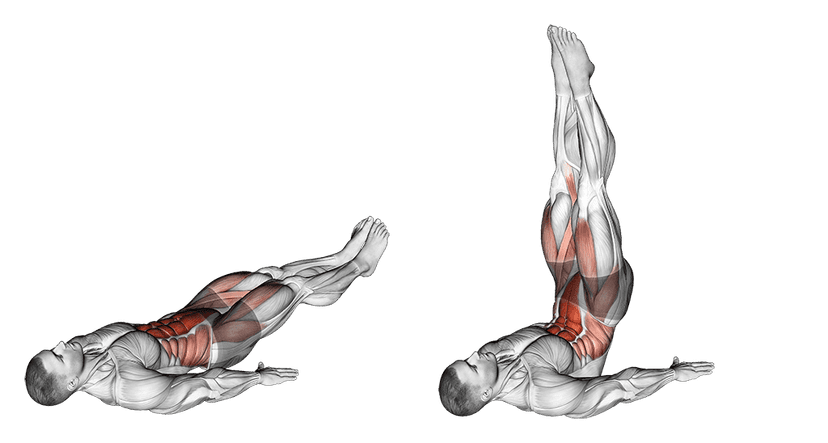
Lying Leg Raise: Complete Guide
The lying leg raise is the quintessential basic ab exercise. No equipment needed, just a flat surface and your motivation. It is often the first leg raise variation people learn, and for good reason: the lying position provides full back support, which makes controlling the movement easier. Yet this seemingly simple exercise is regularly performed incorrectly. Done right, it effectively targets the lower portion of the rectus abdominis. Done wrong, it becomes a hip flexor exercise that fatigues the iliopsoas and pulls on the lower back.
This is the ideal exercise for building the foundation before progressing to more advanced variations (decline bench, captain's chair, hanging bar). If you cannot master the floor leg raise, you will not master the harder versions.
Muscles targeted
- Rectus abdominis (lower portion): primary mover, responsible for flexing the pelvis toward the thorax
- Rectus abdominis (upper portion): trunk stabilizer against the floor
- Iliopsoas: hip flexor, mainly active during the first degrees of the movement
- Rectus femoris (quadriceps): maintains leg extension
- Transverse abdominis: deep core bracing to keep the lower back pressed into the floor
- Obliques: lateral stabilization, especially if the legs drift slightly
The main challenge is minimizing hip flexor contribution and maximizing rectus abdominis work. The key is lower back control: it must stay pressed into the floor throughout the entire movement.
Proper execution
Starting position
Lie on your back, arms at your sides, palms facing down (or hands under your glutes for better anchoring). Legs straight, feet together, toes pointing toward the ceiling. Press your lower back into the floor by contracting your transverse abdominis and performing a slight posterior pelvic tilt. There should be no gap between your lower back and the floor.
Concentric phase (raise)
- Contract your abs and slowly raise your legs, feet together.
- Keep your legs straight or with a very slight bend at the knees.
- Lift until your legs are perpendicular to the floor (90 degrees from your torso).
- At the top, voluntarily contract your abs for 1 second.
Eccentric phase (descent)
- Lower your legs very slowly (3-4 seconds).
- Your lower back must stay pressed into the floor during the entire descent. This is the critical point.
- Stop the movement as soon as you feel your lower back starting to lift. That is your current range of motion limit.
- Do not let your feet touch the floor between reps. Keep them 5-10 cm above the ground.
Breathing: exhale as you raise your legs, inhale during the controlled descent.
Common mistakes
1. Lower back lifting off the floor This is the most common and most dangerous mistake. When the lower back arches, the load transfers directly to the lumbar vertebrae instead of the abs. If your back lifts, you are going too low for your level. Reduce the range of motion or bend your knees.
2. Dropping the legs A free-fall descent cancels all the eccentric work, which accounts for half the effectiveness of the exercise. Control every centimeter of the descent. If you cannot lower in 3 seconds, it is too heavy: bend your knees.
3. Resting feet on the floor between reps Touching the floor completely releases abdominal tension. Keep your feet hovering a few centimeters above the ground to maintain continuous contraction.
4. Holding your breath Breath-holding excessively increases intra-abdominal pressure and can cause dizziness. Exhale on the way up, inhale on the way down, in a smooth and continuous manner.
5. Head lifting off the floor Raising your head to watch your legs creates unnecessary cervical flexion and neck tension. Keep your head on the floor with a neutral chin.
Variations
Floor knee raises (beginner) Bend your knees to 90 degrees and bring them toward your chest. The short lever arm makes it easier to keep the back pressed into the floor. This is the first step for all beginners.
Alternating floor leg raises (beginner to intermediate) Raise one leg at a time while the other hovers 10 cm above the floor. This cuts the load in half and develops hip-pelvis dissociation.
Banded floor leg raises (intermediate) Attach a resistance band to a fixed point behind your head and loop it around your feet. The band assists the ascent and resists the descent, perfect for learning eccentric control.
Weighted floor leg raises (advanced) Place a medicine ball between your ankles or use ankle weights (1-3 kg). Increases intensity without modifying technique. Only attempt this variation if you master 4 x 20 unweighted with a perfectly flat back.
Programming
Placement in your session: Foundation exercise to start your ab session, or a light finisher at the end. It pairs perfectly with planks (bracing) and crunches (upper portion).
Volume and intensity:
- Beginner: 3 x 10-12 reps (bent knees), focus on keeping back flat
- Intermediate: 3-4 x 15-20 reps (straight legs), tempo 2-1-4
- Advanced: 4 x 12-15 reps with weight or in a superset with crunches
Frequency: 2-4 times per week. This exercise is gentle enough for high frequency. It can serve as an ab warm-up before every weight training session.
Progression: The golden rule is that the back stays flat. If the back lifts, you are not ready for that range of motion or load. Start with bent knees, then straighten the legs, then increase time under tension (slower tempo), then add weight.
Key takeaways
- Back flat on the floor: this is rule number one, non-negotiable
- Slow descent: 3-4 seconds minimum, this is where the abs work hardest
- Feet off the floor: no ground contact between reps
- Adapted range of motion: only lower to the point where the back stays flat
- Foundation for progression: master this exercise before attempting hanging variations
