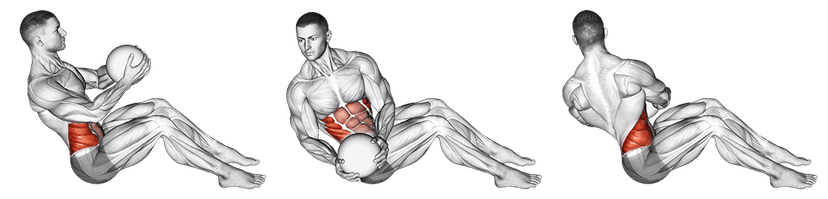
Russian Twist: Complete Guide
The russian twist is the most popular trunk rotation exercise in strength training. Seated on the floor with your torso leaning back, you rotate your upper body from side to side with or without a load. It looks simple but is remarkably effective for sculpting the obliques and developing rotational trunk power.
Targeted Muscles
- External obliques: primary movers of rotation, they initiate and control the trunk pivot
- Internal obliques: work in synergy with the opposite-side external obliques to produce rotation
- Rectus abdominis: isometric stabilization, keeps the torso in the inclined position
- Transverse abdominis: deep bracing, abdominal compression throughout the movement
- Hip flexors (psoas): keeping the legs suspended (if using the feet-off variation)
- Erector spinae: spinal stabilization during rotation
- Quadratus lumborum: lateral stabilization, prevents collapsing to one side
The obliques are the true targets of the russian twist. If you do not feel them burning during the exercise, there is a technique or load problem.
Proper Execution
Starting Position
Seated on the floor, knees bent at approximately 90 degrees, feet flat on the floor (or raised for more difficulty). Lean the torso back about 45 degrees. Keep the back straight, not rounded. Hands clasped in front of the chest or holding a load (dumbbell, medicine ball, plate).
The Movement
- Brace your abdominals to stabilize the torso in the inclined position.
- Rotate the torso to the right, bringing your hands (or the load) beside your right hip.
- Control the rotation: the obliques turn the trunk, the arms do not just swing.
- Return to center, then rotate to the left in the same manner.
- One rep = one right rotation + one left rotation.
Breathing
Exhale during the rotation (effort phase). Inhale as you pass through center. The breathing rhythm naturally follows the back-and-forth motion.
Tempo
2 seconds per rotation, 1 second pause on each side. No bouncing or rushing.
Common Mistakes
1. Moving the arms instead of the trunk The most common mistake. Many people swing their arms from side to side without the torso actually moving. The obliques do not work if the trunk does not rotate. Solution: keep your eyes on your hands and make sure your shoulders follow the rotation.
2. Rounded back A hunched back shifts the load onto the spinal discs instead of the muscles. Keep the chest out and shoulders back, even when fatigued.
3. Momentum and excessive speed Spinning at full speed with swinging reduces oblique tension and increases the risk of lumbar injury. Each rotation should be controlled and deliberate.
4. Load too heavy Excessive weight forces you to compensate with momentum or back rounding. Start without weight to master the movement, then add load progressively. A 3-5 kg medicine ball is enough for most people.
5. Feet shifting If your feet slide or tilt with each rotation, you are using the legs to generate the movement instead of the trunk. Pin the feet (under a dumbbell or support) or keep them flat and focus on torso isolation.
Variations
Russian twist feet on floor, no weight (beginner) The most accessible version. Feet flat, hands clasped in front of the chest. Perfect for learning controlled trunk rotation without overload. Master 3 x 15 reps per side before progressing.
Russian twist with medicine ball (intermediate) Add a 3 to 6 kg medicine ball. The load increases demand on the obliques and transverse. Keep the ball close to your body to limit the lever on your spine.
Russian twist feet off the floor (intermediate to advanced) Lift the feet off the floor, knees bent. This adds a hip flexor and lower ab bracing component. Balance becomes more demanding. Only choose this variation if you have perfectly mastered the feet-on-floor version.
Banded russian twist (advanced) Attach a resistance band to a fixed lateral point. The band resistance increases progressively during rotation, creating a more demanding resistance profile at end range. Excellent for rotational power work.
Programming
Placement in the session: At the end, in the ab circuit. The russian twist does not require freshness to be effective. It pairs well with other core exercises.
Volume and intensity:
- Beginner: 3 x 10-12 reps per side (no weight, feet on floor)
- Intermediate: 3 x 12-15 reps per side (3-5 kg, feet on floor or raised)
- Advanced: 4 x 15-20 reps per side (5-8 kg, feet off floor)
Frequency: 2 to 3 times per week. The obliques can be trained frequently, but allow at least one rest day between intense rotation sessions.
Recommended combination: Russian twist (rotation) + side plank (anti-lateral flexion) + ab roller (anti-extension). This trio covers the three main abdominal functions.
Key Takeaways
- The trunk rotates, the arms do not just swing
- Straight back, chest out, no hunching even at the end of the set
- Start without weight to master the technique
- Controlled tempo: 2 seconds per rotation, no bouncing
- The obliques should burn: if you do not feel them, fix your technique
