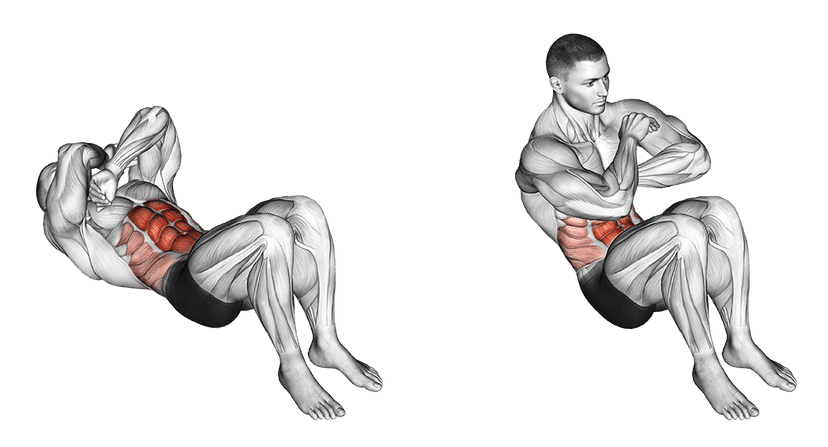
Sit-Up: Complete Guide
The sit-up is one of the oldest and most widely recognized abdominal exercises in the world. Often confused with the crunch, it involves a full trunk flexion until you reach a seated position. Despite ongoing debates about its impact on the lumbar spine, the sit-up remains a functional movement when performed correctly. It allows you to train the entire anterior trunk chain with zero equipment.
If you practice combat sports, CrossFit, or simply want a complete bodyweight abdominal exercise, the sit-up deserves a spot in your training toolkit. The key is understanding when and how to use it intelligently.
Muscles targeted
- Rectus abdominis: primary mover, responsible for trunk flexion through the full range of motion
- Iliopsoas: strongly involved in the upper phase of the movement (hip flexion)
- Rectus femoris (quadriceps): assists hip flexion
- Internal and external obliques: lateral stabilizers during the ascent
- Transversus abdominis: deep stabilization of the abdominal cavity
The sit-up recruits the hip flexors more than the crunch does. That is not a problem if your technique is clean and you have no pre-existing lower back issues. However, if you feel pain in your lower back, switch to crunches or dead bugs instead.
Proper execution
Starting position
Lie on your back with your knees bent at roughly 90 degrees, feet flat on the floor. You can anchor your feet under a support (bench, dumbbell, partner) to make the ascent easier, or leave them free to increase abdominal demand. Arms crossed over your chest or hands behind your ears (without pulling on your neck). Lower back in contact with the floor at the start.
Concentric phase (ascent)
- Contract your abdominals to peel your shoulders off the floor.
- Continue the movement by curling your spine vertebra by vertebra.
- Rise until your torso is upright or close to your thighs.
- Exhale progressively throughout the ascent.
Eccentric phase (descent)
- Lower yourself under control, vertebra by vertebra.
- Do not drop backward. The descent should last at least 2 seconds.
- Your lower back touches the floor first, then your shoulders.
- Inhale during the descent.
Recommended tempo: 2 seconds up, 2-3 seconds down. No excessive speed.
Common mistakes
1. Pulling on your neck with your hands This is the number one mistake. Hands behind the head serve as a reference point, not a lever. If you pull on your neck to compensate for weak abs, you compress your cervical discs. Solution: cross your arms over your chest.
2. Using momentum to rise Swinging your arms forward for momentum reduces abdominal work and increases lumbar stress. Every repetition should start from a conscious abdominal contraction.
3. Lifting the lower back as a rigid block The movement should be a progressive curl, not a rigid motion where your torso rises as one stiff unit. Think of rolling up a sheet of paper: each vertebra peels off the floor one by one.
4. Excessive speed Fast, jerky sit-ups recruit the hip flexors more than the abs and increase shear forces on the spine. Control the tempo on every phase.
5. Always anchoring your feet Anchoring your feet makes the movement easier but transfers some work to the hip flexors and quadriceps. Alternate between both versions for balanced development.
Variations
Butterfly sit-up (beginner to intermediate) Feet together, knees open to the sides (butterfly position). The externally rotated hips prevent the hip flexors from dominating, which isolates the abs more effectively. Very popular in CrossFit.
Decline sit-up (intermediate) On a decline bench with your head lower than your feet. The range of motion and resistance increase thanks to gravity. Start with a low angle (15-20 degrees) and progress gradually.
Weighted sit-up (intermediate to advanced) Hold a plate, dumbbell, or medicine ball against your chest or with arms extended overhead. Adding load increases resistance without changing the technique. Start with 5 kg (10 lb) and progress in 2.5 kg (5 lb) increments.
V-up (advanced) Legs and arms extended. Raise your torso and legs simultaneously to form a V shape. An intense variation that demands solid abdominal control and hamstring flexibility.
Programming
Placement in your session: At the end, after your main compound exercises. Your abs stabilize your trunk during heavy lifts, so do not fatigue them early.
Volume and intensity:
- Beginner: 3 x 10-15 reps, bodyweight, focus on spinal articulation
- Intermediate: 3-4 x 15-20 reps or 3 x 10-12 weighted
- Advanced: 4 x 15-20 weighted or superset with other ab exercises
Frequency: 2-3 times per week. Abs recover quickly, but avoid daily work if you already perform heavy compound lifts (squat, deadlift).
Caution: If you have a history of disc herniation or chronic lower back pain, favor crunches, dead bugs, or the Pallof press, which impose less stress on the spine.
Key takeaways
- Spinal articulation: rise vertebra by vertebra, not as a rigid block
- Zero neck pulling: cross your arms over your chest if you pull involuntarily
- Controlled tempo: 2 seconds up, 2-3 seconds down minimum
- Breathing: exhale on the way up, inhale on the way down
- Adaptation: choose the variation suited to your level and lower back health
