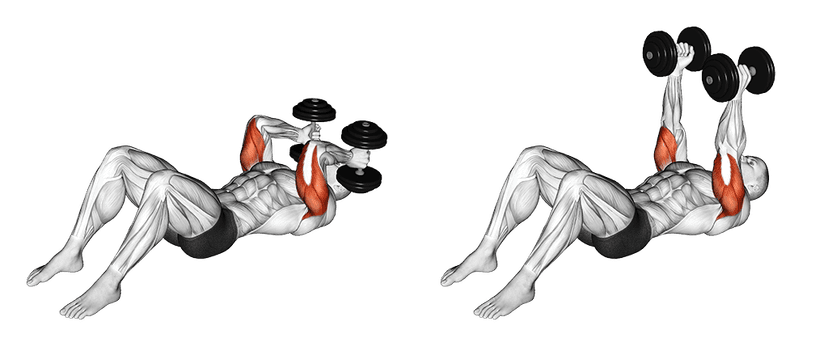
Skull Crusher: Complete Guide
The skull crusher (lying triceps extension) is the single most effective isolation exercise for the triceps. Lying on a bench, you lower the bar toward your forehead then press it back up. This movement targets the long head of the triceps like nothing else and builds thick arms visible from every angle.
Muscles targeted
- Triceps brachii (long head): primary mover. The skull crusher stretches it fully at the bottom thanks to the combination of elbow flexion and arms positioned overhead.
- Triceps brachii (lateral head): assists elbow extension, especially at lockout.
- Triceps brachii (medial head): stabilizes the movement and contributes to the lockout.
- Anconeus: small muscle behind the elbow that assists extension.
- Anterior deltoids and pectorals: stabilize the shoulder in a static position.
The long head makes up roughly 50% of total triceps volume. If your arms have stalled, the skull crusher is often the missing piece.
Proper execution
Starting position
Lie flat on a bench, feet on the floor. Grab an EZ bar (ideal for wrist comfort) or a straight bar with a pronated grip, hands shoulder-width apart. Press the bar up until your arms are vertical above your shoulders. This is your start position.
Eccentric phase (lowering)
- Keep your elbows locked in place, pointing at the ceiling. They do not move: only the forearms pivot.
- Lower the bar slowly (2 to 3 seconds) by bending at the elbows.
- Bring the bar to forehead level or just behind the crown of your head. The further back you go, the greater the stretch on the long head.
- Inhale on the way down.
Concentric phase (pressing up)
- Contract the triceps to push the bar back to the starting position.
- Lock out without slamming into hyperextension.
- Exhale as you press.
Recommended tempo: 3 seconds down, no pause at the bottom, explosive up (3-0-X).
Common mistakes
1. Elbows flaring out The elbows drift sideways instead of staying pointed at the ceiling. This shifts the load to the shoulders and kills triceps isolation. Fix: imagine your elbows are glued to a vertical rail. If you cannot keep them steady, reduce the weight.
2. Lowering the bar to the nose instead of the forehead A short range of motion limits the triceps stretch and reduces effectiveness. The bar should reach at least the forehead, ideally just behind the crown. That is where the name "skull crusher" comes from.
3. Moving the shoulders Some people turn the exercise into a pullover by pulling the arms back with the shoulders. The upper arms should stay nearly vertical. Only the forearms pivot around the elbow joint.
4. Too much weight and momentum The skull crusher is an isolation exercise: technique beats load. Going too heavy forces you to use momentum and puts the elbows at risk. If you cannot control the descent for 2-3 seconds, lighten up.
5. Wrists bent back Wrists should stay neutral, in line with the forearms. Hyperextended wrists create unnecessary stress and invite tendinitis. The EZ bar often solves this thanks to its angled grips.
Variations
Dumbbell skull crusher (beginner) Dumbbells allow a neutral grip (palms facing each other), which is gentler on sensitive elbows. Same range of motion, but each arm works independently to fix imbalances.
Incline skull crusher (intermediate) An inclined bench (15-30 degrees) increases the long head stretch at the bottom. This is the most effective version for hypertrophy, but it demands greater control.
Lying cable extension (intermediate) Lie on a bench facing a low pulley and replicate the same movement with a cable. The advantage: constant tension across the full range of motion, not just at the bottom like with a barbell.
Single-arm skull crusher (advanced) One dumbbell, one arm. Excellent for targeting imbalances and developing stabilization. Keep the elbow perfectly fixed: it is harder without the bar as a guide.
Programming
Placement: after compound movements (bench press, dips). The skull crusher is an isolation exercise, so it belongs in the middle or end of an arm/triceps session.
Volume and intensity:
- Beginner: 3 x 10-12 reps, moderate weight, focus on technique
- Intermediate: 3-4 x 8-12 reps, controlled tempo (3-0-X)
- Advanced: 4 x 8-10 reps + drop set on the last set
Frequency: 1-2 times per week. Triceps also get hit during pressing movements and dips, so do not overload them.
Effective pairings:
- Classic superset: skull crusher + barbell curl (agonist/antagonist)
- Triceps chain: weighted dips, then skull crusher, then cable pushdown
- Push day: bench press, overhead press, skull crusher as a finisher
Key takeaways
- Elbows locked in place: this is rule number one. They point at the ceiling and do not move.
- Full range of motion: lower to the forehead or behind the head to maximize the long head stretch.
- EZ bar recommended: it relieves wrist and elbow stress, especially on heavier sets.
- Control before load: if you cannot control the descent for 2-3 seconds, lighten the bar.
- Progression: add 1-2 kg every two weeks once your technique is solid.
