Stomach Vacuum: Complete Guide
The stomach vacuum is an isometric exercise that targets the transversus abdominis, the deepest muscle in the abdominal wall. Unlike crunches or sit-ups, it produces no visible trunk flexion. Its purpose is different: strengthening the abdominal wall from the inside to achieve a flatter stomach, better posture, and more effective trunk stabilization.
Popularized by classic-era bodybuilders like Frank Zane and Arnold Schwarzenegger, the vacuum has made a strong comeback in functional fitness programs. It is one of the few exercises that specifically targets the transversus without loading the spine.
Muscles targeted
- Transversus abdominis: primary mover, acts as a natural belt around the trunk
- Internal obliques: assist abdominal compression
- Lumbar multifidus: deep spinal stabilizer
- Diaphragm: indirect involvement through breathing control
- Pelvic floor muscles: co-activation with the transversus
The transversus works differently from other abdominal muscles. It does not flex the trunk: it compresses the viscera and stabilizes the spine. It is the muscle that contracts when you cough or when you draw your belly in.
Proper execution
Starting position (standing version)
Stand with feet hip-width apart, knees slightly bent. Hands on your hips or thighs. You can also practice on all fours (easier for beginners) or lying on your back.
Execution phase
- Inhale deeply through your nose, expanding your belly.
- Exhale slowly and completely through your mouth. Empty your lungs as much as possible.
- Once the air is expelled, draw your navel as close to your spine as possible. Imagine trying to stick your belly button to your backbone.
- Hold this contraction for 10-30 seconds while breathing shallowly (small chest breaths).
- Release gently and resume normal breathing.
- Rest 15-20 seconds between repetitions.
Hold time progression:
- Weeks 1-2: 10-15 seconds per hold
- Weeks 3-4: 15-20 seconds
- Weeks 5+: 20-30 seconds or more
Tip: At first, practice in front of a mirror to visually confirm that your stomach is actually hollowing. Your navel should visibly move toward your spine.
Common mistakes
1. Holding your breath during the hold Many people completely stop breathing once the belly is drawn in. You must maintain the transversus contraction while breathing lightly through your chest. This is the hardest part of the exercise.
2. Contracting the superficial abs If you feel your abs "hardening" on the surface like during a crunch, you are contracting the rectus abdominis instead of the transversus. The vacuum is an inward draw, not an outward brace.
3. Rounding the back to cheat Leaning forward and rounding your back gives the impression of drawing the belly in, but gravity is doing the work. Keep your torso upright and your spine neutral.
4. Giving up too quickly The vacuum takes practice. If you cannot hold the contraction for more than 5 seconds initially, that is normal. Your transversus is probably weak. Stay consistent and add 2-3 seconds each week.
Variations
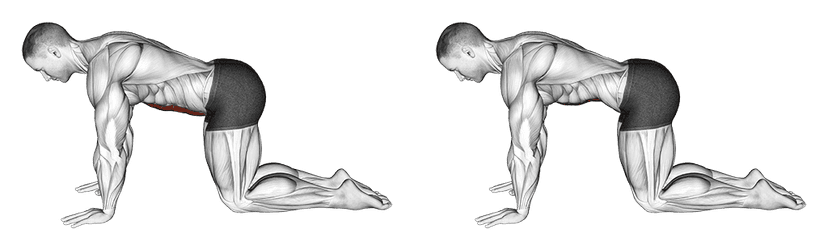
All-fours vacuum (beginner) Quadruped position, flat back. Gravity helps pull the belly upward, making the transversus contraction easier. Ideal for learning the sensation.
Supine vacuum (beginner) Lying on your back, knees bent, feet on the floor. The easiest position because gravity does not oppose the contraction. Perfect for the first few weeks.
Seated vacuum (intermediate) Sitting on a chair or bench, back straight, feet flat. The absence of back support forces the transversus to work harder to maintain posture.
Standing vacuum with arms overhead (advanced) Same principle standing, but with arms extended toward the ceiling. Raising the arms lengthens the anterior chain and increases the difficulty of maintaining the abdominal contraction.
Programming
Placement in your session: The vacuum can be practiced any time. As a warm-up to activate the transversus before compound movements. At the end of a session as complementary core work. Or even first thing in the morning on an empty stomach (when the belly is at its flattest).
Volume and intensity:
- Beginner: 3 x 10-15 second holds, 2-3 times per week
- Intermediate: 4 x 20-30 seconds, 3-4 times per week
- Advanced: 5 x 30-45 seconds, daily if desired
Effective combinations: Pair the vacuum with plank holds for a complete transversus + rectus abdominis workout. Or superset it with dead bugs to target deep trunk stabilization.
Expected results: After 4-6 weeks of consistent practice, you should notice a visually flatter stomach at rest, a better ability to maintain abdominal bracing during compound lifts, and improved posture.
Key takeaways
- Targets the transversus: the deep muscle that acts as a natural belt
- Breathing: exhale fully before drawing in, then breathe lightly during the hold
- Not a crunch: this is an inward draw, not a superficial contraction
- Progressive overload: increase hold time by a few seconds each week
- Consistency: results come with daily or near-daily practice
