Superman: Complete Guide
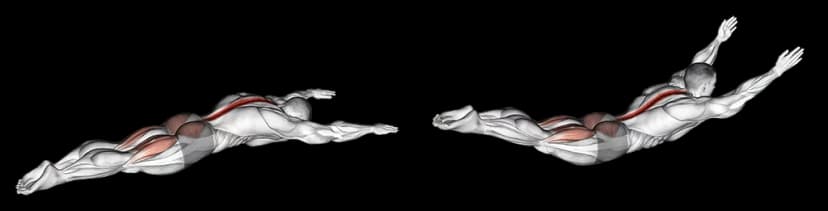
The superman is a bodyweight back extension hold that strengthens the entire posterior chain. Lying face down, you simultaneously lift your arms and legs to form an arch with your body. The name comes from the posture resembling the superhero in flight. It is a movement accessible to all levels that requires zero equipment.
In a world where most abdominal exercises target the front of the trunk, the superman balances the work by strengthening the spinal extensors. It is a pillar of lower back pain prevention and an essential complement to any core training program.
Muscles targeted
- Erector spinae: primary movers, responsible for spinal extension
- Gluteus maximus: hip extension to lift the legs
- Hamstrings: assist hip extension
- Middle and lower trapezius: scapular retraction and depression to lift the arms
- Rhomboids: draw the shoulder blades together
- Posterior deltoids: assist arm elevation
The superman is one of the few exercises that simultaneously works the spinal extensors and hip extensors. This dual recruitment is what makes it so effective for strengthening the entire posterior chain.
Proper execution
Starting position
Lie face down (prone position). Arms extended in front of you, palms facing the floor. Legs straight, toes in contact with the floor. Forehead on the floor or chin slightly lifted. Body completely relaxed at the start.
Concentric phase (lift)
- Simultaneously contract your glutes, lower back, and upper back muscles.
- Lift your arms, chest, and legs off the floor at the same time.
- Rise to a point where you feel a strong contraction without pain in your lower back. The range of motion does not need to be huge: 10-15 cm (4-6 inches) is enough.
- Keep your gaze toward the floor to maintain a neutral cervical spine. Do not lift your head into hyperextension.
Isometric phase (hold)
- Hold the top position for 2-5 seconds.
- Squeeze your glutes and pull your shoulder blades back.
- Breathe normally during the hold. Do not hold your breath.
Eccentric phase (descent)
- Lower slowly over 2-3 seconds.
- Fully rest your arms, chest, and legs on the floor.
- Take a full breath before the next repetition.
Recommended tempo: 2 seconds up, 2-5 second hold, 2-3 seconds down.
Common mistakes
1. Cervical hyperextension Lifting your head to look forward during the movement compresses the cervical vertebrae. Keep your gaze fixed on the floor, chin slightly tucked. Your cervical spine should stay in line with your thoracic spine.
2. Excessive lower back range of motion Arching too high beyond the natural extension capacity of the lumbar spine can cause pinching. Rise to a comfortable contraction, not to the point of pain.
3. Dropping suddenly on the way down Letting your arms and legs fall to the floor eliminates the entire eccentric phase and cuts the exercise's effectiveness in half. The controlled descent is as important as the lift.
4. Holding your breath The superman is a bracing exercise: you should be able to breathe during the hold. If you hold your breath, you compensate through increased intra-abdominal pressure instead of working the extensor muscles.
5. Bending the knees to make it easier Bending the knees shortens the lever arm and reduces the work on the glutes and hamstrings. Keep your legs straight throughout the movement.
Variations
Alternating superman (beginner) Lift the right arm and left leg simultaneously, then alternate. This version reduces load on the lower back and adds an anti-rotation stabilization component. Ideal for beginners or rehabilitation.
Superman with arms at sides (beginner) Same movement but arms along the body, palms facing the ceiling. The shorter lever arm makes lifting the chest easier. Focus on squeezing the shoulder blades together at the top.
Extended isometric superman (intermediate) Instead of doing repetitions, hold the top position for 20-45 seconds. Similar to an inverted floor plank. Excellent for spinal extensor endurance.
Superman with medicine ball (advanced) Hold a medicine ball between your hands (arms extended) during the movement. The added weight increases demand on the spinal extensors and upper back muscles.
Programming
Placement in your session: As a complement to the front plank or at the end of a back session. The superman pairs well with trunk stabilization exercises. You can also use it as a warm-up before deadlifts to activate the posterior chain.
Volume and intensity:
- Beginner: 3 x 8-10 reps with 3-second hold at the top
- Intermediate: 3-4 x 12-15 reps or 3 x 20-30 second isometric holds
- Advanced: 4 x 15-20 weighted reps or 3 x 30-45 second isometric holds
Frequency: 2-4 times per week. The spinal extensors are postural muscles that tolerate high frequency. You can incorporate the superman into your daily routine without overtraining risk.
Classic superset: Front plank 30 seconds + Superman 30 seconds. This pairing covers both trunk extensors and flexors in a single block.
Key takeaways
- Gaze toward the floor: neutral cervical spine, never hyperextended
- Controlled range of motion: rise to contraction, not to pain
- Controlled descent: do not drop suddenly, 2-3 seconds minimum
- Active glutes: squeeze your glutes to protect the lower back and maximize recruitment
- Complementarity: always pair the superman with front planks to balance the trunk
