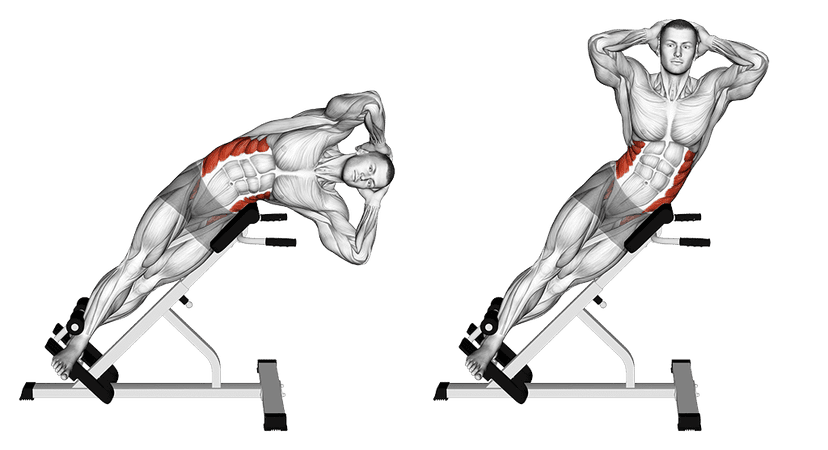
Roman Chair Oblique Twist: Complete Guide
The Roman chair oblique twist is an advanced exercise that targets the obliques through a combined lateral flexion and trunk rotation movement. The Roman chair (or hyperextension bench) provides a stable anchor for the pelvis and legs, allowing you to isolate the lateral abdominal wall with a greater range of motion than floor-based exercises.
It is a movement you rarely see in gyms, and for good reason: it requires a solid baseline of core strength and sound technique. But if you are looking to develop powerful, defined obliques, it is one of the most effective exercises available.
Muscles targeted
- External oblique: primary mover for trunk rotation and lateral flexion
- Internal oblique: assists rotation in the opposite direction and lateral flexion
- Quadratus lumborum: lateral spinal stabilizer, works eccentrically to control the descent
- Erector spinae: spinal stabilization during rotation
- Rectus abdominis: co-contraction to stabilize the trunk in the sagittal plane
- Transversus abdominis: deep bracing throughout the movement
The major advantage of this exercise over floor-based rotations is the range of motion. The Roman chair position allows a deep lateral flexion followed by a full oblique contraction, which is not possible lying on the ground.
Proper execution
Starting position
Set up on the Roman chair in a lateral position. Your hips rest on the pad, your feet are locked under the rollers. Your torso is suspended, perpendicular to the floor. Hands behind your ears or crossed over your chest. Your body forms a straight line from heel to shoulder.
Eccentric phase (lateral descent)
- Slowly lower your torso toward the floor in lateral flexion.
- Control the descent over 2-3 seconds. You should feel a stretch on the obliques of the upper side.
- Lower to a comfortable angle (roughly 30-45 degrees below horizontal). Do not force the range of motion beyond what you can control.
Concentric phase (ascent with rotation)
- Contract your obliques to raise your torso back to horizontal.
- As you rise, add a slight trunk rotation toward the ceiling to maximize oblique recruitment.
- At the top, your upper shoulder points slightly toward the ceiling.
- Voluntarily contract your obliques for 1-2 seconds at the top.
- Exhale during the ascent.
Switching sides: Complete all reps on one side before switching. Rest 30-60 seconds between sides.
Common mistakes
1. Using momentum to rise Swinging your torso for momentum unloads the obliques and imposes harsh rotational stress on the spine. Every ascent should be slow and controlled, initiated by a conscious oblique contraction.
2. Excessive descent range Lowering too far places excessive stress on the quadratus lumborum and lateral spinal ligaments. If you go beyond 45 degrees, you lose muscular control and gravity takes over. Stay within a range where you maintain tension.
3. Excessive cervical rotation Turning your head independently from your trunk to "look at the ceiling" adds nothing to oblique work and compresses the cervical vertebrae. Your head follows the trunk movement without additional rotation.
4. Poor hip placement on the pad If your hips are too far forward, you tip over and lose your anchor. Too far back, and you cannot descend enough. The top of your hip (iliac crest) should align with the edge of the pad.
5. Neglecting one side Doing more reps or achieving better range on one side creates an imbalance. Always start with your weaker side and match the volume.
Variations
Simple lateral flexion on Roman chair (beginner to intermediate) Same position, but without the rotation component. Rise and lower strictly in the lateral plane. A simpler version that lets you learn the movement before adding rotation.
Oblique twist with plate (advanced) Hold a 5-10 kg (10-20 lb) plate against your chest during the movement. The added load intensifies oblique work. Do not exceed 10 kg to protect the spine.
Standing side bend with dumbbell (beginner) A floor-based alternative if you do not have access to a Roman chair. Standing with a dumbbell in one hand, flex laterally. Less range of motion than the Roman chair, but accessible anywhere.
Lateral flexion on 45-degree bench (intermediate) If your gym does not have a horizontal Roman chair, use the hyperextension bench set at 45 degrees. The angle reduces gravitational load and makes the movement more accessible.
Programming
Placement in your session: At the end of your core work, after front and back bracing exercises. The oblique twist is demanding on the obliques and quadratus lumborum. Do not place it before exercises that require heavy trunk stabilization.
Volume and intensity:
- Beginner: 2-3 x 8-10 reps per side (no rotation, lateral flexion only)
- Intermediate: 3 x 10-12 reps per side with rotation
- Advanced: 3-4 x 12-15 reps per side or 3 x 8-10 weighted
Frequency: 1-2 times per week. The obliques already work as stabilizers in many compound exercises (squat, deadlift, overhead press). Direct work 1-2 times is enough.
Balance: Always pair the oblique twist with an anti-rotation exercise (like the Pallof press) for obliques that are both strong in movement and stable under static load.
Key takeaways
- Lateral position: hips on the pad, body perpendicular to the floor
- Controlled range: lower to 30-45 degrees maximum, never beyond your control
- Gentle rotation: rotation is added during the ascent, not during the descent
- Slow tempo: 2-3 seconds down, marked contraction at the top
- Symmetry: same number of reps and same range of motion on both sides
