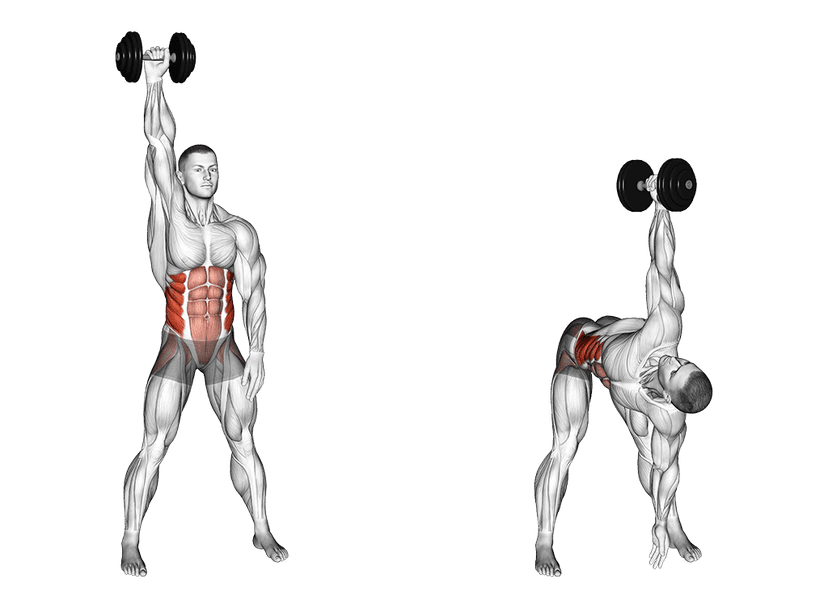
Kettlebell Windmill: Complete Guide
The windmill is a mobility and stability exercise from the kettlebell world. It combines a lateral trunk flexion with rotation and overhead shoulder stabilization. It is an unusual movement in a weight room, but its benefits are substantial: hip mobility, shoulder stability, oblique strengthening, and hamstring flexibility. If your routine is all bench press and curls, the windmill is exactly what is missing.
This exercise has been used for decades by kettlebell sport athletes and functional training practitioners. It develops a rare quality in strength training: the ability to be strong and stable in unconventional positions. This "angular" strength transfers directly to sports and daily life.
Muscles targeted
- External and internal obliques: primary movers for lateral flexion and rotation
- Quadratus lumborum: lateral spinal stabilization during the bend
- Gluteus maximus and medius: hip stabilization and descent control
- Hamstrings: actively stretched during the descent, especially on the front leg side
- Deltoids and rotator cuff: isometric shoulder stabilization in the overhead position
- Upper trapezius and serratus anterior: maintain the scapula in the elevated position
- Spinal erectors: spinal stabilization throughout the movement
The windmill is unique because it trains strength in the frontal (lateral) plane, a plane often neglected in traditional weight training. The overhead component adds a shoulder stability challenge rarely matched by other exercises.
Proper execution
Starting position
Stand with feet slightly wider than shoulder width. Turn your feet roughly 45 degrees away from the kettlebell side. If the kettlebell is in your right hand, your feet point left. Press the kettlebell overhead, arm locked out, eyes fixed on the kettlebell. The free arm hangs by your side or rests on your front thigh.
Descent phase
- Push your right hip (kettlebell side) back and to the side.
- Laterally flex your trunk, sliding your free hand down the front leg (left).
- Keep your eyes on the kettlebell throughout the descent.
- The arm holding the kettlebell stays perfectly vertical. Do not let it drift.
- Go as low as your mobility allows. The goal is to touch the floor with your free hand, but do not force it.
- Inhale during the descent.
Ascent phase
- Drive through the feet and contract the obliques to bring the trunk back up.
- The overhead arm stays locked and vertical.
- Your eyes stay on the kettlebell.
- Return to standing with hips locked.
- Exhale during the ascent.
Breathing: inhale going down, exhale coming up. Some practitioners prefer a light breath hold at the bottom for added stability.
Common mistakes
1. Losing arm verticality The arm holding the kettlebell must remain perfectly vertical at all times. If it drifts forward or backward, the load crushes the shoulder. Keep your eyes on the kettlebell and actively engage the shoulder to hold the arm in place.
2. Excessive knee bend The windmill is a hip and trunk movement, not a lateral squat. The back leg (kettlebell side) can have a slight bend, but the front leg should stay nearly straight to maximize the hamstring stretch.
3. Descending too fast Diving toward the floor without control puts the shoulder and lower back at risk. The descent should take at least 3-4 seconds. The windmill is a control exercise, not a speed exercise.
4. Incorrect foot angle If the feet are not turned (roughly 45 degrees away from the kettlebell), hip rotation is limited and the movement forces the spine. The correct foot angle opens the hip and protects the back.
5. Looking at the floor Dropping your gaze makes you lose awareness of the arm position and increases the risk of dropping the kettlebell. Keep your eyes on the kettlebell from start to finish. It also provides excellent cervical proprioception work.
Variations
Bodyweight windmill (beginner) Perform the movement with no load, arm extended overhead. This lets you learn the path and work on mobility without risk. Keep your eyes on your hand.
Dumbbell windmill (beginner to intermediate) The dumbbell is easier to stabilize than the kettlebell because the center of gravity sits in your hand. A good transition before moving to the kettlebell, whose mass sits above the wrist.
Double windmill (advanced) One kettlebell overhead and another in the free hand that travels toward the floor. The bottom load adds resistance to the lateral flexion. Requires excellent mobility and advanced shoulder stability.
Kneeling windmill (intermediate) Perform the movement from a kneeling position. This isolates the obliques and trunk further by removing the hip component. Useful for athletes with limited hip mobility.
Programming
Placement in your session: As a warm-up with a light load to activate the shoulders and hips, or mid-session as a trunk and stability exercise.
Volume and intensity:
- Beginner: 3 x 5 reps per side unloaded or with 4-8 kg, focus on mobility
- Intermediate: 3-4 x 5-8 reps per side with 8-16 kg
- Advanced: 3-4 x 5-8 reps per side with 16-24 kg, or double windmill
Frequency: 2-4 times per week. With light loads as a warm-up, the windmill can be practiced very frequently. With heavy loads, 1-2 times is enough.
Progression: The windmill progresses first through range of motion (going deeper) before increasing load. Master the movement unloaded, then increase in 4 kg increments.
Key takeaways
- Eyes on the kettlebell: your gaze never leaves the overhead load
- Vertical arm: the arm holding the kettlebell must stay perfectly vertical
- Hip back: push the kettlebell-side hip back to initiate the movement
- Controlled descent: 3-4 seconds minimum, this is a control exercise
- Mobility first: progress depth before adding weight
