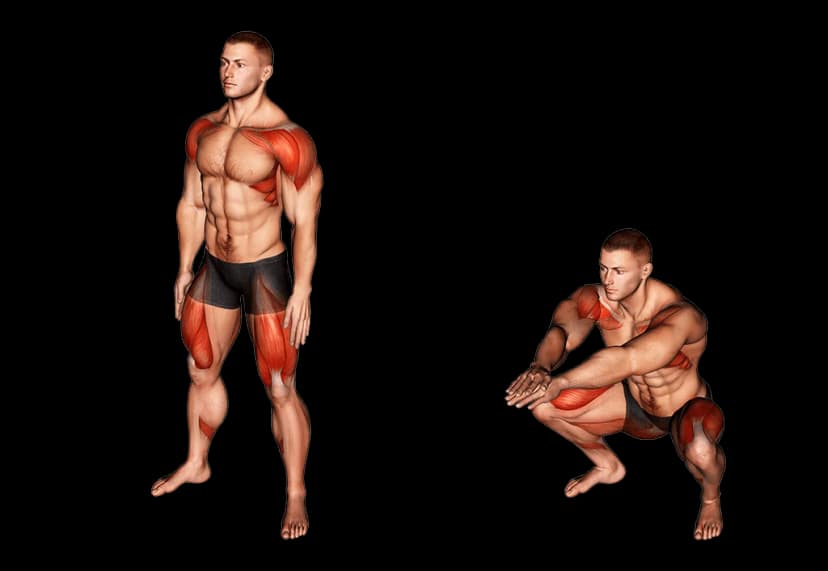
Air Squat (Bodyweight Squat): Complete Guide
The air squat, or bodyweight squat, is the fundamental movement everyone should master before touching a barbell. It is the ultimate test of mobility, motor control, and baseline strength. If you cannot do a clean, deep air squat, you have no business putting weight on your back. The good news: you can do it anywhere, with zero equipment.
Muscles Targeted
Primary muscles:
- Quadriceps: main drivers of knee extension
- Glutes (gluteus maximus and medius): fire below parallel for hip extension
- Adductors: stabilize the knees and control leg width
Secondary muscles:
- Hamstrings: assist the glutes and stabilize the knee
- Calves: stabilize the ankle at the bottom position
- Spinal erectors: keep the back straight
- Abs: brace the trunk
Without external load, muscular recruitment is less intense, but the motor pattern is identical to the back squat. That is why the air squat is the ultimate diagnostic tool: if your technique is bad unloaded, it will be worse with weight.
Proper Execution
- Starting position: stand with feet shoulder-width or slightly wider. Toes pointed out 20-30 degrees. Arms at your sides or in front for balance.
- The descent: push your hips back and down simultaneously. Knees track over the toes. The torso stays as upright as possible. Arms rise in front of you (parallel to the floor) to counterbalance the hips shifting back.
- Depth: go as low as your mobility allows. The goal is to bring the hip crease below the knees, heels on the floor, back straight. In a full squat, the hips graze the calves.
- Bottom position: knees open (no valgus), weight evenly distributed across the entire foot, neutral spine, chest open.
- The ascent: push the floor away with your feet, squeeze the glutes, rise with the torso straight. Hips and shoulders rise at the same rate.
- Breathing: inhale on the way down, exhale on the way up. No Valsalva maneuver needed without load.
Common Mistakes
Knees caving in (valgus) The most common mistake and a clear sign of weak abductors and glute medius. Fix: actively push the knees outward on every rep. Add abduction exercises (clamshells, monster walks) to your warm-up.
Heels rising off the floor Insufficient ankle mobility. Fix: work on daily calf and ankle stretches. In the meantime, widen your stance and point your toes out more.
Torso collapsing forward The hips shift too far back, and the torso compensates by leaning. Fix: extend your arms in front as a counterweight. Work on hip mobility and quad strength.
Stopping at parallel Many people believe you should not go lower. Wrong: a full, deep air squat is the standard to aim for. Any depth limitation should be worked on, not accepted.
Going too fast Repping out at maximum speed without control teaches nothing. Fix: take 2-3 seconds to descend, 1-2 seconds to rise. Every rep should be a control exercise.
Variations
Air squat with pause (beginner): 3-5 second pause at the bottom. Improves mobility, stability, and isometric strength. The best corrective exercise for progress.
One-and-a-half air squat (intermediate): go down on two legs, come up primarily on one. Introduces unilateral overload without equipment.
Pistol squat (advanced): full squat on one leg, the other extended in front. Requires exceptional mobility and strength. A long-term goal.
Squat jump (intermediate to advanced): descend into an air squat, explode up and jump. Develops leg power. Land softly with knees bent.
Programming
Primary uses: warm-up, mobility, beginners, or cardio/HIIT circuits.
Volume and intensity:
- Warm-up: 2-3 x 15-20 reps, slow and controlled
- Beginner (strength building): 3-4 x 15-25 reps, 2-3 times per week
- HIIT / circuit: 20-30 reps per round, fast tempo
- Daily mobility: 1 x 10-20 deep reps with pauses
Frequency: daily if you want. The air squat imposes no significant fatigue and improves mobility with practice.
Progression: when you can do 3 x 25 deep reps without difficulty, move on to goblet squats or barbell squats.
Key Takeaways
- The air squat is the baseline test: if technique is bad unloaded, it will be worse with weight
- Aim for maximum depth, heels on the floor, back straight
- Arms in front serve as a natural counterweight
- Practice it daily to improve your mobility
- It is the stepping stone to the goblet squat and back squat
