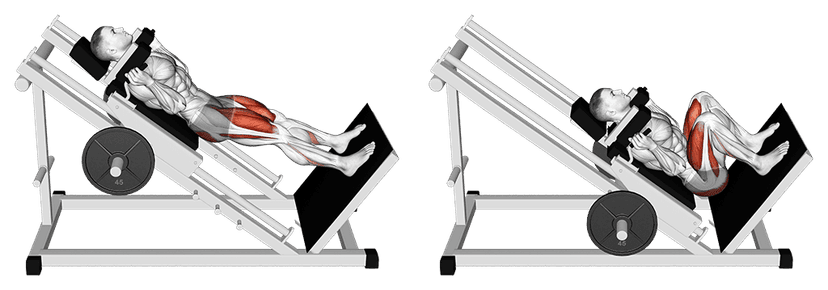
Hack Squat: Complete Guide
The hack squat is a must-have machine exercise for building massive quadriceps without the stability demands of free-weight squats. Thanks to the guided trajectory, you can focus purely on pushing hard and loading heavy with confidence. It is a top choice for serious leg development.
Targeted Muscles
- Quadriceps (vastus lateralis, vastus medialis, rectus femoris): primary movers for knee extension
- Glutes: more engaged when feet are placed higher on the platform
- Hamstrings: secondary stabilization role in the bottom position
- Calves (soleus): minor contribution for ankle stability
Foot placement changes the muscular emphasis. Low and narrow feet: maximum quad focus. High and wide feet: more glutes and hamstrings.
Proper Execution
Starting Position
- Press your back flat against the pad. Shoulders locked under the shoulder pads.
- Feet shoulder-width apart on the platform, toes slightly turned out (15 to 30 degrees).
- Unlock the safety handles by pushing with your legs, then control the descent.
Eccentric Phase (Lowering)
- Lower by bending your knees in a controlled manner (2 to 3 seconds).
- Keep your back glued to the pad throughout the descent.
- Go down until your thighs are at least parallel to the floor. Deeper if your mobility allows it.
- Inhale during this entire phase.
Concentric Phase (Pushing Up)
- Push through the entire foot, emphasizing your heels.
- Drive up explosively but with control.
- Do not fully lock out your knees at the top: maintain a slight bend to keep tension.
- Exhale during the push.
Common Mistakes
1. Heels Lifting Off the Platform Danger: overloads the knees and patellar tendon. Fix: place your feet slightly higher on the platform and work on ankle mobility.
2. Lower Back Coming Off the Pad Danger: lumbar disc compression under load. Fix: reduce range of motion if needed, or lower the weight. Your pelvis must stay glued to the pad.
3. Knees Caving Inward (Valgus) Danger: ligament stress on the knee (ACL and MCL). Fix: actively push your knees outward in line with your toes. Reduce the load if you cannot maintain alignment.
4. Locking Out the Knees at the Top Danger: excessive joint pressure. Fix: always keep 5 to 10 degrees of flexion at the top.
5. Dropping Too Fast Danger: loss of control and traumatic bounce at the bottom. Fix: enforce a 2 to 3 second minimum tempo on the way down.
Variations
High Foot Placement Hack Squat (Beginner) Place your feet at the top of the platform to reduce knee stress and recruit more glutes. Ideal for beginners or those with joint sensitivity.
Narrow Stance Hack Squat (Intermediate) Feet close together and placed low on the platform. The vastus lateralis and rectus femoris are targeted more aggressively. Expect an intense quad burn.
Reverse Hack Squat (Intermediate to Advanced) Face the machine with your chest against the pad. This mimics a front squat and hammers the quads while reducing spinal compression. Great for those who lack barbell squat mobility.
Single-Leg Hack Squat (Advanced) One foot on the platform, the other in the air. Corrects strength imbalances between legs. Start with 40 to 50% of your bilateral load.
Programming
Placement: as a primary compound (second after squats) or a heavy isolation exercise for quads.
- Strength (4 to 6 reps): 4 sets, 4 to 6 reps, 3 minutes rest
- Hypertrophy (8 to 12 reps): 3 to 4 sets, 8 to 12 reps, 90 seconds rest
- Muscular endurance (15 to 20 reps): 2 to 3 sets, 15 to 20 reps, 60 seconds rest
Recommended frequency: 1 to 2 times per week. If you already squat with a barbell in the same session, use the hack squat as a complement with lighter sets.
Key Takeaways
- Back pinned to the pad at all times, zero pelvis lift-off
- Feet flat on the platform, heels firmly planted
- Knees tracking over toes, never caving inward
- Slight bend at the top, no full lockout
- Foot placement determines muscular emphasis: adjust it to your goal
