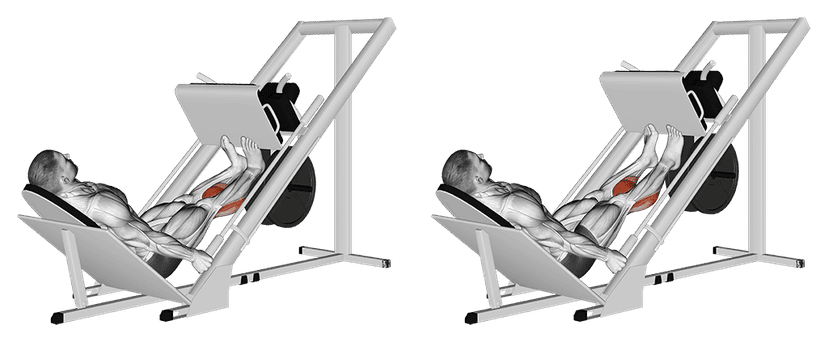
Calf Press on Leg Press: Complete Guide
The leg press is not just for quads. By placing your feet low on the platform and pushing only through the balls of your feet, you turn this machine into a powerful calf-building tool. The calf press on the leg press lets you load heavy with total safety, no spinal compression, and a generous range of motion. If your calves have been stubborn, this exercise deserves a spot in your rotation.
The main advantage over other calf variations is the ability to work with heavy loads without balance being a limiting factor. You can focus entirely on the contraction and stretch of the calves.
Muscles targeted
- Gastrocnemius (medial and lateral heads): primary mover, responsible for plantar flexion when the knee is extended or slightly bent
- Soleus: secondary contributor, recruited more if the knees are slightly bent
- Peroneus longus and brevis: lateral ankle stabilization
- Tibialis posterior: arch stabilization under load
The gastrocnemius handles most of the work thanks to the near-straight leg position. It is the muscle that creates visible calf shape and should be your top priority for aesthetics.
Proper execution
Starting position
Set up on the leg press as usual: back firmly against the pad, head resting. Place your feet low on the platform so only the balls of your feet and toes are in contact. Your heels hang off the edge. Feet hip-width apart. Legs nearly straight without locking the knees. Release the safeties.
Concentric phase (push)
- Push the platform by performing plantar flexion: rise onto the balls of your feet.
- Squeeze your calves hard at the top. Hold the contraction for 1-2 seconds.
- Keep your knees still. Only your ankles move.
Eccentric phase (lowering)
- Let your heels drop slowly below the level of the platform.
- Lower until you feel a full calf stretch. Do not force beyond your flexibility.
- Recommended tempo: 1 second up, 1-2 second hold at the top, 2-3 seconds down.
Breathing: exhale on the push (up), inhale on the way down.
Common mistakes
1. Bending the knees during the movement If your knees flex and extend on each rep, you are turning this into a mini leg press. Your knees stay fixed, slightly bent. Only your ankles work.
2. Cutting the range of motion This is the number one mistake on calf exercises. Half reps with massive weight are worthless. Go to a full stretch at the bottom and a full squeeze at the top. Complete range of motion is the key to calf growth.
3. Bouncing at the bottom Rushing through the bottom position uses Achilles tendon elasticity rather than muscular force. Control every phase, especially the eccentric. Calves respond particularly well to time under tension.
4. Feet too high on the platform If too much of your foot is on the platform, you reduce the range of motion. Only the balls of your feet and toes should touch the surface.
5. Forgetting to lock the safeties at the end When your calves are fatigued, you may not control the platform on the rerack. Always engage the safeties before removing your feet.
Variations
Toes turned out (intermediate) Point your toes outward at roughly 30 degrees. This recruits more of the medial gastrocnemius head for a more pronounced inner calf sweep.
Toes turned in (intermediate) Point your toes slightly inward. Targets the lateral head. Use a moderate load because the position is less stable.
Single-leg calf press (intermediate to advanced) Work one calf at a time. Corrects imbalances and allows you to focus on the mind-muscle connection. Use about half the weight of your bilateral sets.
Vertical leg press for calves (intermediate) If your gym has a vertical leg press (reverse hack squat), the upright position slightly changes the working angle and provides a different stretch sensation.
Programming
Placement in your session: At the end of your leg session, after your quad and hamstring work. Calves do not fatigue the main leg muscles, so save them for last.
Volume and intensity:
- Beginner: 3 x 12-15 reps, moderate load, focus on range of motion
- Intermediate: 4 x 10-15 reps, last reps close to failure
- Advanced: 4-5 x 10-20 reps, intensification techniques (drop sets, stretch pauses)
Frequency: 2-3 times per week. Calves recover quickly and need high volume to grow. Alternate between this exercise and other calf variations.
Typical load: You can go significantly heavier than standing calf raises because the press removes balance from the equation. Start with half the weight you use for regular leg presses, then adjust.
Key takeaways
- Feet low on the platform: only the balls of your feet and toes touch the surface
- Knees locked in position: no knee bending, only ankle movement
- Full range of motion: maximum stretch at the bottom, maximum squeeze at the top
- Controlled tempo: 2-3 seconds on the eccentric to maximize time under tension
- Progressive overload: the press allows safe heavy loading, take advantage of it
