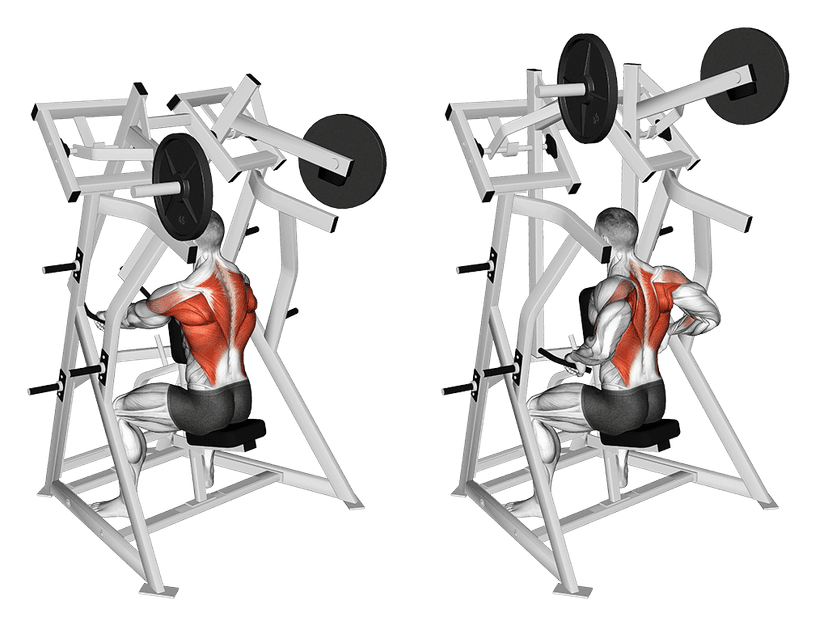
Seated Row Machine: Complete Guide
The seated row machine is one of the most underrated exercises in the gym. Many consider it a beginner movement or an inferior substitute for free-weight rows. That is a mistake. The guided machine offers unique advantages: it perfectly isolates the back by eliminating the lumbar stabilization component, it allows you to push intensity without injury risk, and it guarantees an optimal path on every repetition.
For lifters with a history of lower back pain, the row machine is often the best option. The chest pad and seat stabilize the trunk, letting you focus exclusively on back contraction.
Muscles targeted
- Latissimus dorsi: primary mover, pulls the arms back and down
- Mid-trapezius: scapular retraction, brings the shoulder blades together
- Rhomboids: work in synergy with the mid-trapezius for retraction
- Teres major: assists the lats in humeral adduction
- Posterior deltoid: active at end range when the elbows travel backward
- Biceps and brachialis: elbow flexion, secondary role
- Infraspinatus: stabilizes the humeral head in the glenoid cavity
Depending on the machine and grip, the emphasis shifts. A neutral grip (palms facing each other) favors the lats. A wide overhand grip recruits the mid-trapezius and rhomboids more.
Proper execution
Starting position
Adjust the seat so the handles line up with your lower chest. Press your torso against the chest pad (if there is one). Feet flat on the floor or on the foot rest. Grab the handles with arms extended, shoulders relaxed forward to stretch the lats.
Concentric phase (pull)
- Initiate the movement by squeezing your shoulder blades. Your arms do not pull yet.
- Pull the handles toward you, keeping your elbows close to your body.
- Continue until your elbows pass slightly behind the plane of your back.
- Contract the lats for 1 second at peak contraction.
- Keep your chest pressed against the pad throughout the movement.
Eccentric phase (return)
- Release slowly, letting your arms return forward.
- Control the return over 2-3 seconds.
- Let your shoulder blades spread apart fully for a maximum stretch.
- Do not let the plates touch the stack between reps.
Breathing: exhale while pulling, inhale while releasing.
Common mistakes
1. Lifting the torso off the pad
If you lean back to finish the rep, you are cheating with momentum and recruiting the spinal erectors instead of the back. Stay pressed against the pad. If you cannot, the weight is too heavy.
2. Pulling too high or too low
The path should bring the handles toward your lower chest. Pulling toward your stomach reduces lat recruitment. Pulling toward your upper chest overloads the upper traps.
3. Jerky movements
Using momentum to move the weight reduces time under tension and increases shoulder injury risk. Every rep should be smooth and controlled, especially during the eccentric phase.
4. Fixed shoulder blades
Not allowing the shoulder blades to move reduces range of motion. They should spread apart during the eccentric (stretch) and squeeze together during the concentric (contraction). This scapular movement is what works the back deeply.
Variations
Wide-grip row machine (intermediate)
If your machine offers wide handles, use them with an overhand grip. The work concentrates on the mid-trapezius, rhomboids, and posterior deltoid. Excellent for improving posture.
Single-arm row machine (intermediate)
Pull one arm at a time. This is the best way to detect and correct a strength imbalance between sides. Add 1-2 extra sets on the weaker side.
Slow-tempo row machine (beginner to intermediate)
Use a 4-1-2 tempo: 4 seconds eccentric, 1-second pause in the stretch, 2 seconds concentric. Reduce the load by 30-40% compared to your normal sets. Time under tension skyrockets and the lats burn.
Drop-set row machine (advanced)
Complete your normal set, then reduce the weight by 20-25% and continue without rest. Repeat 2-3 times. Ideal as a final exercise to trigger an intense metabolic stimulus.
Programming
Placement in your session: Middle or end of your back session. The row machine is perfect after a heavy compound movement (pull-ups, barbell rows). Use it to accumulate volume with perfect form.
Volume and intensity:
- Beginner: 3 x 10-12 reps, light to moderate load, contraction focus
- Intermediate: 3-4 x 8-12 reps, progressive loading
- Advanced: 4 x 8-12 reps with intensity techniques (slow tempo, drop sets, isometric pauses)
Frequency: Include the row machine 1-2 times per week. It pairs well with a vertical pull on the same day or on a separate session.
Starting weight: Begin at 20-30 kg. The goal is not to lift heavy but to feel the lats contracting on every repetition.
Key takeaways
- Torso pressed against the pad: zero cheating, zero momentum
- Mobile shoulder blades: spread during the stretch, squeeze during the contraction
- Elbows close to the body: to target the lats
- Controlled tempo: at least 2 seconds on the eccentric
- Marked contraction: 1-second pause at peak contraction
